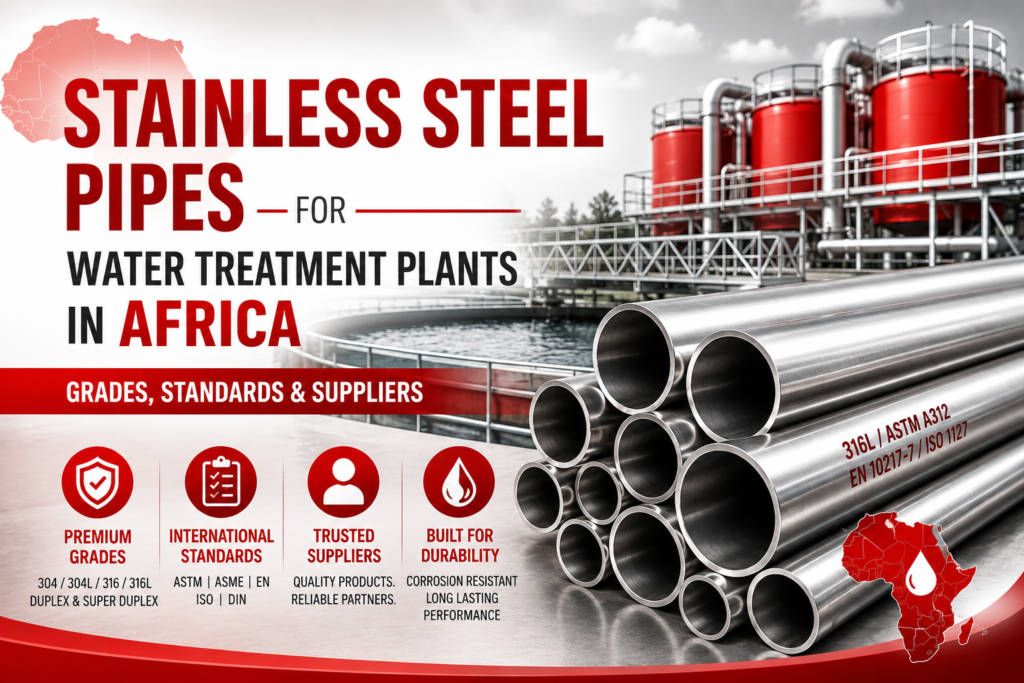
Stainless Steel Pipes are becoming increasingly important in water treatment plants across Africa due to their superior corrosion resistance, long service life, and hygienic performance. As African countries continue investing in municipal water supply systems, desalination plants, wastewater treatment facilities, and industrial water recycling projects, the demand for high-quality Stainless Steel Pipes continues to rise.
Water treatment systems often operate in highly corrosive environments involving chlorides, chemicals, saline water, and fluctuating temperatures. In such conditions, Stainless Steel Pipes provide better durability and reliability compared to traditional carbon steel piping systems.
This guide explains the most commonly used stainless steel pipe grades, international standards, applications, and supplier considerations for water treatment plants in Africa.
Why Stainless Steel Pipes Are Used in Water Treatment Plants
Water treatment facilities require piping systems that can withstand corrosion, maintain water purity, and operate efficiently for long periods. Stainless Steel Pipes are preferred because they offer:
- Excellent corrosion resistance
- Long operational life
- Hygienic and contamination-free water transport
- High mechanical strength
- Low maintenance requirements
- Smooth internal surface for efficient flow
- Resistance to chemicals and chlorides
These advantages make Stainless Steel Pipes ideal for water infrastructure projects in Africa, especially in coastal and high-humidity regions.
Common Stainless Steel Pipe Grades for Water Treatment Plants
SS 304 / 304L Stainless Steel Pipes
SS 304 and 304L are among the most widely used stainless steel grades for general water treatment applications.
Key Features
- Good corrosion resistance
- Excellent weldability
- Cost-effective solution
- Suitable for potable water systems
Applications
- Municipal water pipelines
- Drinking water systems
- Low-chloride water treatment plants
- Industrial water transfer systems
304L is the low-carbon version of 304, offering better weldability and reduced risk of carbide precipitation.
SS 316 / 316L Stainless Steel Pipes
SS 316 and 316L contain molybdenum, which significantly improves corrosion resistance in chloride-rich environments.
Key Features
- Superior chloride resistance
- Better pitting resistance
- Excellent chemical resistance
- High durability in coastal environments
Applications
- Desalination plants
- Wastewater treatment facilities
- Chemical dosing systems
- Seawater pipelines
316L is preferred for welded applications because of its lower carbon content and improved corrosion performance.
Duplex Stainless Steel Pipes (2205)
Duplex Stainless Steel Pipes combine the benefits of ferritic and austenitic stainless steel structures.
Key Features
- High mechanical strength
- Excellent corrosion resistance
- Resistance to stress corrosion cracking
- Better performance than 316L in aggressive environments
Applications
- Reverse osmosis systems
- High-pressure water pipelines
- Industrial wastewater systems
- Seawater handling facilities
Duplex 2205 is increasingly used in African desalination and industrial water infrastructure projects.
Super Duplex Stainless Steel Pipes
Super Duplex Stainless Steel Pipes such as UNS S32750 and UNS S32760 are designed for highly corrosive environments involving seawater and chlorides.
Key Features
- Outstanding seawater resistance
- Excellent pitting resistance
- High pressure handling capability
- Long service life
Applications
- Offshore desalination plants
- Marine water systems
- High-salinity water treatment plants
- Coastal infrastructure projects
These grades are commonly selected for critical water treatment systems where maximum corrosion resistance is required.
904L Stainless Steel Pipes
904L Stainless Steel Pipes are high-alloy stainless steels designed for severe corrosive environments.
Key Features
- Excellent resistance to acidic chemicals
- Superior chloride resistance
- High durability
Applications
- Chemical wastewater systems
- Acidic water treatment plants
- Industrial processing facilities
904L pipes are generally used in specialized applications where standard stainless steel grades may not provide sufficient corrosion resistance.
Important Standards for Stainless Steel Pipes
Choosing the correct international standards is essential for ensuring quality, safety, and long-term performance.
ASTM A312
ASTM A312 is one of the most widely used standards for seamless and welded stainless steel pipes.
Common Grades
- TP304
- TP304L
- TP316
- TP316L
- TP321
- TP347
This standard is commonly used in water treatment, chemical processing, and industrial applications.
ASTM A790
ASTM A790 covers seamless and welded duplex and super duplex stainless steel pipes.
Common Grades
- UNS S31803
- UNS S32205
- UNS S32750
- UNS S32760
These pipes are suitable for highly corrosive and high-pressure applications.
EN Standards
Many African infrastructure projects also follow European pipe standards.
Common EN Standards
- EN 10216-5
- EN 10217-7
These standards specify technical delivery conditions for stainless steel pipes used in industrial systems.
ISO & Certification Requirements
Water treatment projects may require additional certifications such as:
- ISO 9001
- EN 10204 3.1 certification
- NACE compliance
- PED approval
These certifications help ensure product quality, traceability, and compliance with project requirements.
Applications of Stainless Steel Pipes in African Water Treatment Plants
Desalination Plants
Several African countries are investing in desalination systems to address water shortages.
Stainless Steel Pipes are used in:
- Seawater intake systems
- Reverse osmosis units
- High-pressure brine pipelines
- Pumping systems
Municipal Water Supply Systems
Stainless Steel Pipes help maintain clean and contamination-free drinking water distribution.
Applications include:
- Potable water pipelines
- Water storage facilities
- Distribution networks
Wastewater Treatment Plants
Wastewater systems contain corrosive chemicals and contaminants that can damage traditional piping systems.
Applications include:
- Sludge transfer pipelines
- Chemical dosing lines
- Effluent discharge systems
Industrial Water Recycling Plants
Industrial sectors across Africa are adopting water recycling technologies for sustainability.
Industries include:
- Mining
- Food processing
- Pharmaceutical manufacturing
- Chemical processing
Benefits of Stainless Steel Pipes in African Water Infrastructure
Long Service Life
Stainless Steel Pipes can perform efficiently for decades with minimal maintenance.
Lower Maintenance Costs
High corrosion resistance reduces repair and replacement expenses.
Hygienic Water Transport
Smooth internal surfaces minimize bacterial growth and contamination risks.
Environmental Sustainability
Stainless steel is recyclable and environmentally friendly.
Better Operational Reliability
These pipes maintain performance under harsh climatic and chemical conditions.
Factors to Consider When Selecting Stainless Steel Pipes
Corrosion Environment
The chloride content and chemical exposure determine the suitable stainless steel grade.
Operating Pressure & Temperature
High-pressure systems may require duplex or super duplex grades.
Project Budget
Premium grades provide lower lifecycle costs despite higher initial investment.
Welding & Fabrication Requirements
Low-carbon grades such as 304L and 316L are preferred for welded systems.
Choosing Reliable Stainless Steel Pipe Suppliers
When selecting suppliers for African water treatment projects, buyers should evaluate:
- Manufacturing certifications
- International standard compliance
- Export experience
- Third-party inspection support
- Availability of test certificates
- Production capacity
- Technical support capabilities
Reliable suppliers typically provide pipes, fittings, flanges, and customized fabrication services for large-scale infrastructure projects.
Conclusion
Because of their superior corrosion resistance, durability, hygienic qualities, and long-term dependability, stainless steel pipes are indispensable for contemporary water treatment facilities in Africa. Desalination plants, municipal water systems, wastewater facilities, and industrial water recycling projects all make extensive use of grades like 304L, 316L, Duplex 2205, Super Duplex, and 904L.
For long-term African development, choosing the appropriate stainless steel grade, international standard, and reliable supplier helps guarantee effective, secure, and affordable water treatment infrastructure.
How We Support You
Selecting the right stainless steel pipes for water treatment plants is essential for ensuring corrosion resistance, hygienic performance, durability, and long-term operational reliability. Our team helps EPC contractors, water infrastructure companies, procurement engineers, and project consultants choose the most suitable stainless steel pipe grades for municipal water treatment, desalination, wastewater recycling, and industrial water management projects across Africa.
We support you with:
- Guidance in selecting suitable stainless steel grades such as SS 304, 304L, 316, 316L, Duplex, and Super Duplex for water treatment applications
- Recommendations based on water chemistry, chloride exposure, operating pressure, temperature, and corrosion resistance requirements
- Support for desalination plants, wastewater treatment facilities, RO plants, municipal water systems, and industrial water pipelines
- Assistance with compliance to ASTM, ASME, AWWA, EN, ISO, NACE, and international EPC project specifications
- Guidance for seamless, welded, ERW, and large-diameter stainless steel pipe solutions
- Recommendations for potable water systems, chemical dosing lines, sludge handling systems, and seawater intake applications
- Technical support for pipe schedules, wall thickness selection, fittings, flanges, and protective finishing requirements
- Documentation support including MTCs, hydro test reports, third-party inspection, and quality certifications
- Fast quotations, export logistics, and bulk supply support for African water infrastructure and utility projects
Whether your project involves desalination plants, municipal water treatment facilities, wastewater recycling systems, industrial process water networks, or large-scale water distribution infrastructure, we provide reliable stainless steel piping solutions tailored to meet performance, hygiene, durability, and international compliance requirements.