Choosing the right steel pipe type is critical for construction and infrastructure projects across Africa. From commercial buildings and industrial plants to oil & gas facilities, water pipelines, and structural applications, project buyers must select piping systems that offer strength, durability, cost-efficiency, and long-term reliability.
Among the most commonly used pipe types are ERW Pipes and Seamless Pipes. While both are widely used in construction projects, each offers distinct advantages depending on the application, operating pressure, project budget, and environmental conditions.
This guide explains the key differences between ERW and Seamless Pipes, including manufacturing methods, advantages, limitations, applications, and factors African project buyers should consider before making a purchase decision.
What Are ERW Pipes?
ERW (Electric Resistance Welded) Pipes are manufactured by rolling steel sheets or coils into a cylindrical shape and welding the edges together using electric resistance welding technology.
The welding process creates a strong and uniform joint without using filler material.
Key Features of ERW Pipes
- Smooth surface finish
- Consistent wall thickness
- High dimensional accuracy
- Cost-effective manufacturing
- Suitable for medium and low-pressure applications
ERW Pipes are commonly available in carbon steel, stainless steel, and galvanized steel grades.
What Are Seamless Pipes?
Seamless Pipes are manufactured without any welded joints. They are produced by piercing solid steel billets and elongating them into hollow pipes through hot rolling or cold drawing processes.
Because they do not contain a weld seam, Seamless Pipes are known for higher pressure resistance and superior mechanical strength.
Key Features of Seamless Pipes
- No welded seam
- High pressure handling capability
- Better structural integrity
- Excellent strength under extreme conditions
- Suitable for critical applications
Seamless Pipes are widely used in oil & gas, petrochemical, power generation, and heavy industrial construction projects.
ERW vs Seamless Pipe: Major Differences
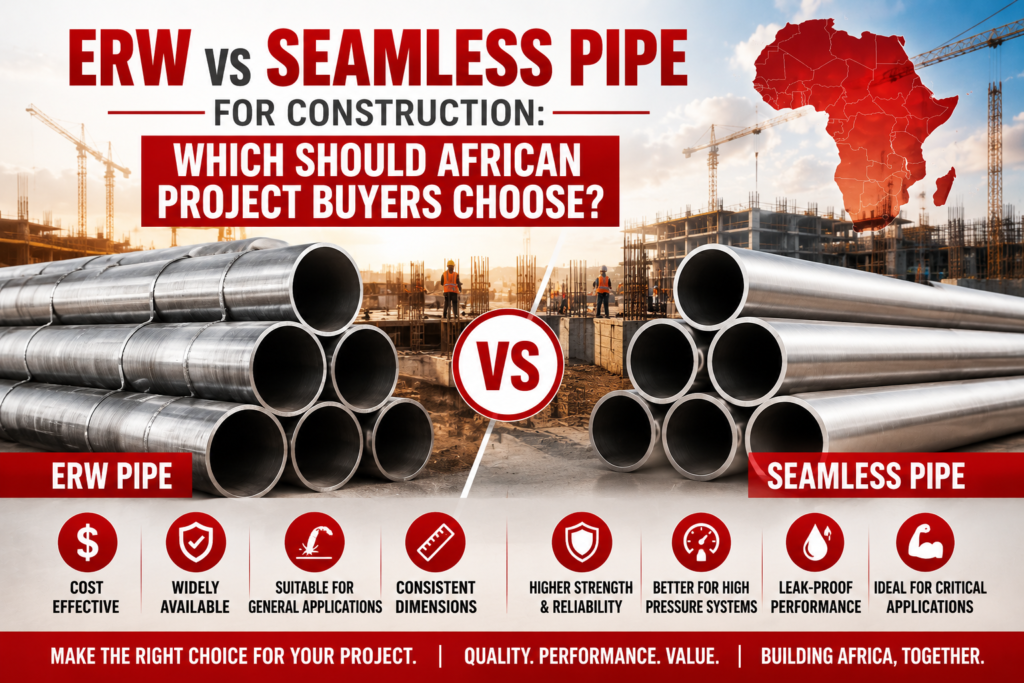
Feature | ERW Pipe | Seamless Pipe |
Manufacturing Process | Welded from steel coil | Made from solid billet |
Weld Seam | Present | No seam |
Cost | Lower | Higher |
Strength | Moderate to high | Very high |
Pressure Resistance | Medium pressure | High pressure |
Dimensional Accuracy | Excellent | Good |
Surface Finish | Smooth | Slightly rougher |
Availability | Easily available | Limited in larger sizes |
Production Speed | Faster | Slower |
Maintenance Cost | Lower for general use | Lower for critical operations |
Advantages of ERW Pipes for African Construction Projects
Cost-Effective Solution
ERW Pipes are generally more affordable than Seamless Pipes, making them ideal for large-scale African infrastructure and construction projects where budget control is important.
Easy Availability
ERW Pipes are widely produced in various sizes and thicknesses, allowing faster procurement and shorter project timelines.
Uniform Wall Thickness
The manufacturing process ensures consistent thickness throughout the pipe, improving fabrication and installation efficiency.
Suitable for Structural Applications
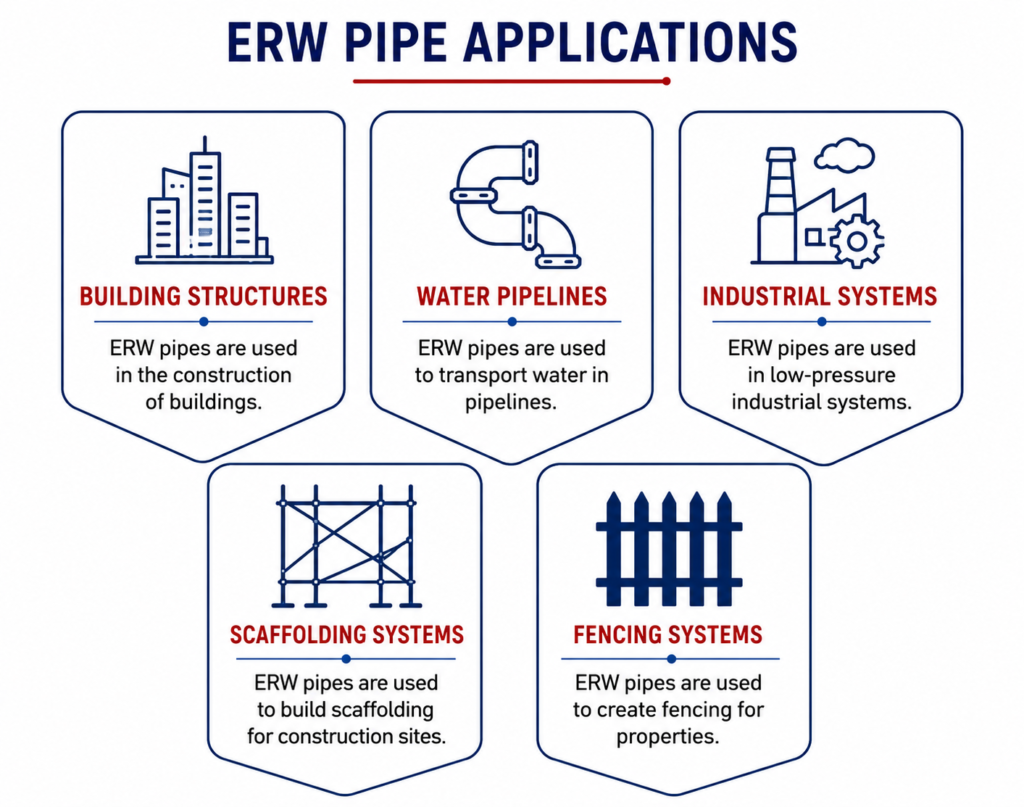
ERW Pipes are commonly used in:
- Building structures
- Scaffolding systems
- Water pipelines
- Fencing systems
- Low-pressure industrial systems
Better Surface Finish
ERW Pipes typically offer smoother internal and external surfaces, which can improve coating performance and fluid flow efficiency.
Advantages of Seamless Pipes for African Projects
Superior Strength
Seamless Pipes provide better mechanical strength because they do not contain a welded joint.
High Pressure Resistance
These pipes are ideal for:
- High-pressure fluid transportation
- Steam pipelines
- Oil & gas systems
- Chemical processing plants
Better Performance in Harsh Environments
Seamless Pipes are highly reliable in extreme temperatures, corrosive environments, and heavy industrial operations.
Reduced Risk of Weld Failure
The absence of a weld seam minimizes the risk of seam-related defects under critical operating conditions.
When Should African Buyers Choose ERW Pipes?
ERW Pipes are generally the preferred choice when:
- The project has budget limitations
- Medium or low-pressure applications are involved
- Large quantities of pipes are required
- Structural applications are the main focus
- Fast delivery is important
- The operating environment is less aggressive
Common African Applications for ERW Pipes
- Commercial construction projects
- Water supply pipelines
- Agricultural irrigation systems
- Structural steel frameworks
- Fire protection systems
- HVAC systems
When Should Buyers Choose Seamless Pipes?
Seamless Pipes are recommended when:
- High-pressure systems are involved
- Safety is critical
- Extreme temperatures are present
- Corrosive chemicals are transported
- Long-term heavy-duty performance is required
Common African Applications for Seamless Pipes
- Oil & gas pipelines
- Petrochemical plants
- Mining operations
- Power generation facilities
- Boiler systems
- Offshore infrastructure
Material Options for ERW and Seamless Pipes
Both ERW and Seamless Pipes are available in various materials, including:
Carbon Steel Pipes
Used for general construction, water pipelines, and industrial applications.
Stainless Steel Pipes
Preferred for corrosion resistance and hygienic applications.
Alloy Steel Pipes
Suitable for high-temperature and high-pressure systems.
Galvanized Steel Pipes
Commonly used for water distribution and outdoor applications due to zinc coating protection.
Important Standards for ERW and Seamless Pipes
Project buyers in Africa should ensure compliance with international standards.
Common Standards for ERW Pipes
- ASTM A53
- ASTM A500
- API 5L
- EN 10219
Common Standards for Seamless Pipes
- ASTM A106
- ASTM A312
- ASTM A335
- API 5L
These standards ensure quality, safety, and compatibility with industrial project requirements.
Factors African Project Buyers Should Consider
Project Budget
ERW Pipes are more economical for standard construction projects, while Seamless Pipes offer better value in critical operations.
Operating Pressure
High-pressure systems generally require Seamless Pipes.
Corrosion Environment
Corrosive environments may require stainless steel or alloy grades regardless of pipe type.
Availability & Delivery Time
ERW Pipes are often easier to source quickly in large quantities.
Lifecycle Cost
Although Seamless Pipes have higher initial costs, they may reduce maintenance expenses in demanding environments.
Fabrication & Welding Requirements
ERW Pipes are easier to fabricate and install in many construction applications.
Which Pipe Type Is Better for African Construction?
There is no single answer because the ideal pipe type depends on the project requirements.
ERW Pipes Are Best For:
- Budget-sensitive projects
- Structural construction
- Water transportation
- Medium-pressure applications
- Large-volume procurement
Seamless Pipes Are Best For:
- Critical industrial systems
- High-pressure operations
- Oil & gas infrastructure
- Chemical processing
- Heavy-duty industrial projects
For many African infrastructure projects, buyers often use both ERW and Seamless Pipes in different sections of the same project to optimize performance and cost.
Conclusion
ERW and seamless pipes are both crucial to the building and infrastructural development of Africa. While seamless pipes offer greater strength and dependability for high-pressure and crucial industrial systems, ERW pipes offer a practical and affordable choice for structural and medium-pressure applications.
Before choosing the appropriate pipe type, African project purchasers should consider elements such operating pressure, environmental circumstances, project budget, safety standards, and long-term maintenance expenses.
In Africa’s expanding industrial and construction sectors, selecting the right pipe solution contributes to the creation of safe, long-lasting, and economical infrastructure.
How We Support You
Selecting the right pipe type is essential for ensuring structural strength, cost efficiency, durability, and long-term performance in construction and infrastructure projects across Africa. Our team helps contractors, EPC companies, procurement engineers, and project consultants choose between ERW and seamless pipes based on project requirements, operating pressure, structural load, environmental conditions, and budget considerations.
We support you with:
- Guidance in selecting ERW or seamless pipes for structural, industrial, and infrastructure applications
- Recommendations based on pressure ratings, mechanical strength, weldability, corrosion resistance, and cost efficiency
- Support for construction projects including buildings, bridges, industrial plants, water pipelines, and oil & gas infrastructure
- Assistance with compliance to ASTM, ASME, API, EN, ISO, and international EPC project specifications
- Guidance for carbon steel, stainless steel, and alloy steel pipe solutions in multiple sizes and schedules
- Recommendations for high-pressure systems, structural applications, water transportation, and process piping networks
- Technical support for pipe schedules, wall thickness selection, coatings, fittings, and flanges
- Documentation support including MTCs, hydro test reports, third-party inspection, and quality certifications
- Fast quotations, export logistics, and bulk supply support for African construction and infrastructure projects
Whether your project involves commercial construction, industrial facilities, water transmission systems, refinery infrastructure, or structural steel applications, we provide reliable ERW and seamless pipe solutions tailored to meet strength, durability, performance, and international compliance requirements.