One of the main issues facing the oil and gas, water, petrochemical, marine, and infrastructure sectors is pipeline corrosion. Moisture, soil, salts, chemicals, and mechanical damage are all constant threats to underground and subsea pipelines. Corrosion can weaken pipe walls, raise maintenance expenses, and ultimately jeopardize pipeline integrity in the absence of an efficient exterior coating system.
Epoxy, FBE, and 3LPE coatings are three popular coating options. Although all three are intended to prevent corrosion in steel pipes, they vary greatly in terms of structure, application method, mechanical resistance, temperature tolerance, and common uses.
To assist engineers, contractors, and procurement teams in choosing a suitable corrosion protection system, this guide contrasts 3LPE, FBE, and epoxy-coated pipes.
What Is 3LPE Coating?
3LPE, or Three-Layer Polyethylene, is a multi-layer external coating system commonly used to protect steel pipelines from corrosion and mechanical damage.
A typical 3LPE system consists of three layers:
Fusion Bonded Epoxy (FBE) primer
Adhesive layer
Polyethylene outer layer
Each layer performs a specific function.
Layer 1: Fusion Bonded Epoxy
The FBE layer bonds directly to the prepared steel surface and provides strong adhesion and corrosion protection.
Layer 2: Adhesive
The adhesive layer connects the FBE primer with the polyethylene outer layer.
Layer 3: Polyethylene
The polyethylene layer provides mechanical protection against:
- Impact
- Abrasion
- Moisture
- Soil movement
- Handling damage
This combination makes 3LPE particularly suitable for buried and demanding pipeline applications.
What Is FBE Coating?
Fusion Bonded Epoxy (FBE) is a thermoset powder coating applied to a heated steel pipe.
During application, epoxy powder melts and chemically bonds to the prepared steel surface, creating a continuous protective coating.
FBE provides:
- Excellent adhesion
- Good corrosion resistance
- Strong chemical resistance
- Good electrical insulation
- Relatively uniform coverage
FBE is widely used in oil & gas pipelines, water pipelines, offshore applications, and industrial piping.
Unlike 3LPE, FBE does not have a polyethylene outer layer, so its resistance to mechanical impact and abrasion depends primarily on the epoxy coating itself.
What Are Epoxy Coated Pipes?
“Epoxy coated pipe” is a broad term covering steel pipes protected with an epoxy-based coating system.
Depending on the application, epoxy coatings can be applied using different methods and formulations.
Epoxy coatings can provide:
- Corrosion protection
- Chemical resistance
- Adhesion to steel
- Internal or external protection
- Smooth internal surfaces in selected applications
Epoxy systems are widely used for industrial piping, water pipelines, tanks, fittings, and other steel components.
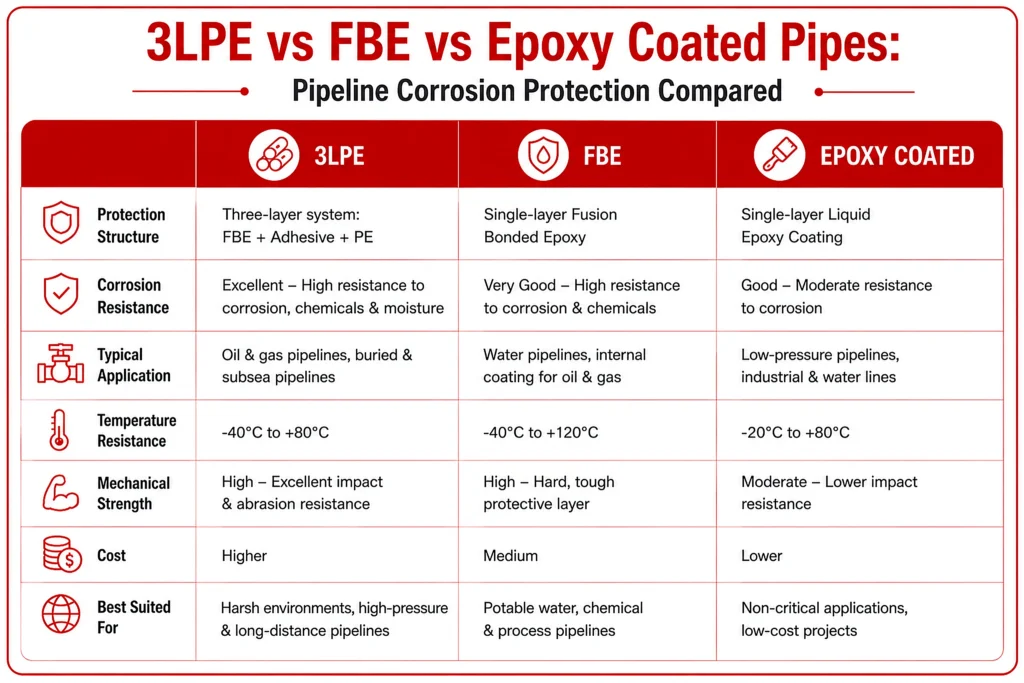
3LPE vs FBE vs Epoxy: Quick Comparison
Feature | 3LPE | FBE | Epoxy Coating |
Structure | 3 layers | Single epoxy system | Varies |
Corrosion Protection | Excellent | Excellent | Good to excellent |
Mechanical Protection | Excellent | Moderate | Depends on system |
Adhesion | Excellent | Excellent | Good to excellent |
Impact Resistance | Very high | Moderate | Depends on formulation |
Abrasion Resistance | Very high | Good | Depends on formulation |
Moisture Protection | Excellent | Good | Good |
Temperature Capability | Moderate to high, system dependent | High, grade dependent | Formulation dependent |
Typical Use | Buried pipelines | Oil & gas pipelines | Water, industrial & process piping |
The actual performance depends on the specific coating formulation, thickness, application procedure, service environment, and applicable coating standard.
3LPE: Major Advantages
Excellent Mechanical Protection
One of the biggest advantages of 3LPE is its polyethylene outer layer.
It protects the underlying steel and epoxy from mechanical damage during:
- Transportation
- Handling
- Installation
- Backfilling
- Soil movement
Strong Corrosion Resistance
The combination of FBE and polyethylene provides multiple barriers against moisture and corrosive environments.
Excellent for Buried Pipelines
3LPE is widely selected for underground oil, gas, and water pipelines because the polyethylene layer provides additional protection against soil and moisture.
Long Service Life
When properly designed and applied, 3LPE can provide long-term external corrosion protection and reduce maintenance requirements.
FBE: Major Advantages
Excellent Adhesion
FBE bonds strongly to properly prepared steel surfaces, helping prevent moisture from reaching the substrate.
Good Corrosion Protection
FBE provides a continuous barrier against corrosion and is widely used for pipeline protection.
Good Temperature Performance
Certain FBE formulations can withstand relatively high operating temperatures, making them suitable for demanding pipeline services.
Environmentally Efficient Application
FBE is a powder coating system and does not require conventional liquid solvents during application.
Epoxy Coating: Major Advantages
Epoxy coatings are highly versatile and can be formulated for different service environments.
They can provide:
- Chemical resistance
- Corrosion protection
- Strong adhesion
- Smooth surfaces
- Internal pipe protection
- External pipe protection
Epoxy systems are commonly considered for water pipelines, industrial process systems, tanks, and piping components.
Which Coating Is Best for Buried Pipelines?
When high mechanical protection is needed for subterranean pipes, 3LPE is frequently chosen.
The pipe is shielded from soil-related damage during installation by the polyethylene outer covering.
Although additional mechanical protection may be needed depending on the installation conditions, FBE can also be utilized for subterranean pipelines, especially if the project specifications demand it.
The selection should consider:
- Soil conditions
- Installation method
- Pipeline diameter
- Operating temperature
- Handling requirements
- Cathodic protection
- Design life
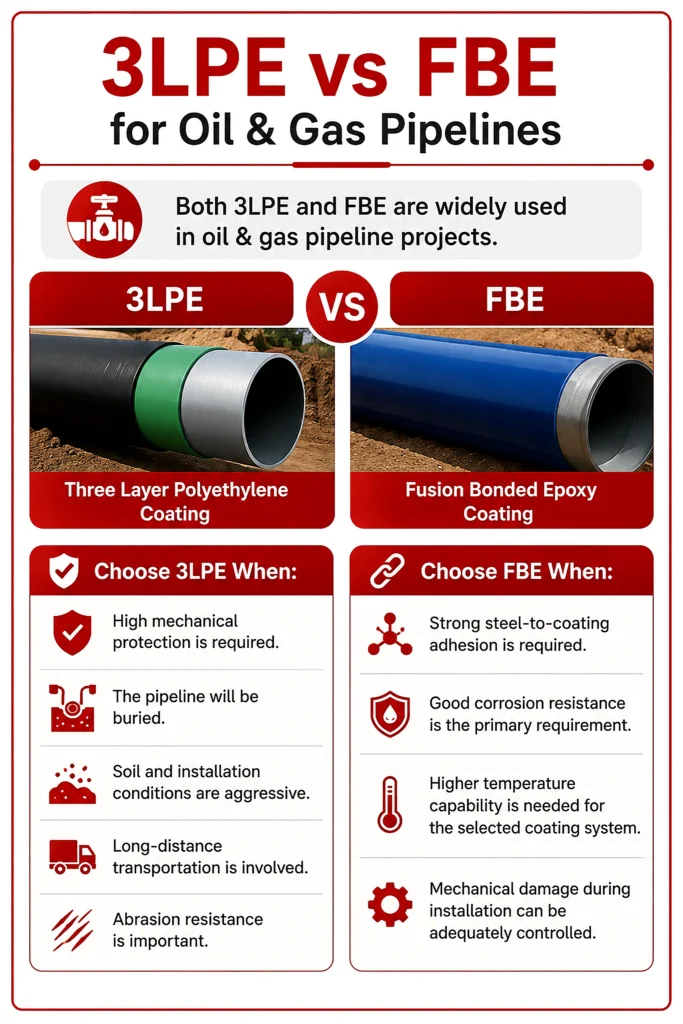
3LPE vs FBE for Oil & Gas Pipelines
Both 3LPE and FBE are widely used in oil & gas pipeline projects.
Choose 3LPE When:
- High mechanical protection is required.
- The pipeline will be buried.
- Soil and installation conditions are aggressive.
- Long-distance transportation is involved.
- Abrasion resistance is important.
Choose FBE When:
- Strong steel-to-coating adhesion is required.
- Good corrosion resistance is the primary requirement.
- Higher temperature capability is needed for the selected coating system.
- Mechanical damage during installation can be adequately controlled.
Epoxy Coating for Water Pipelines
Epoxy coatings are frequently used in water and industrial applications because they can provide corrosion protection while creating a relatively smooth surface.
For water pipelines, coating selection should consider:
- Water
- chemistryOperating temperature
- Flow conditions
- Potable-water requirements where applicable
- Coating thickness
- Surface preparation
- Applicable standards
The coating must be specifically qualified for the intended service.
Importance of Surface Preparation
Regardless of the coating system, surface preparation is one of the most important factors affecting coating performance.
Before coating, the steel surface is typically cleaned to remove:
- Mill scale
- Rust
- Oil
- Grease
- Dirt
- Moisture
A properly prepared surface improves coating adhesion and reduces the risk of premature coating failure.
Coating Inspection and Quality Control
A coating system should undergo appropriate inspection before the pipe is accepted.
Typical checks include:
- Surface preparation inspection
- Coating thickness measurement
- Visual inspection
- Holiday detection
- Adhesion testing
- Impact testing where specified
- Peel or bond testing where applicable
Holiday testing is particularly important because small coating defects can create pathways for moisture and corrosion.
Cathodic Protection and Pipeline Coatings
Pipeline coatings and cathodic protection are often used together.
The coating provides the primary physical barrier, while cathodic protection helps protect areas where coating imperfections or damage expose the steel.
A properly designed pipeline corrosion-control system therefore considers both:
Coating + Cathodic Protection
rather than treating the coating as the only corrosion-control measure.
How to Select the Right Coating
Before choosing between 3LPE, FBE, and epoxy, evaluate:
Operating Temperature
Some coating systems have temperature limitations. Always verify the maximum continuous operating temperature for the selected coating.
Installation Environment
Buried, above-ground, offshore, and subsea pipelines can require different coating systems.
Mechanical Loads
Consider impact, abrasion, bending, transportation, and installation stresses.
Corrosive Environment
Evaluate soil resistivity, chloride exposure, moisture, chemicals, and operating fluid.
Design Life
A long-term pipeline may justify a more robust multi-layer coating system.
Project Specification
Oil & gas and infrastructure projects often specify particular coating standards and qualification procedures.
Why Choose a Reliable Coated Pipe Supplier?
In addition to the coating material, other factors that affect coating performance include surface preparation, application conditions, coating thickness, curing, inspection, and handling.
Metallon Pipings can fulfill coated pipe requirements in accordance with project specifications and provides industrial pipes and piping products for oil and gas, petrochemical, water, marine, and infrastructure applications.
Buyers should obtain comprehensive coating paperwork, such as coating system details, inspection records, thickness measurements, holiday test results, and relevant certificates, for key pipeline projects.
Conclusion
Epoxy, FBE, and 3LPE coatings all offer useful corrosion protection, although the strengths of each system vary.
3LPE is especially appropriate for underground and long-distance pipelines since it combines FBE, adhesive, and polyethylene to offer superior mechanical and corrosion protection.
FBE is frequently utilized as a stand-alone pipeline coating system because it offers outstanding temperature performance, strong adhesion, and corrosion resistance.
Epoxy coatings are adaptable and can be designed for both external and internal protection in industrial, chemical, process, and water applications.
There isn’t a coating solution that works for every pipeline. Operating temperature, soil and climatic conditions, mechanical exposure, installation technique, design life, cathodic protection, and project specifications all influence the optimal decision. Careful coating selection and quality control can significantly extend pipeline service life and reduce corrosion-related maintenance costs.
How We Support You
Selecting between duplex and super duplex steel pipes is essential for offshore and subsea projects where seawater, chlorides, high pressure, and demanding mechanical conditions can affect long-term piping performance. Our team supports EPC contractors, offshore engineers, procurement specialists, and project consultants in choosing the right material grade and piping solution for critical marine and energy applications.
We support you with:
- Guidance in selecting duplex grades such as UNS S31803 and UNS S32205 and super duplex grades such as UNS S32750 and UNS S32760
- Recommendations based on seawater exposure, chloride concentration, operating temperature, pressure, corrosion resistance, and mechanical strength requirements
- Assistance in comparing duplex and super duplex pipes based on corrosion resistance, PREN, strength, weldability, and service conditions
- Support for offshore platforms, subsea pipelines, flowlines, risers, seawater injection systems, and marine process piping
- Guidance on material selection for offshore oil & gas, desalination, marine engineering, chemical processing, and seawater handling applications
- Assistance in selecting compatible duplex and super duplex fittings, flanges, valves, fasteners, and other piping components
- Guidance on compliance with ASTM, ASME, API, NACE, ISO, and project-specific offshore and subsea specifications
- Technical support for pipe schedules, wall thickness, welding requirements, heat treatment, corrosion protection, and fabrication considerations
- Documentation support including Mill Test Certificates (MTCs), PMI reports, impact test results, hydrostatic test reports, third-party inspection certificates, and quality certifications
- Assistance with material traceability, bulk procurement, inspection requirements, and project-specific quality documentation
- Fast quotations, export packaging, logistics coordination, and reliable supply support for offshore, subsea, marine, and energy projects across the GCC, Africa, Europe, and international markets
Whether your project involves subsea pipelines, offshore platforms, seawater injection systems, desalination plants, or marine infrastructure, we provide reliable duplex and super duplex steel pipe solutions tailored to deliver corrosion resistance, high mechanical strength, durability, and compliance with international project requirements.