Selecting the correct pipeline material is one of the most important responsibilities for EPC procurement engineers working in oil & gas, petrochemical, refinery, water transmission, LNG, and infrastructure projects. Pipeline systems operate under demanding conditions involving high pressure, corrosive environments, temperature fluctuations, and long-distance transportation requirements. Choosing the wrong pipe grade can lead to operational failures, safety risks, increased maintenance costs, and reduced project lifespan.
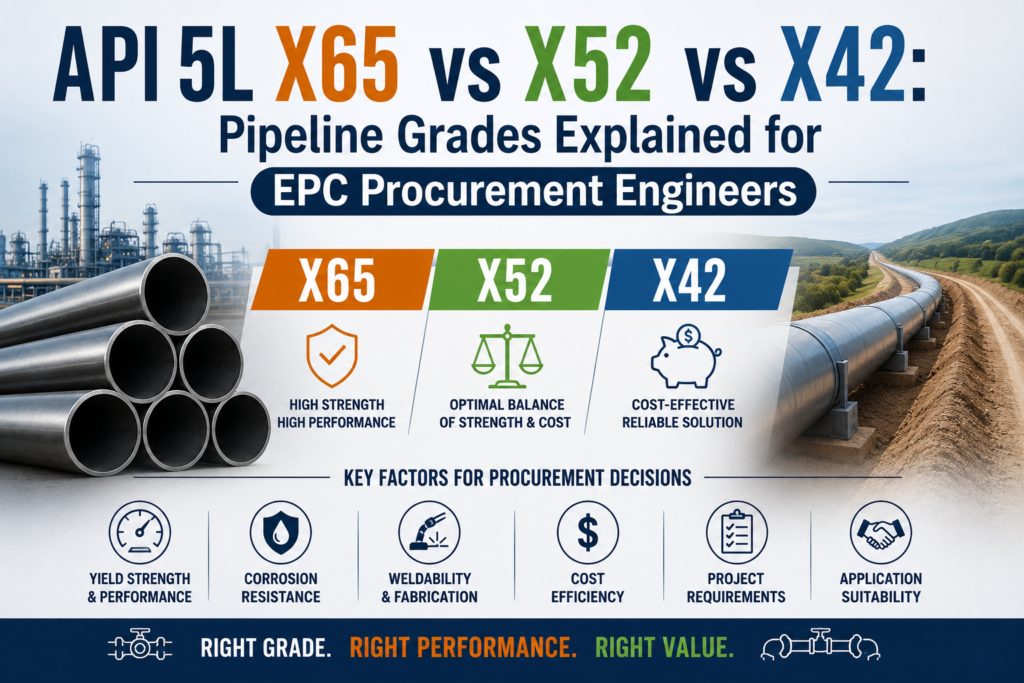
Among the most commonly specified pipeline materials in global industrial projects are API 5L X65, X52, and X42 carbon steel pipeline grades. These grades are widely used for transporting oil, natural gas, water, slurry, and petrochemical fluids across onshore and offshore infrastructure systems.
Although these grades belong to the same API 5L specification, they differ significantly in mechanical strength, pressure-handling capability, weldability, application suitability, and project cost considerations.
For EPC procurement engineers, understanding these differences is critical for selecting the right material for project performance, compliance, and long-term reliability.
What Is API 5L Pipe?
API 5L is a specification developed by the American Petroleum Institute (API) for line pipes used in transporting oil, gas, water, and industrial fluids.
API 5L pipes are designed for:
- High-pressure pipeline systems
- Oil & gas transportation
- Offshore pipelines
- Refinery infrastructure
- Petrochemical plants
- Industrial fluid transfer systems
The specification defines:
- Mechanical properties
- Chemical composition
- Manufacturing standards
- Testing requirements
- Pressure performance
API 5L grades are commonly divided into:
- PSL1 (Product Specification Level 1)
- PSL2 (Product Specification Level 2)
PSL2 includes stricter quality, testing, and chemical requirements.
Understanding API 5L Grade Naming
The “X” in API 5L grades refers to the minimum yield strength of the pipe material.
For example:
- X42 = 42,000 PSI minimum yield strength
- X52 = 52,000 PSI minimum yield strength
- X65 = 65,000 PSI minimum yield strength
Higher grades generally provide:
- Greater strength
- Higher pressure resistance
- Reduced wall thickness possibilities
- Improved transportation efficiency
However, higher grades may also involve:
- Increased material cost
- More complex welding requirements
- Stricter quality control
What Is API 5L X42 Pipe?
API 5L X42 is considered a lower-to-medium strength carbon steel pipeline grade commonly used in moderate-pressure pipeline systems.
Key Features of X42
- Good weldability
- Cost-effective material
- Suitable for lower-pressure systems
- Reliable mechanical performance
- Easier fabrication and installation
Common Applications of X42
- Water pipelines
- Low-pressure oil pipelines
- Structural piping systems
- Utility infrastructure
- Industrial fluid transfer systems
X42 remains popular for projects where extremely high pressure resistance is not required.
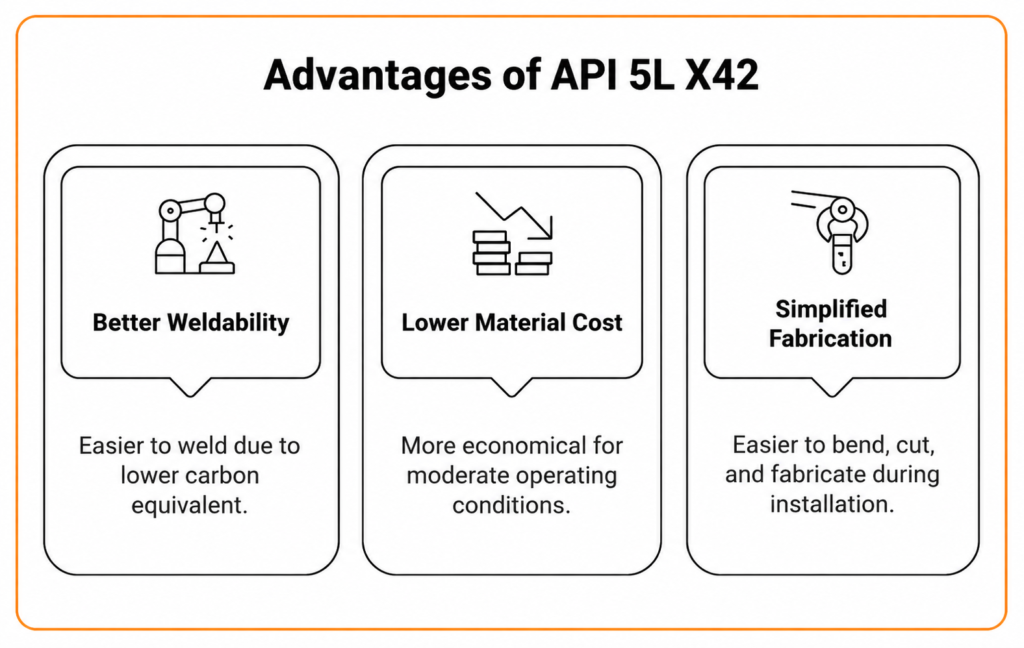
Advantages of API 5L X42
1. Better Weldability
X42 is easier to weld compared to higher-strength grades because of its lower carbon equivalent.
2. Lower Material Cost
It is generally more economical for moderate operating conditions.
3. Simplified Fabrication
Lower strength grades are easier to bend, cut, and fabricate during installation.
Limitations of X42
Despite its advantages, X42 has limitations:
- Lower pressure handling capability
- Thicker wall requirements for high-pressure systems
- Reduced strength compared to X52 and X65
This makes it less suitable for demanding offshore or high-pressure transmission pipelines.
What Is API 5L X52 Pipe?
API 5L X52 is one of the most commonly used pipeline grades globally because it offers a strong balance between strength, cost efficiency, weldability, and pressure performance.
Key Features of X52
- Medium-to-high strength
- Good pressure resistance
- Excellent weldability
- Cost-effective performance
- Suitable for long-distance pipelines
Common Applications of X52
- Oil transmission pipelines
- Natural gas pipelines
- Petrochemical infrastructure
- Refinery systems
- Offshore piping systems
X52 is widely preferred in EPC projects because it supports both performance and economic efficiency.
Advantages of API 5L X52
1. Balanced Mechanical Strength
X52 provides stronger performance than X42 while remaining easier to fabricate than higher grades.
2. Better Pressure Handling
It supports higher operating pressures for oil & gas transmission systems.
3. Strong Industry Acceptance
Many international pipeline projects standardize around X52 because of its versatility.
Limitations of X52
Some limitations include:
- Lower strength than X65
- Thicker wall requirements compared to high-grade pipes
- Moderate performance in ultra-high-pressure systems
What Is API 5L X65 Pipe?
API 5L X65 is a high-strength carbon steel pipeline grade designed for demanding oil & gas transmission applications.
Key Features of X65
- High yield strength
- Superior pressure resistance
- Reduced wall thickness capability
- Better transportation efficiency
- Strong performance in long-distance pipelines
Common Applications of X65
- High-pressure gas transmission
- Offshore pipelines
- Long-distance crude oil pipelines
- Subsea infrastructure
- LNG projects
X65 is widely used in large-scale EPC and energy infrastructure projects.
Advantages of API 5L X65
1. Higher Strength-to-Weight Ratio
Higher strength allows thinner wall designs while maintaining pressure performance.
2. Improved Pipeline Efficiency
Reduced wall thickness lowers transportation and installation costs.
3. Better Performance in Harsh Environments
X65 performs well in high-pressure and demanding operational conditions.
Limitations of X65
1. More Complex Welding
Higher-strength steels require stricter welding procedures and quality control.
2. Higher Material Cost
X65 generally costs more than X42 and X52.
3. More Stringent Quality Requirements
Inspection and testing standards are stricter for high-strength grades.
Mechanical Property Comparison
API 5L X42
- Minimum Yield Strength: 42,000 PSI
- Lower pressure resistance
- Easier fabrication
API 5L X52
- Minimum Yield Strength: 52,000 PSI
- Balanced performance and cost
API 5L X65
- Minimum Yield Strength: 65,000 PSI
- High-pressure and long-distance pipeline capability
Higher grades provide stronger mechanical performance but may increase project complexity.
Which Grade Is Best for EPC Procurement?
The correct grade depends on:
- Operating pressure
- Project environment
- Transportation medium
- Installation conditions
- Budget limitations
- Welding requirements
- Regulatory standards
Choose X42 If:
- The project involves low-pressure systems
- Budget optimization is critical
- Fabrication simplicity is important
Choose X52 If:
- Balanced performance and cost are required
- Moderate-to-high pressure exists
- General oil & gas transmission is involved
Choose X65 If:
- High-pressure systems are required
- Long-distance transmission is involved
- Offshore or subsea conditions exist
- Weight optimization is important
Importance of PSL1 vs PSL2
Procurement engineers must also consider whether the project requires:
- PSL1 pipes
or - PSL2 pipes
PSL2 Provides:
- Stricter chemical controls
- Enhanced mechanical testing
- Better toughness requirements
- Improved weldability standards
PSL2 is often mandatory for critical oil & gas infrastructure projects.
Industries Using API 5L Pipeline Grades
These grades are widely used in:
- Oil & gas industries
- Petrochemical plants
- LNG infrastructure
- Refineries
- Offshore platforms
- Water transmission systems
- Power generation projects
API 5L remains one of the most important pipeline standards globally.
Common Procurement Challenges
EPC procurement engineers often face challenges such as:
- Material availability
- Compliance verification
- Mill certification review
- Delivery timelines
- Cost optimization
- Corrosion resistance requirements
- Welding compatibility
Proper grade selection helps reduce operational and procurement risks.
Future Demand for High-Strength Pipeline Grades
Global infrastructure expansion continues increasing demand for:
- High-pressure transmission systems
- Hydrogen pipelines
- LNG projects
- Offshore energy infrastructure
- Cross-country pipeline networks
High-strength grades such as X65 are expected to see growing adoption in future energy projects.
Conclusion
The pipeline grades API 5L X42, X52, and X65 are all crucial to the transportation of oil and gas and industrial infrastructure. For lower-pressure applications, X42 offers affordable performance; for general transmission systems, X52 offers balanced strength and versatility; and for challenging high-pressure and long-distance pipeline projects, X65 offers high-strength performance. EPC procurement engineers must carefully consider pressure circumstances, environmental exposure, welding needs, compliance standards, and project economics when choosing the appropriate grade. Across crucial industrial projects, choosing the right pipeline materials enhances operational safety, dependability, efficiency, and long-term infrastructure performance.
How We Support You
Selecting the right API 5L pipeline grade is essential for ensuring strength, weldability, corrosion resistance, and long-term performance in oil & gas, petrochemical, and infrastructure projects across GCC and African markets. Our team helps EPC contractors, procurement engineers, and project consultants choose the most suitable pipeline grades, including API 5L X42, X52, and X65, based on pressure requirements, operating environments, transportation media, and project specifications.
We support you with:
- Guidance in selecting the right API 5L grades for onshore, offshore, and cross-country pipeline projects
- Recommendations for API 5L X42, X52, and X65 based on pressure ratings, mechanical strength, and weldability
- Support for oil transmission, natural gas pipelines, water pipelines, slurry systems, and petrochemical applications
- Assistance with compliance to API, ASTM, ASME, NACE, ARAMCO, and international EPC specifications
- Guidance for seamless, ERW, LSAW, SSAW, and welded pipeline solutions
- Recommendations for sour service, high-pressure, and corrosive operating conditions
- Technical support for pipe schedules, wall thickness selection, coatings, fittings, and flanges
- Documentation support including MTCs, hydro testing, third-party inspection reports, and quality certifications
- Fast quotations, export logistics, and bulk supply support for GCC & African pipeline projects
Whether your project involves refinery infrastructure, gas transmission lines, offshore pipelines, petrochemical facilities, water transportation systems, or industrial process networks, we provide reliable API 5L pipeline solutions tailored to your performance, durability, and project compliance requirements.