For upstream, middle, and downstream activities, Nigeria’s oil and gas sector needs a steady supply of dependable pipes, fittings, flanges, and other piping components. Piping systems are crucial to the upkeep of a secure and effective energy infrastructure, from crude oil pipelines and flowlines to refineries, gas processing facilities, ports, and petrochemical plants.
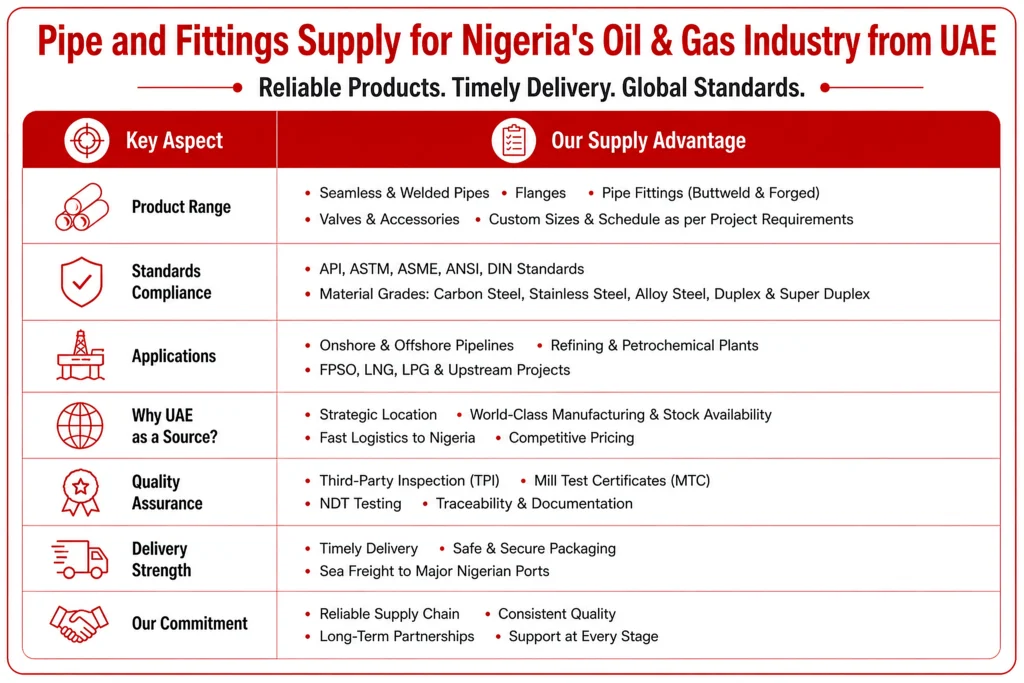
Sourcing from the UAE can give Nigerian EPC contractors, distributors, oil and gas firms, and project procurement teams access to a well-established regional trading and export base. Bulk purchases, international logistics, and combined shipments of piping items from various production sources can all be supported by UAE-based vendors.
The benefits of sourcing industrial pipes and fittings from the United Arab Emirates for Nigerian oil and gas projects are explained in this guide, along with factors that purchasers should take into account before placing an order.
Why Source Pipes and Fittings from the UAE?
The UAE has developed into an important hub for industrial equipment, metals, engineering products, and international trade. Its strategic location between Asia, Europe, Africa, and the Middle East supports efficient movement of industrial products.
For Nigerian buyers, UAE sourcing can offer several potential advantages:
- Access to a broad supplier network
- Consolidated procurement
- International shipping connections
- Availability of carbon and alloy steel products
- Support for large project orders
- Flexible export logistics
- Access to manufacturers and stockists
The UAE can therefore serve as a convenient procurement point for Nigerian projects requiring multiple piping products.
Pipes for Nigerian Oil & Gas Projects
Different sections of an oil & gas facility require different pipe materials and specifications.
Carbon Steel Pipes
Carbon steel remains one of the most widely used materials for oil & gas piping because of its strength and cost-effectiveness.
Common specifications include:
- ASTM A106
- ASTM A53
- API 5L
- ASTM A333
API 5L line pipes are particularly important for oil and natural gas transportation applications.
Common API 5L grades include:
- X42
- X52
- X60
- X65
- X70
The appropriate grade depends on pipeline design, pressure, temperature, service conditions, and project specifications.
Stainless Steel Pipes
Stainless steel is used where improved corrosion resistance is required.
Common grades include:
- 304
- 304L
- 316
- 316L
- 321
- 347
- 904L
Stainless steel piping can be used in process systems, chemical services, water treatment, and selected offshore applications.
Alloy Steel Pipes
Alloy steel pipes are frequently used for elevated-temperature and high-pressure applications.
Common ASTM A335 grades include:
- P5
- P9
- P11
- P22
- P91
These materials are commonly specified for refinery, petrochemical, boiler, steam, and power-generation applications.
Duplex and Super Duplex Pipes
For aggressive chloride and marine environments, duplex and super duplex stainless steels can offer substantially improved corrosion resistance.
Common grades include:
- UNS S31803
- UNS S32205
- UNS S32750
- UNS S32760
These materials can be considered for:
- Offshore platforms
- Seawater systems
- Water injection
- Desalination
- Marine piping
- Subsea applications
Pipe Fittings for Oil & Gas Applications
Pipes alone are not enough to construct a complete piping system. Fittings are required to connect pipes, change flow direction, modify pipe size, and create branch connections.
Common fittings include:
Elbows
Elbows change the direction of flow.
Common configurations include:
- 45° elbows
- 90° elbows
- 180° elbows
- Long-radius elbows
- Short-radius elbows
Tees
Tees provide branch connections and are available as:
- Equal tees
- Reducing tees
Reducers
Reducers connect pipes of different diameters.
Common types include:
- Concentric reducers
- Eccentric reducers
Caps
Pipe caps close the end of a pipeline or piping section.
Crosses
Cross fittings provide four-way connections and are used in selected piping configurations.
Flanges for Nigerian Projects
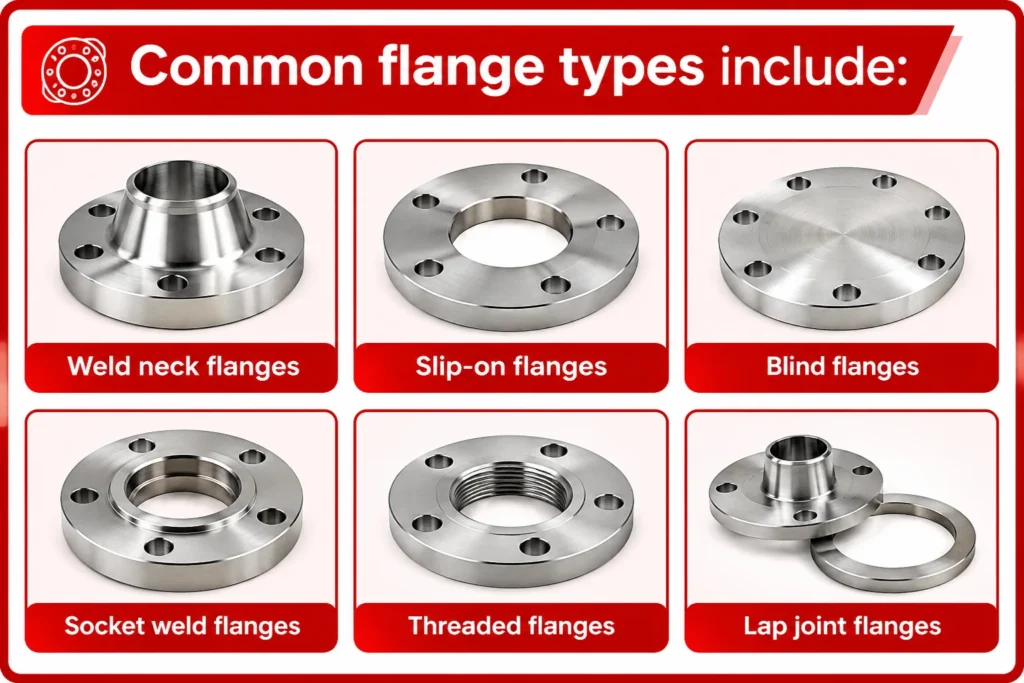
Flanges provide detachable connections between pipes, valves, equipment, and other piping components.
Common flange types include:
- Weld neck flanges
- Slip-on flanges
- Blind flanges
- Socket weld flanges
- Threaded flanges
- Lap joint flanges
Common standards include ASME B16.5 for many standard flange sizes and ASME B16.47 for large-diameter flanges.
Pressure classes may include:
- Class 150
- Class 300
- Class 600
- Class 900
- Class 1500
- Class 2500
The correct flange class must be selected according to pressure, temperature, material, and applicable piping design requirements.
Standards and Specifications Matter
Nigerian oil & gas projects often involve strict technical specifications.
Depending on the application, procurement may require compliance with:
- ASTM
- ASME
- API
- EN
- ISO
- Project-specific engineering specifications
- Customer or EPC requirements
For example, an order may specify:
API 5L X65 PSL2 seamless or welded line pipe
or:
ASTM A234 WPB butt-weld fittings + ASME B16.9 dimensions
The supplier must understand exactly what each requirement means and ensure that the supplied material matches the purchase order.
Material Test Certificates and Traceability
Documentation is critical when supplying pipes and fittings for oil & gas projects.
Buyers should request appropriate documentation such as:
- Material Test Certificates
- Chemical composition reports
- Mechanical test results
- Heat number traceability
- Hydrostatic test certificates
- NDT reports
- PMI reports where applicable
- Dimensional inspection reports
- Certificate of conformity
- Third-party inspection reports when required
Heat numbers should remain traceable from the supplied product to the relevant material certificate.
UAE-to-Nigeria Export Logistics
One of the advantages of sourcing through the UAE is access to established international logistics infrastructure.
For large shipments, suppliers should carefully coordinate:
- Packing
- Bundling
- Container or break-bulk requirements
- Shipping documentation
- Commercial invoices
- Packing lists
- Certificates of origin
- Inspection documents
- Freight arrangements
Pipes and fittings should be packed appropriately to prevent damage, corrosion, and deformation during handling and transportation.
Bulk Supply for EPC and Oil & Gas Projects
Large Nigerian projects may require hundreds or thousands of pipes, fittings, and flanges in different sizes and grades.
A capable UAE-based supplier can help consolidate these requirements into a coordinated procurement package.
This can simplify purchasing by allowing buyers to source:
Pipes + Fittings + Flanges + Related Piping Components
from one supply partner.
Bulk procurement also makes it easier to coordinate documentation, inspection, packaging, and shipping.
What Nigerian Buyers Should Check Before Ordering
Before purchasing pipes and fittings from a UAE supplier, procurement teams should verify:
1. Material Grade
Confirm the exact grade and UNS designation where applicable.
2. Standard
Verify the applicable ASTM, ASME, API, EN, or project specification.
3. Dimensions
Check:
- Nominal size
- Outside diameter
- Wall thickness
- Schedule
- Length
- Fitting dimensions
4. Pressure Rating
For flanges and pressure-containing components, verify the required pressure class and temperature rating.
5. Testing
Confirm all required hydrostatic, NDT, PMI, impact, and dimensional testing requirements.
6. Documentation
Ensure the supplier can provide complete MTCs and traceability documents.
7. Inspection
For critical projects, arrange third-party inspection before shipment if required by the EPC contractor or end user.
Metallon Pipings for Nigeria-Bound Piping Supply
Metallon Pipings supports international customers requiring industrial pipes, fittings, and flanges for oil & gas, petrochemical, refinery, offshore, marine, and infrastructure projects.
Its product range includes:
- Carbon steel pipes
- Stainless steel pipes
- Alloy steel pipes
- Duplex steel pipes
- Super duplex pipes
- Nickel alloy pipes
- Butt-weld fittings
- Forged fittings
- Industrial flanges
For Nigeria-bound orders, proper specification review, material traceability, inspection, export packaging, and documentation are essential to ensure that products arrive ready for project use.
Conclusion
Purchasing pipes and fittings from the UAE can give purchasers access to a wide industrial supply network, global logistical infrastructure, and consolidated procurement prospects for Nigeria’s oil and gas sector.
Products made of carbon steel, stainless steel, alloy steel, duplex, and nickel alloy can be chosen based on the particular needs of process systems, pipelines, refineries, petrochemical plants, and offshore facilities.
However, obtaining a competitive price is not the only requirement for successful procurement. Material grades, ASTM/API/ASME standards, dimensions, pressure ratings, testing, MTCs, traceability, inspection, packaging, and shipping documents should all be thoroughly checked by Nigerian consumers.
Working with a seasoned UAE-based piping supplier like Metallon Pipings can help expedite the acquisition of pipes, fittings, and flanges for major EPC and oil and gas projects while meeting the technical and documentation standards typical of global energy projects.
How We Support You
Sourcing pipes and fittings for Nigeria’s oil & gas industry requires dependable international supply, strict quality control, and efficient export logistics. Our team supports EPC contractors, oil & gas companies, procurement specialists, engineering consultants, and industrial distributors in Nigeria by supplying piping solutions from the UAE for demanding upstream, midstream, and downstream projects.
We support you with:
- Guidance in selecting carbon steel, stainless steel, alloy steel, duplex, super duplex, and high nickel alloy pipes and fittings for oil & gas applications
- Recommendations based on operating pressure, temperature, corrosion resistance, sour service conditions, fluid characteristics, and project specifications
- Support for oil & gas pipelines, refineries, petrochemical plants, gas processing facilities, offshore platforms, FPSO projects, and industrial process piping
- Supply of seamless, ERW, welded, and specialty pipes along with elbows, tees, reducers, caps, flanges, and other pipe fittings
- Assistance in selecting compatible pipe and fitting materials, dimensions, schedules, pressure classes, and connection types
- Guidance on compliance with ASTM, ASME, API, NACE, ISO, and project-specific international and EPC specifications
- Support for material traceability, approved manufacturer sourcing, inspection requirements, and quality assurance throughout procurement
- Documentation support including Mill Test Certificates (MTCs), EN 10204 3.1/3.2 certificates, PMI reports, hydrostatic test reports, third-party inspection certificates, and certificates of origin
- Assistance with export packaging, containerization, customs documentation, freight coordination, and shipment planning from the UAE to Nigeria
- Fast quotations, bulk procurement support, inventory coordination, and project-based supply planning to help reduce procurement lead times
- Technical assistance for material selection, pipe schedules, wall thickness, corrosion protection, and project-specific testing requirements
Whether your requirement involves upstream oil & gas operations, pipeline construction, refinery projects, offshore developments, or petrochemical infrastructure in Nigeria, we provide reliable pipe and fitting supply from the UAE backed by quality documentation, technical support, and efficient international logistics.