Introduction
Strict adherence to material specifications, quality standards, and project approval procedures is necessary for major oil, gas, petrochemical, and industrial projects in the Middle East. Businesses that supply piping materials for ADNOC and SABIC projects need to be aware of the technical specifications, paperwork requirements, and permitted material grades that end users and EPC contractors anticipate.
In order to stay competitive and land long-term contracts, suppliers of pipes, fittings, flanges, valves, and related piping components must guarantee complete compliance with project specifications as major investments continue throughout the United Arab Emirates and Saudi Arabia.
The main plumbing materials, standards, certifications, and supplier requirements that are frequently connected to ADNOC and SABIC projects are explained in this guide.
Understanding ADNOC and SABIC Project Requirements
ADNOC and SABIC projects typically involve demanding operating conditions, including:
- High-pressure systems
- High-temperature service
- Corrosive process environments
- Sour gas applications
- Offshore and marine exposure
- Petrochemical processing operations
Because of these conditions, piping materials must meet strict international standards and project-specific technical specifications.
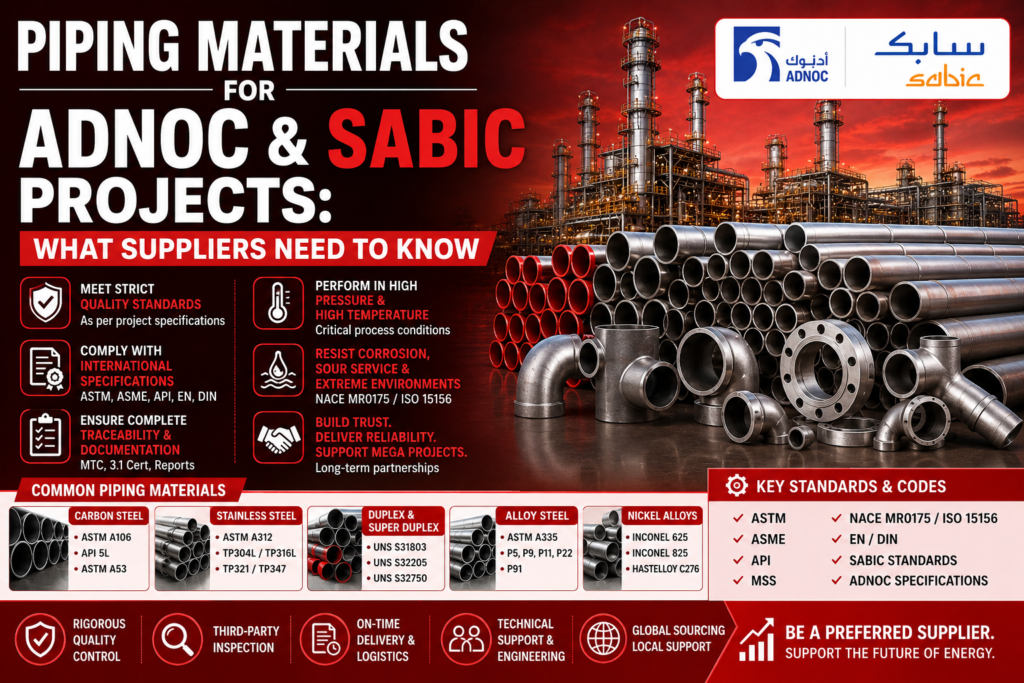
Common Piping Materials Used in ADNOC and SABIC Projects
Carbon Steel Pipes
Carbon steel remains one of the most widely used materials for process piping, utility systems, and pipeline applications.
Common Grades
- ASTM A106 Grade B
- ASTM A53 Grade B
- API 5L Grade B
- API 5L X42
- API 5L X52
- API 5L X65
Typical Applications
- Process piping
- Water transmission systems
- Utility services
- Oil and gas transportation
- Refinery infrastructure
Carbon steel offers a cost-effective solution for many industrial applications where corrosion risks are manageable.
Stainless Steel Pipes
Stainless steel piping materials are widely used where corrosion resistance and long service life are critical.
Common Grades
- ASTM A312 TP304L
- ASTM A312 TP316L
- ASTM A312 TP321
- ASTM A312 TP347
Typical Applications
- Chemical processing
- Water treatment systems
- Desalination plants
- Petrochemical facilities
- Corrosive fluid handling
Stainless steel provides excellent resistance to oxidation, chemical attack, and moisture-related corrosion.
Duplex Stainless Steel Pipes
Duplex stainless steels combine high strength with enhanced corrosion resistance.
Common Grades
- UNS S31803
- UNS S32205
Typical Applications
- Offshore platforms
- Seawater systems
- Produced water pipelines
- High-pressure process lines
Duplex materials are commonly selected for applications requiring both strength and corrosion resistance.
Super Duplex Stainless Steel Pipes
Super Duplex grades are frequently specified for severe service conditions involving chlorides and seawater.
Common Grades
- UNS S32750
- UNS S32760
Typical Applications
- Offshore facilities
- Seawater injection systems
- Marine infrastructure
- Desalination projects
These materials provide outstanding resistance to pitting, crevice corrosion, and stress corrosion cracking.
Alloy Steel Pipes
Alloy steel pipes are used in high-temperature and high-pressure applications.
Common Grades
- ASTM A335 P5
- ASTM A335 P9
- ASTM A335 P11
- ASTM A335 P22
- ASTM A335 P91
Typical Applications
- Refineries
- Power plants
- Steam systems
- Heat recovery units
These grades offer excellent mechanical strength at elevated temperatures.
High Nickel Alloy Materials
Nickel alloys are selected for extremely corrosive process environments.
Common Grades
- Inconel 625
- Inconel 825
- Hastelloy C276
- Monel 400
Typical Applications
- Chemical processing
- Sour gas systems
- Offshore applications
- Acid handling systems
These materials provide exceptional corrosion resistance under aggressive operating conditions.
Common Standards for Piping Materials
Projects generally require compliance with internationally recognized standards.
Pipe Standards
- ASTM A106
- ASTM A312
- ASTM A335
- API 5L
- ASTM A790
Fittings Standards
- ASTM A234
- ASTM A403
- ASTM A815
Flange Standards
- ASME B16.5
- ASME B16.47
Pipe Dimensions
- ASME B36.10M
- ASME B36.19M
Compliance with these standards ensures compatibility, reliability, and project acceptance.
Material Testing and Inspection Requirements
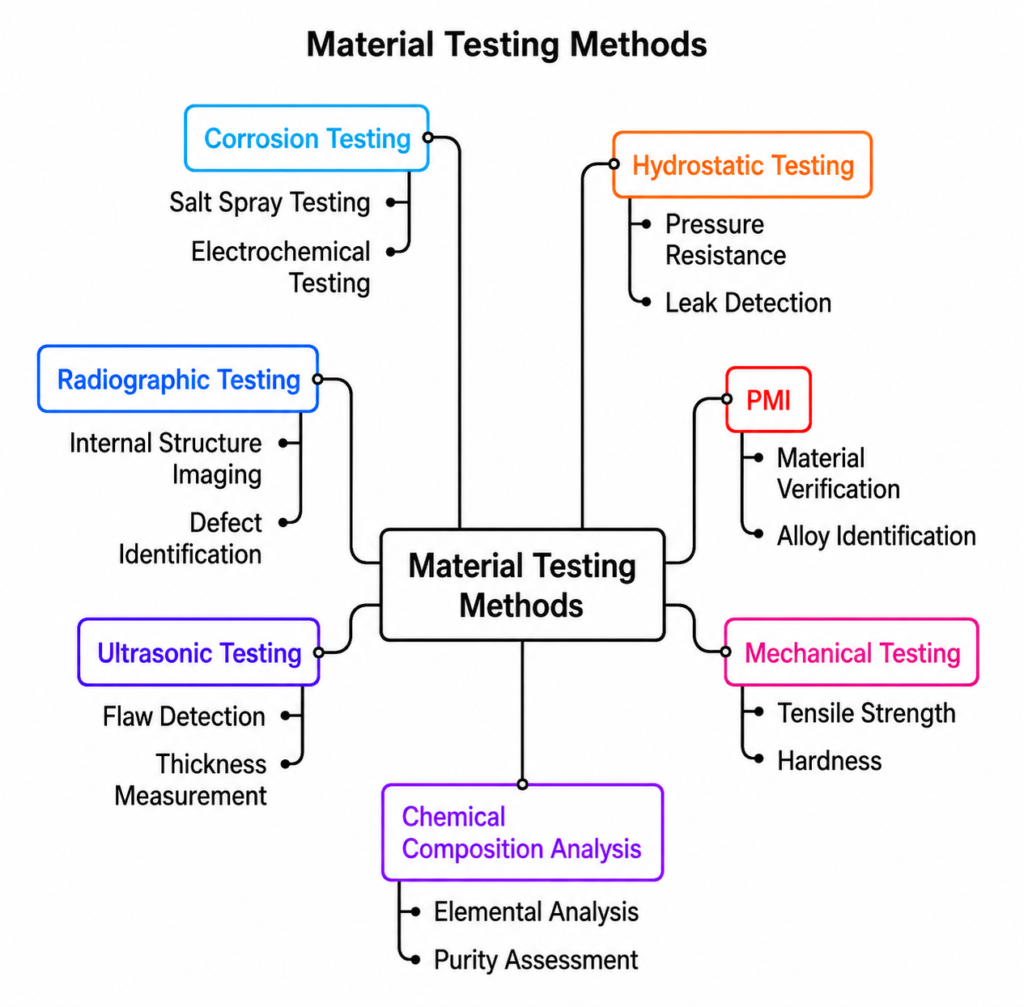
Piping materials supplied for major industrial projects typically undergo extensive quality control procedures.
Common Testing Requirements
- Hydrostatic testing
- PMI (Positive Material Identification)
- Mechanical testing
- Chemical composition analysis
- Ultrasonic testing
- Radiographic testing
- Corrosion testing
These tests verify compliance with project specifications and international standards.
Documentation Required from Suppliers
Documentation is often as important as the product itself.
Common Documentation
- Mill Test Certificates (MTC)
- EN 10204 3.1 Certification
- Material Traceability Records
- Inspection Reports
- Quality Assurance Documents
- Packing Lists
- Country of Origin Certificates
Complete documentation helps ensure smooth project approvals and material acceptance.
NACE Compliance for Sour Service Applications
Many oil and gas projects involve sour service conditions containing hydrogen sulfide (H₂S).
For these applications, materials may need to comply with:
- NACE MR0175
- ISO 15156
Compliance helps prevent sulfide stress cracking and other corrosion-related failures.
Supplier Qualification Considerations
To participate in major EPC, refinery, and petrochemical projects, suppliers should demonstrate:
- Strong manufacturing capability
- Proven export experience
- Product traceability systems
- Third-party inspection support
- Consistent quality control
- Compliance with international standards
- Reliable delivery performance
Project owners and EPC contractors often prioritize suppliers with a strong record of successful industrial project deliveries.
Challenges Suppliers Must Address
Stringent Quality Requirements
Projects require strict adherence to technical specifications and inspection procedures.
Documentation Accuracy
Incomplete or incorrect documentation can delay project approvals and material acceptance.
Material Traceability
Full traceability is often mandatory from raw material procurement through final delivery.
Delivery Commitments
Large projects operate on tight schedules and require dependable supply chains.
Third-Party Inspection Requirements
Independent inspection agencies are frequently involved in verifying compliance before shipment.
Best Practices for Piping Material Suppliers
Suppliers serving major Middle Eastern industrial projects should:
- Maintain robust quality management systems
- Offer complete traceability documentation
- Provide international inspection support
- Ensure compliance with ASTM, ASME, API, and NACE requirements
- Maintain adequate inventory for critical project timelines
- Develop strong relationships with EPC contractors and project procurement teams
These practices improve supplier credibility and increase opportunities for project participation.
Conclusion
It takes more than just pipes and fittings to supply piping materials for ADNOC and SABIC projects. Material specifications, international standards, inspection criteria, traceability expectations, and project documentation procedures must all be understood by suppliers.
Refinery, petrochemical, offshore, and industrial infrastructure projects all heavily rely on carbon steel, stainless steel, duplex, super duplex, alloy steel, and high nickel alloy materials. Suppliers can effectively assist significant Middle Eastern energy and industrial growth by upholding stringent quality standards and fulfilling project compliance requirements.
How We Support You
Supplying piping materials for ADNOC and SABIC projects requires a thorough understanding of stringent material specifications, quality standards, documentation requirements, and project compliance procedures. Our team helps suppliers, EPC contractors, procurement specialists, and project managers navigate these requirements and source fully compliant piping solutions for oil & gas, petrochemical, refining, and industrial applications across the UAE and Saudi Arabia.
We support you with:
- Guidance in selecting compliant carbon steel, stainless steel, duplex steel, super duplex steel, and alloy steel piping materials
- Assistance with ADNOC, SABIC, Saudi Aramco, ASTM, ASME, API, NACE, and ISO specification requirements
- Support for project-approved pipes, fittings, flanges, valves, and related piping components
- Recommendations for refinery, petrochemical, offshore, gas processing, LNG, and chemical plant applications
- Guidance on material traceability, heat number tracking, and quality assurance requirements
- Assistance with Material Test Certificates (MTCs), inspection reports, third-party certifications, and technical documentation
- Support for corrosion-resistant materials suitable for sour service, seawater exposure, and high-temperature environments
- Guidance on project procurement planning, approved vendor requirements, and bulk supply management
- Recommendations for seamless, welded, ERW, EFW, LSAW, and SSAW piping solutions
- Fast quotations, export logistics support, and timely delivery for GCC industrial projects
Whether your project involves ADNOC upstream facilities, SABIC petrochemical complexes, refinery expansions, gas processing plants, offshore platforms, or large-scale EPC developments, we provide reliable piping material solutions tailored to meet project specifications, compliance standards, and procurement objectives.