In the energy sector, offshore and subsea piping systems function in some of the harshest conditions. Degradation of materials can be accelerated by prolonged contact to seawater, chlorides, high pressure, temperature fluctuations, and corrosive chemicals. Therefore, selecting the appropriate pipe material is crucial for preserving pipeline integrity, lowering maintenance needs, and increasing service life.
Seawater systems, desalination facilities, offshore oil and gas, subsea pipelines, and marine applications all make extensive use of duplex and super duplex stainless steel pipes. Super Duplex offers improved performance for more demanding service circumstances, yet both materials feature exceptional corrosion resistance with great strength.
This guide assists purchasers in determining which material is more appropriate for offshore and subsea applications by outlining the main distinctions between duplex and super duplex steel pipes.
What Is Duplex Stainless Steel?
Austenite and ferrite make up almost equal parts of the two-phase microstructure of duplex stainless steel. Duplex steel has a practical balance of toughness, corrosion resistance, mechanical strength, and weldability thanks to this combination.
While UNS S32205 is frequently specified as a higher-performance version within the 2205 duplex family, UNS S31803 is one of the most popular grades.
When traditional austenitic stainless steels, such 316L, do not offer enough resistance to conditions containing chloride, duplex stainless steel pipes are frequently chosen.
Typical applications include:
- Offshore process piping
- Oil and gas pipelines
- Seawater systems
- Chemical processing
- Water injection systems
- Desalination equipment
- Heat exchanger systems
What Is Super Duplex Stainless Steel?
Super duplex stainless steel has a similar two-phase ferritic-austenitic structure but contains higher levels of alloying elements such as chromium, molybdenum, and nitrogen.
Common grades include:
- UNS S32750
- UNS S32760
Compared to ordinary duplex grades, these grades offer greater resistance to pitting, crevice corrosion, and stress corrosion cracking caused by chloride.
Super Duplex is especially useful in harsh offshore and subsea locations where high mechanical stresses and exposure to seawater produce demanding service conditions.
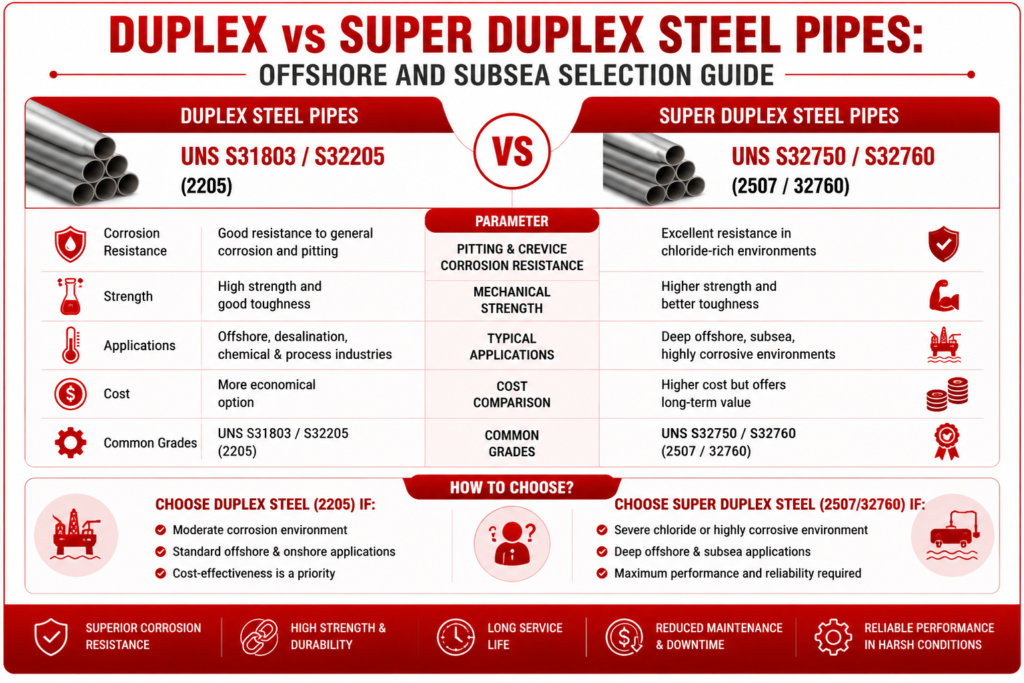
Duplex vs Super Duplex: Key Differences
Property | Duplex Steel | Super Duplex Steel |
Typical Grades | UNS S31803 / S32205 | UNS S32750 / S32760 |
Corrosion Resistance | Excellent | Exceptional |
Chloride Resistance | Very good | Excellent |
Mechanical Strength | High | Very high |
Pitting Resistance | High | Higher |
Seawater Applications | Suitable | Highly suitable |
Cost | Generally lower | Generally higher |
Typical Service | Offshore and process systems | Severe offshore and subsea environments |
The choice should always be based on the actual design conditions and applicable project specification rather than simply selecting the higher grade.
Corrosion Resistance in Seawater
High quantities of chloride ions found in seawater can lead to localized corrosion in stainless steels that are vulnerable. Around flange connections, welds, joints, and places where deposits build up, pitting and crevice corrosion can be especially troublesome.
Super duplex stainless steel offers an extra degree of protection, whereas duplex stainless steel offers robust resistance to chloride conditions.
Super duplex grades usually benefit from nitrogen additions and have greater levels of chromium and molybdenum. These alloying components increase super duplex’s resistance to localized corrosion and make it appropriate for extremely hostile marine situations.
Pitting Resistance and PREN
One useful way to compare stainless steel grades is through the Pitting Resistance Equivalent Number (PREN).
A commonly used approximation is:
PREN = %Cr + 3.3 × %Mo + 16 × %N
Although PREN shouldn’t be regarded as a perfect indicator of actual corrosion performance, higher PREN values often suggest stronger resistance to pitting corrosion.
Super duplex grades like UNS S32750 and S32760 have higher PREN values than typical duplex 2205 grades.
Super Duplex’s greater corrosion resistance can offer a major engineering advantage for subsea systems that are constantly exposed to seawater.
Mechanical Strength
When compared to many traditional austenitic stainless steels, duplex stainless steel has a high yield strength, which is one of its main advantages.
In general, super duplex offers even greater strength.
Depending on design calculations, relevant codes, corrosion allowance, manufacturing tolerances, and project needs, this may enable engineers to take into account thinner walls in specific applications.
Higher strength can be particularly beneficial for:
- High-pressure subsea pipelines
- Offshore process piping
- Injection systems
- Structural piping
- High-load components
However, reducing wall thickness should never be based solely on material yield strength. Complete piping design calculations are required.
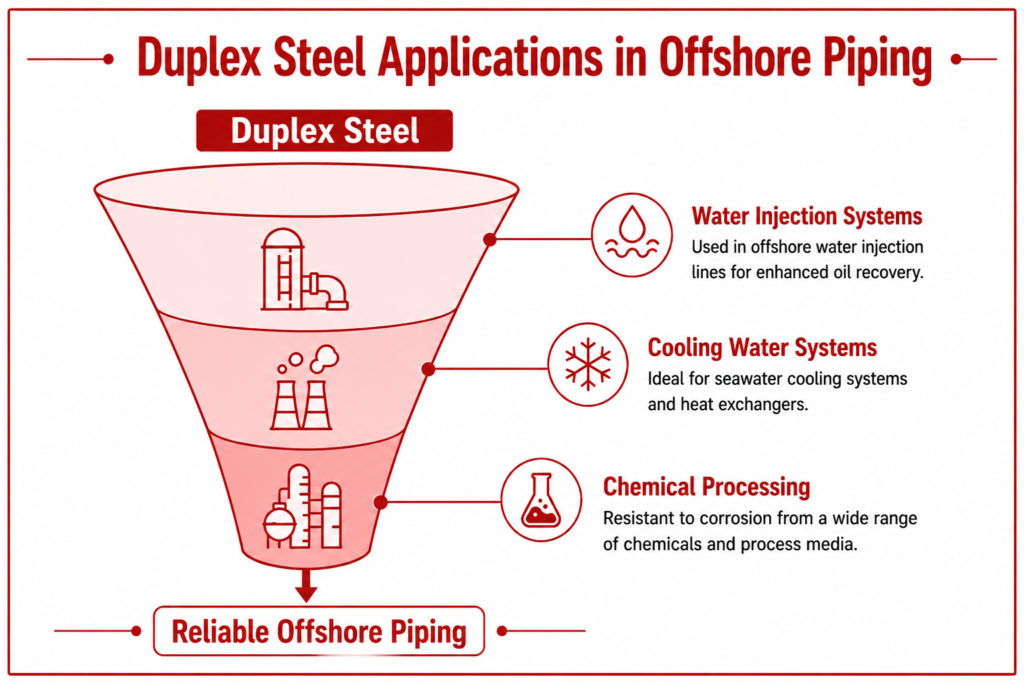
Duplex Steel for Offshore Applications
For offshore applications requiring high strength and good corrosion resistance without the severe corrosion resistance of super duplex, duplex stainless steel is frequently a cost-effective option.
Common applications include:
Offshore Process Piping
Duplex pipes can transport hydrocarbons, process fluids, and utility fluids under demanding conditions.
Water Injection Systems
Water injection systems can expose piping to chlorides and other corrosive contaminants. Duplex provides strong resistance in appropriately designed systems.
Cooling Water Systems
Duplex stainless steel is suitable for many cooling-water and marine utility applications.
Chemical Processing
Its resistance to many corrosive process environments makes duplex suitable for selected chemical and petrochemical services.
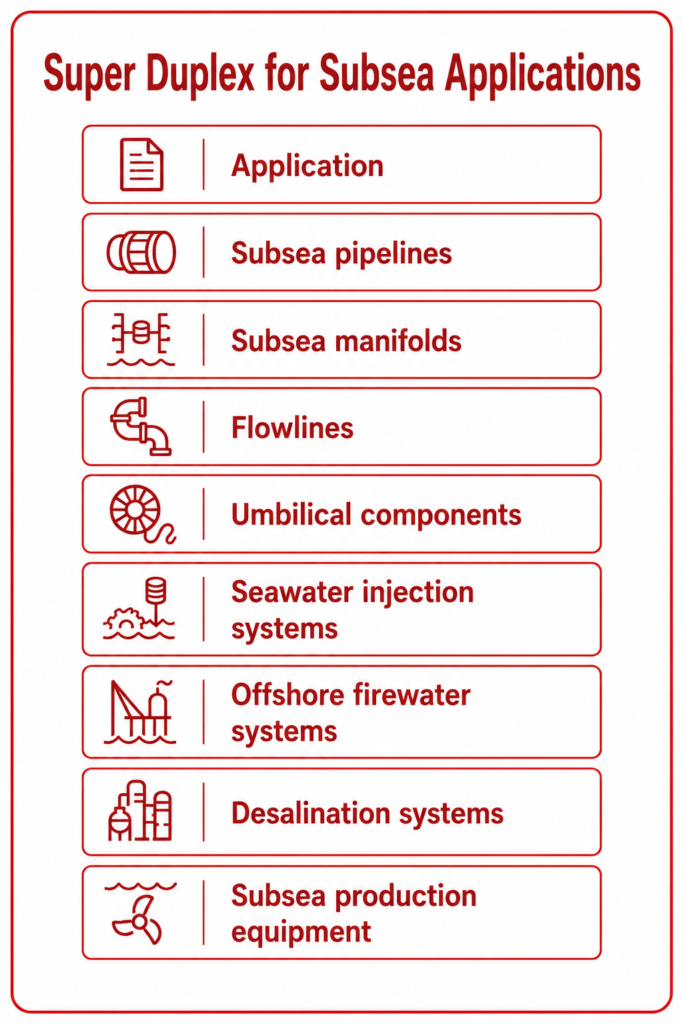
Super Duplex for Subsea Applications
Super duplex is particularly attractive for subsea systems where components remain exposed to seawater for extended periods.
Typical applications include:
- Subsea pipelines
- Subsea manifolds
- Flowlines
- Umbilical components
- Seawater injection systems
- Offshore firewater systems
- Desalination systems
- Subsea production equipment
Its combination of high strength and excellent localized corrosion resistance makes it well suited to severe marine conditions.
Weldability Considerations
Both duplex and super duplex steels require careful welding procedures.
Incorrect welding parameters or excessive heat input can disturb the desired ferrite-austenite balance and negatively affect corrosion resistance and mechanical properties.
Important considerations include:
- Qualified welding procedures
- Controlled heat input
- Appropriate filler metals
- Interpass temperature control
- Proper shielding gas
- Post-weld inspection
- Phase balance verification where required
For critical offshore and subsea projects, welding procedures should follow the applicable project specification and recognized fabrication standards.
Temperature Considerations
Although duplex and super duplex steels perform exceptionally well in a broad temperature range, their suitability must be assessed in relation to the particular operating and design conditions.
Changes in microstructure can impact mechanical and corrosion properties at high temperatures. As a result, engineers should confirm the design specifications and permissible temperature limitations for the chosen grade.
Low-temperature toughness might also be crucial for subsea applications, especially in deepwater settings.
Cost: Duplex vs Super Duplex
Duplex stainless steel is generally more economical than super duplex because super duplex contains higher alloying additions and provides enhanced corrosion performance.
However, material cost should not be the only consideration.
A higher initial material cost can be justified when super duplex provides:
- Longer service life
- Lower corrosion risk
- Reduced maintenance
- Greater reliability
- Better performance in severe seawater environments
The best choice is therefore based on total lifecycle cost, not simply purchase price.
How to Select Between Duplex and Super Duplex
When selecting a pipe material for an offshore or subsea project, consider:
Chloride concentration – Higher chloride exposure may favor super duplex.
Operating temperature – Verify temperature limits for the selected grade.
Pressure requirements – Consider the material’s mechanical strength.
Corrosion risk – Evaluate pitting, crevice corrosion, and stress corrosion cracking.
Seawater exposure – Continuous immersion generally demands greater corrosion resistance.
Welding requirements – Confirm suitable fabrication procedures.
Design life – Consider long-term lifecycle performance.
Project specifications – Follow customer, engineering, and applicable industry requirements.
Budget – Compare initial material cost against long-term maintenance requirements.
Quality and Certification for Duplex Pipes
For critical offshore and subsea projects, buyers should source pipes with complete material documentation and traceability.
Important documents may include:
- Mill Test Certificate (MTC)
- Chemical composition report
- Mechanical test results
- Heat treatment records
- Hydrostatic test certificate
- Ultrasonic testing reports
- Positive Material Identification (PMI)
- Impact test results where specified
- Corrosion testing documentation where required
Heat numbers on the pipes should correspond with the relevant material certificates to maintain complete traceability.
Why Choose a Reliable Duplex Pipe Supplier?
A good procurement process involves more than just choosing the right grade. Strong quality control, material traceability, documentation skills, and experience with global industrial projects should all be exhibited by the supplier.
For demanding applications in the offshore, subsea, oil and gas, maritime, desalination, and petrochemical industries, Metallon Pipings provides duplex and super duplex steel pipes. According to relevant specifications and project needs, materials like UNS S32205, UNS S32750, and UNS S32760 can be delivered.
Conclusion
For offshore and subsea applications, duplex and super duplex stainless steel pipes offer a great mix of strength and corrosion resistance. While super duplex grades like UNS S32750 and UNS S32760 offer an extra degree of protection where seawater exposure, chloride concentration, and localized corrosion concerns are more serious, Duplex 2205 is frequently an affordable option for challenging settings.
Operating temperature, pressure, exposure to seawater, corrosion requirements, design life, welding techniques, and project specifications all influence the best choice. Offshore and subsea operators can create safer, more lasting, and more economical piping systems by carefully weighing these aspects and obtaining certified materials from a reputable provider.
How We Support You
Selecting between duplex and super duplex steel pipes is critical for offshore and subsea projects where chloride exposure, seawater corrosion, pressure, and mechanical loading can affect long-term piping performance. Our team supports EPC contractors, offshore engineers, procurement specialists, and project consultants in selecting the right duplex stainless steel solution for demanding marine and energy applications.
We support you with:
- Guidance in selecting duplex grades such as UNS S31803 and UNS S32205, and super duplex grades such as UNS S32750 and UNS S32760
- Recommendations based on seawater exposure, chloride concentration, operating temperature, pressure, corrosion resistance, and mechanical strength requirements
- Support for offshore platforms, subsea pipelines, flowlines, risers, seawater injection systems, and marine process piping
- Assistance in comparing duplex and super duplex grades based on corrosion resistance, PREN, strength, weldability, and expected service conditions
- Guidance on material selection for offshore oil & gas, desalination, marine engineering, chemical processing, and seawater handling systems
- Assistance with selecting compatible duplex and super duplex fittings, flanges, valves, and other piping components
- Guidance on compliance with ASTM, ASME, API, NACE, ISO, and project-specific offshore and subsea specifications
- Technical support for pipe schedules, wall thickness, welding requirements, heat treatment, corrosion protection, and fabrication considerations
- Documentation support including Mill Test Certificates (MTCs), PMI reports, impact test results, hydrostatic test reports, third-party inspection, and quality certifications
- Fast quotations, export logistics, and bulk supply support for offshore, subsea, marine, and energy projects across the GCC, Africa, and international markets
Whether your project involves subsea pipelines, offshore platforms, seawater injection systems, desalination plants, or marine infrastructure, we provide reliable duplex and super duplex steel pipe solutions tailored to deliver corrosion resistance, strength, durability, and compliance with international project requirements.