Standard grades like 304 and 316 may not always offer enough corrosion protection when stainless steel piping is exposed to acids, chlorides, seawater, and other harsh chemicals. SMO 254 pipe, also referred to as 254 SMO, provides a higher-performance substitute for demanding situations.
High-alloy austenitic stainless steel 254 SMO was created for uses requiring remarkable resistance to stress corrosion cracking, pitting, and crevice corrosion. Compared to traditional stainless steel grades, it has substantially greater corrosion resistance due to its high chromium, molybdenum, and nitrogen content.
The attributes, uses, benefits, and material qualities of SMO 254 pipe are described in this guide, along with the reasons it is frequently chosen for challenging marine, chemical, offshore, and process applications.
What Is SMO 254 Pipe?
The nominal composition of 254 SMO, a high-alloy austenitic stainless steel, is roughly 20% chromium, 18% nickel, and 6% molybdenum in addition to nitrogen and other alloying elements.
The content is frequently linked to UNS S31254.
Because it increases resistance to localized corrosion in settings containing chloride, the high molybdenum level is very significant.
Depending on the relevant material standard and project needs, SMO 254 pipe comes in a variety of shapes and sizes.
Typical applications include:
- Seawater piping
- Offshore platforms
- Desalination plants
- Chemical processing
- Flue gas cleaning systems
- Pulp and paper plants
- Pharmaceutical processing
- Marine equipment
Chemical Composition of SMO 254
The corrosion resistance of 254 SMO comes from its carefully balanced alloying elements.
Key elements include:
- Chromium: Provides general corrosion and oxidation resistance.
- Nickel: Stabilizes the austenitic structure and improves toughness.
- Molybdenum: Significantly improves resistance to pitting and crevice corrosion.
- Nitrogen: Enhances strength and localized corrosion resistance.
- Carbon: Maintained at a low level to support corrosion performance and weldability.
The exact chemical limits should always be checked against the applicable material specification and purchase requirements.
Key Properties of 254 SMO Pipe
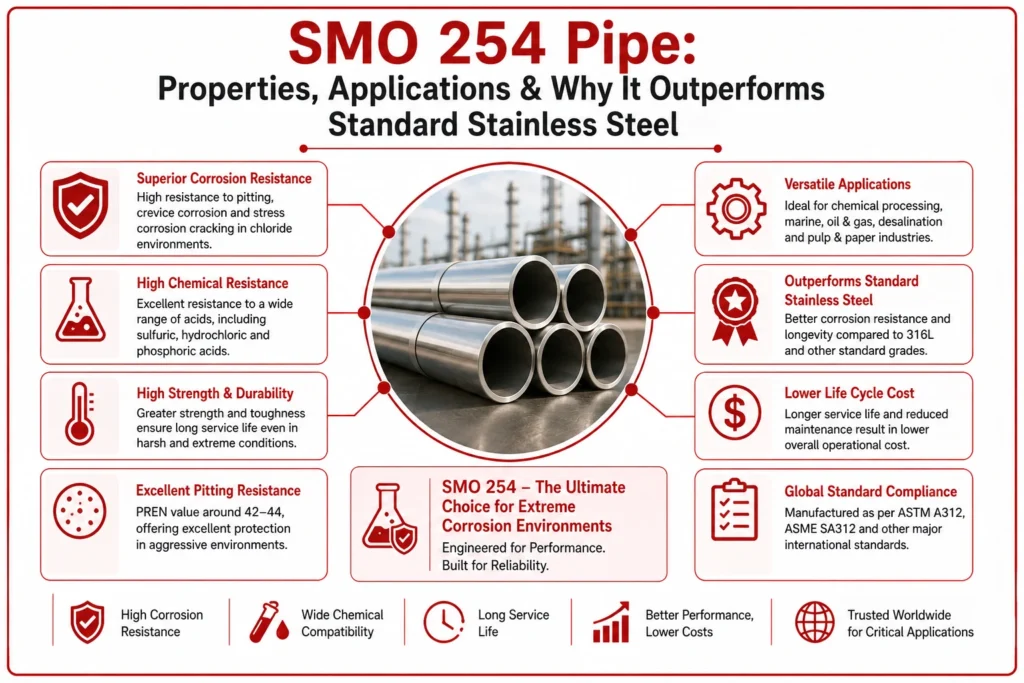
Excellent Pitting Resistance
One of the main issues with stainless steel exposed to seawater and fluids containing chloride is pitting corrosion.
When compared to ordinary stainless steel grades, 254 SMO’s high molybdenum and nitrogen concentration offers exceptional resistance to localized pitting.
Because of this, the material is very appealing for offshore and marine applications.
Superior Crevice Corrosion Resistance
Crevice corrosion can occur in narrow gaps around:
- Flanges
- Gaskets
- Bolted connections
- Pipe supports
- Joints
254 SMO offers strong resistance to this form of localized attack, making it suitable for piping systems where stagnant seawater or chloride-rich fluids may be present.
High Resistance to Chloride Stress Corrosion Cracking
Under specific temperature and ambient circumstances, conventional austenitic stainless steels may be susceptible to stress corrosion cracking caused by chloride.
254 SMO might be taken into consideration for demanding chloride-containing services because it offers noticeably better resistance.
High Mechanical Strength
While retaining good ductility and toughness, 254 SMO delivers greater strength than many traditional austenitic stainless steels.
Because of this combination, it is helpful for pressure-containing pipe systems where corrosion resistance and mechanical performance are crucial.
SMO 254 vs 316L Stainless Steel
One of the most important comparisons for buyers is between 254 SMO and 316L stainless steel.
Property | 316L Stainless Steel | 254 SMO |
Corrosion Resistance | Very good | Exceptional |
Molybdenum Content | ~2–3% | ~6% |
Chloride Resistance | Good | Excellent |
Pitting Resistance | Moderate to good | Very high |
Seawater Service | Limited/select applications | Highly suitable |
Chemical Service | Good | Excellent for many aggressive environments |
Cost | Lower | Higher |
316L remains an excellent general-purpose stainless steel, but 254 SMO provides a higher level of protection in severe chloride and chemical environments.
SMO 254 vs Duplex Stainless Steel
Although they have different metallurgical structures and performance characteristics, 254 SMO and duplex stainless steels can both be utilized in harsh industrial and maritime settings.
Ferritic and austenitic phases are combined in duplex grades, which offer excellent corrosion resistance and high strength.
Austenitic stainless steel with a very high alloy content is called 254 SMO.
The choice between them depends on:
- Operating temperature
- Pressure
- Chloride concentration
- Mechanical strength requirements
- Welding conditions
- Fabrication requirements
- Project specifications
- Lifecycle cost
For applications where extremely high localized corrosion resistance is the primary concern, 254 SMO can be an attractive option.
Applications of SMO 254 Pipes
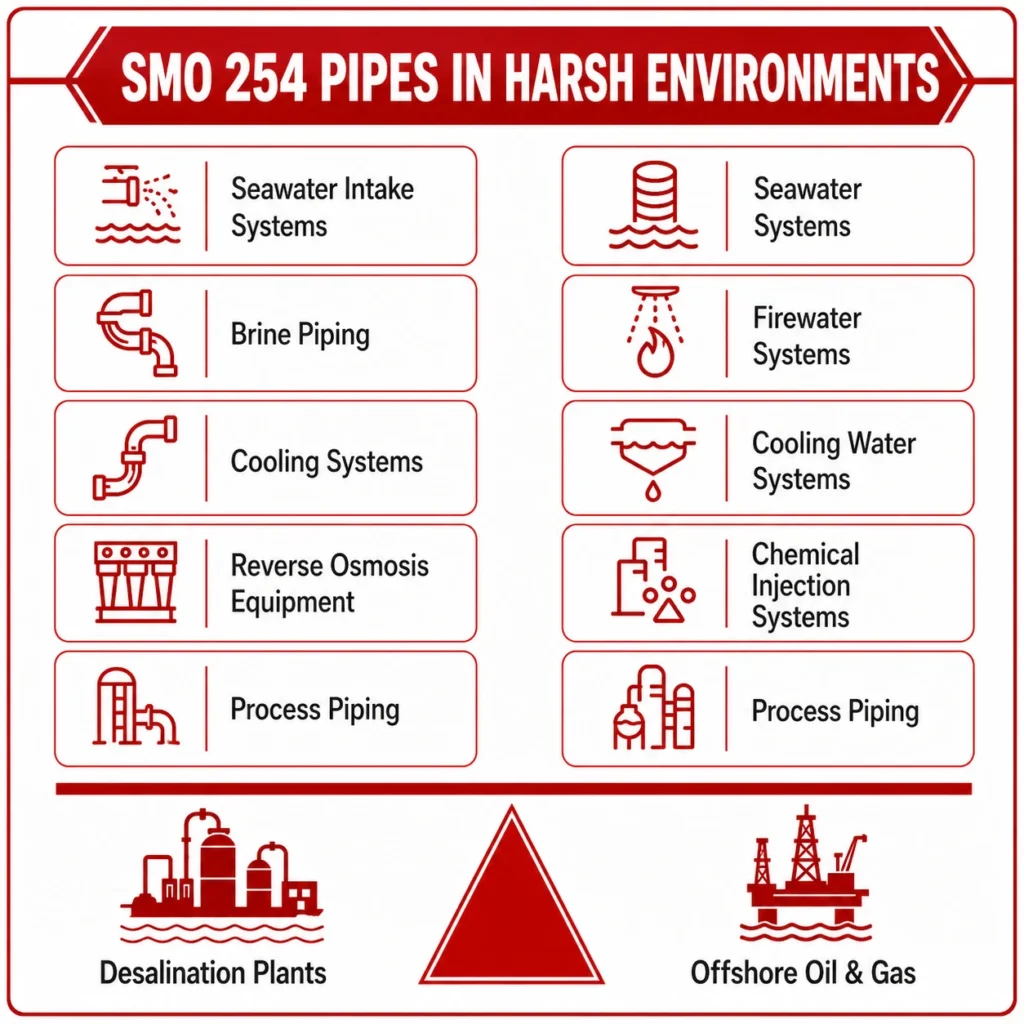
Desalination Plants
Desalination systems expose piping to highly saline water and chloride-rich environments.
254 SMO can be used in selected:
- Seawater intake systems
- Brine piping
- Cooling systems
- Reverse osmosis equipment
- Process piping
Offshore Oil & Gas
Offshore facilities experience continuous exposure to seawater and marine environments.
254 SMO pipes can be considered for:
- Seawater systems
- Firewater systems
- Cooling water systems
- Chemical injection systems
- Process piping
Chemical Processing
Chemical plants often handle acids, chlorides, and other aggressive process fluids.
254 SMO’s high alloy content makes it suitable for selected chemical services where standard stainless steels may have insufficient corrosion resistance.
Marine Applications
254 SMO is used in marine environments where corrosion resistance is critical.
Applications can include:
- Shipboard piping
- Seawater systems
- Marine heat exchangers
- Cooling systems
- Offshore equipment
Pulp and Paper Industry
The pulp and paper industry can involve aggressive chemical environments. High-alloy stainless steels such as 254 SMO can provide enhanced corrosion resistance in selected process systems.
Advantages of SMO 254 Pipe
The major advantages include:
- Excellent chloride resistance
- High resistance to pitting
- Strong crevice corrosion resistance
- Improved stress corrosion cracking resistance
- High mechanical strength
- Excellent toughness
- Long service life
- Suitable for severe marine environments
- Reduced risk of corrosion-related maintenance
These properties can make 254 SMO an economical solution over the full lifecycle of a demanding piping system, despite its higher initial material cost.
Welding and Fabrication Considerations
Although 254 SMO can be fabricated and welded, welding procedures require careful control.
Important considerations include:
- Appropriate welding procedures
- Qualified welding personnel
- Controlled heat input
- Correct filler material
- Proper shielding
- Surface cleaning
- Post-weld inspection
Poor fabrication practices can reduce corrosion resistance or compromise the properties of the finished component.
For critical applications, welding should follow the applicable project specification and qualified welding procedure.
What Buyers Should Check When Purchasing SMO 254 Pipe
When sourcing 254 SMO pipes, buyers should verify:
- UNS designation
- Applicable ASTM/ASME specification
- Pipe manufacturing method
- Outside diameter
- Wall thickness
- Pipe schedule
- Length
- Heat number
- Chemical composition
- Mechanical properties
- Hydrostatic testing
- Non-destructive testing where specified
- Material Test Certificate (MTC)
- PMI requirements
- Surface condition
Complete traceability is particularly important for critical offshore, chemical, and desalination projects.
Why Choose a Reliable SMO 254 Pipe Supplier?
Careful manufacture, testing, identification, and documentation are necessary for high-alloy materials. Therefore, buyers should collaborate with suppliers who are aware of the technical specifications related to specialized stainless steels.
For demanding applications in the oil and gas, offshore, marine, chemical processing, desalination, and industrial sectors, Metallon Pipings provides high-alloy stainless steel pipes and pipeline components.
Depending on the needs of the client and the project, products might be supplied with the proper material documentation and traceability.
Conclusion
SMO 254 pipe (UNS S31254) provides significantly higher corrosion resistance than conventional stainless steel grades such as 304 and 316L. Its high chromium, molybdenum, nickel, and nitrogen content provides excellent resistance to pitting, crevice corrosion, and chloride-related corrosion mechanisms.
This makes 254 SMO an attractive material for offshore oil & gas, seawater systems, desalination, chemical processing, marine applications, and other aggressive environments.
Although the initial cost is higher than standard stainless steel, its superior corrosion resistance and potential for extended service life can make it a cost-effective choice when evaluated on a lifecycle basis. For demanding applications, selecting the correct grade, specification, testing, and documentation is essential to achieving reliable long-term piping performance.
How We Support You
Selecting the right high-performance stainless steel pipe is essential for applications exposed to chlorides, seawater, acids, and other highly corrosive environments. Our team supports EPC contractors, process engineers, procurement specialists, and project consultants in selecting SMO 254 pipe solutions where conventional stainless steel may not provide sufficient corrosion resistance.
We support you with:
- Guidance in selecting SMO 254 (UNS S31254) seamless and welded pipes for demanding corrosive service applications
- Recommendations based on chloride exposure, pitting and crevice corrosion resistance, operating temperature, pressure, and chemical service conditions
- Support for chemical processing plants, desalination facilities, seawater systems, marine applications, pharmaceutical plants, pulp and paper industries, and offshore projects
- Assistance in evaluating SMO 254 against conventional stainless steel grades such as 304 and 316L for challenging corrosion environments
- Guidance on material selection where high resistance to pitting, crevice corrosion, and stress corrosion cracking is required
- Support for selecting compatible SMO 254 fittings, flanges, valves, fasteners, and other piping components
- Guidance on compliance with ASTM, ASME, EN, NACE, and project-specific international material and piping specifications
- Technical assistance with pipe dimensions, schedules, wall thickness, welding considerations, fabrication requirements, and service compatibility
- Documentation support including Mill Test Certificates (MTCs), PMI reports, hydrostatic test certificates, third-party inspection reports, and quality certifications
- Assistance with bulk procurement, custom requirements, material traceability, and project-specific quality documentation
- Fast quotations, export packaging, logistics coordination, and international supply support for GCC, African, European, and global industrial projects
Whether your project involves desalination, seawater handling, chemical processing, offshore infrastructure, or other highly corrosive environments, we provide reliable SMO 254 pipe solutions designed to deliver superior corrosion resistance, durability, and long-term service performance.