Materials that can sustain strength and dimensional stability under harsh operating conditions are needed for high-temperature pipe systems in power plants, refineries, petrochemical facilities, and process industries. Because they offer better high-temperature strength and oxidation resistance than traditional carbon steel, alloy steel pipes made in accordance with ASTM A335 are frequently utilized for these purposes.
P5, P9, P11, P22, and P91 are some of the most often given grades. Because each grade has a unique alloy composition and performance profile, choosing the right material is a crucial technical choice.
The main ASTM A335 alloy steel grades, P5 through P91, are described in this reference along with their characteristics, uses, and sourcing considerations for consumers.
What Is ASTM A335?
ASTM A335 is the specification for seamless ferritic alloy-steel pipe intended for high-temperature service.
These pipes are designed for applications where elevated temperatures and pressures place significant demands on the piping material.
ASTM A335 grades contain alloying elements such as:
- Chromium
- Molybdenum
- Manganese
- Silicon
- Carbon
The combination of chromium and molybdenum is particularly important for improving high-temperature strength, oxidation resistance, and creep resistance.
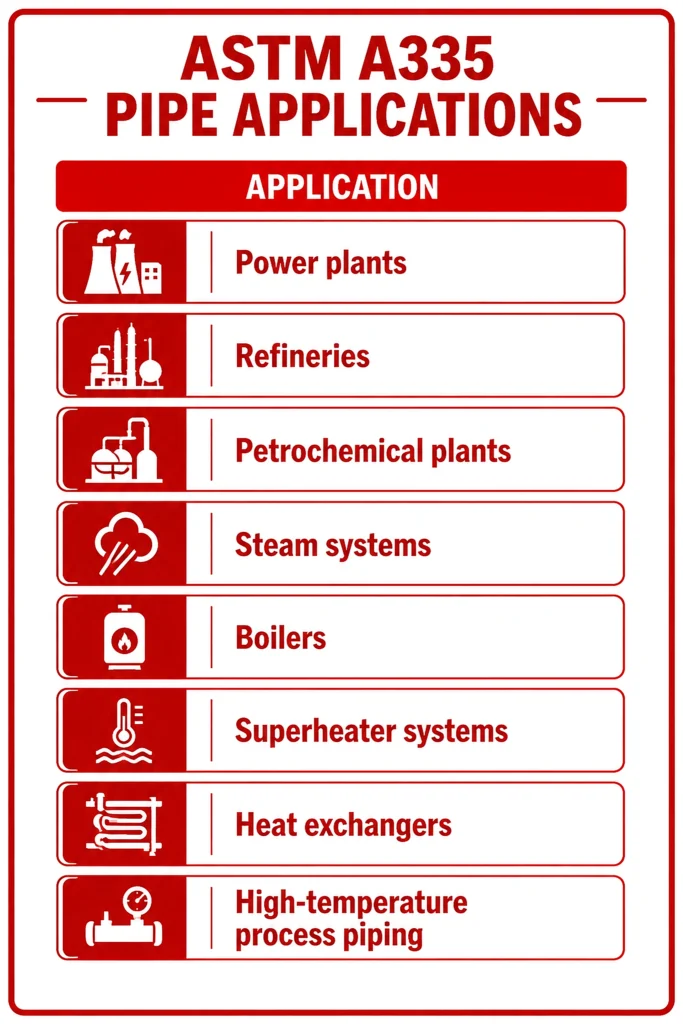
ASTM A335 pipes are commonly used in:
- Power plants
- Refineries
- Petrochemical plants
- Steam systems
- Boilers
- Superheater systems
- Heat exchangers
- High-temperature process piping
Why Alloy Steel Is Used for High-Temperature Piping
Carbon steel can lose strength as operating temperature increases. Alloy steel is designed to provide better performance under elevated-temperature conditions.
Key advantages include:
- Higher high-temperature strength
- Improved creep resistance
- Better oxidation resistance
- Good pressure resistance
- Improved durability
- Long-term performance in demanding service
The appropriate grade depends on the actual design temperature, pressure, process medium, fabrication requirements, and applicable engineering code.
ASTM A335 P5
P5 is a chromium-molybdenum alloy steel grade commonly used for high-temperature applications.
The addition of chromium improves oxidation resistance, while molybdenum contributes to high-temperature strength.
Typical Applications
P5 pipes can be used in:
- Refineries
- Petrochemical plants
- High-temperature process piping
- Heat exchangers
- Steam systems
P5 is generally selected when enhanced temperature performance is required compared with standard carbon steel.
ASTM A335 P9
P9 contains a higher chromium level than grades such as P5, providing improved resistance to oxidation and high-temperature environments.
Typical Applications
P9 pipes are used in:
- Refineries
- Power generation
- High-temperature steam systems
- Heat exchangers
- Petrochemical processing
The higher chromium content makes P9 particularly useful where oxidation resistance is an important consideration.
ASTM A335 P11
P11 is one of the most commonly used chromium-molybdenum alloy steel grades in industrial piping.
It provides a useful balance of:
- High-temperature strength
- Creep resistance
- Weldability
- Cost effectiveness
- Long-term reliability
Common Applications
P11 pipes are frequently specified for:
- Boilers
- Superheaters
- Steam pipelines
- Refineries
- Petrochemical plants
- Power generation systems
Because of its combination of performance and availability, P11 is a popular choice for elevated-temperature piping.
ASTM A335 P22
P22 is another widely used chromium-molybdenum steel grade for high-temperature applications.
It generally provides higher chromium and molybdenum content than P11, making it suitable for more demanding temperature and pressure conditions.
Applications
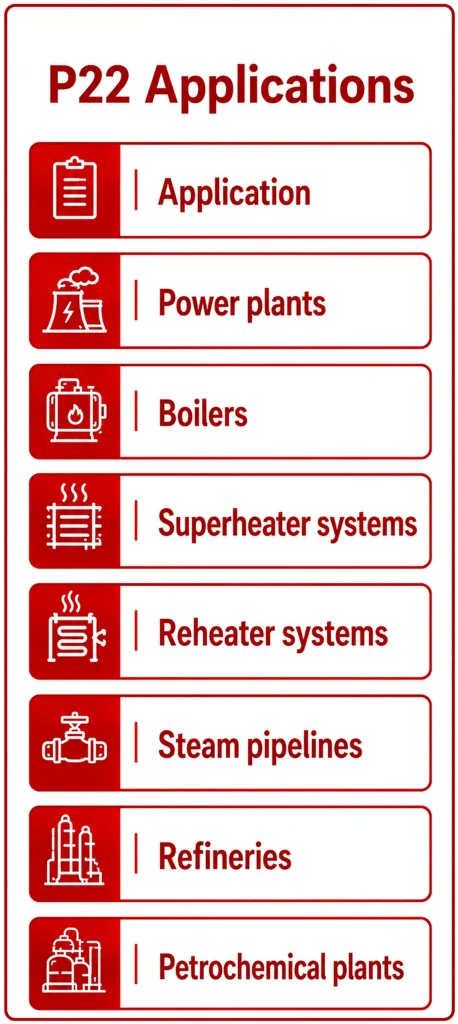
P22 is commonly used in:
- Power plants
- Boilers
- Superheater systems
- Reheater systems
- Steam pipelines
- Refineries
- Petrochemical plants
P22 is particularly important in power-generation applications where high-temperature creep resistance is required.
ASTM A335 P91
For demanding high-temperature applications, P91 is a high-performance, creep-resistant alloy steel.
P91 is a 9% chromium modified alloy steel with modifications that offer exceptional high-temperature strength and creep resistance, in contrast to traditional Cr-Mo grades.
Subject to engineering calculations and relevant norms, its high strength can enable designers to achieve the necessary pressure performance with optimal wall thickness.
Common Applications
P91 is widely used in:
- Ultra-supercritical power plants
- Superheater systems
- Reheater systems
- High-pressure steam piping
- Boilers
- Power generation facilities
P91 is generally selected for more demanding high-temperature service than conventional P11 and P22 systems.
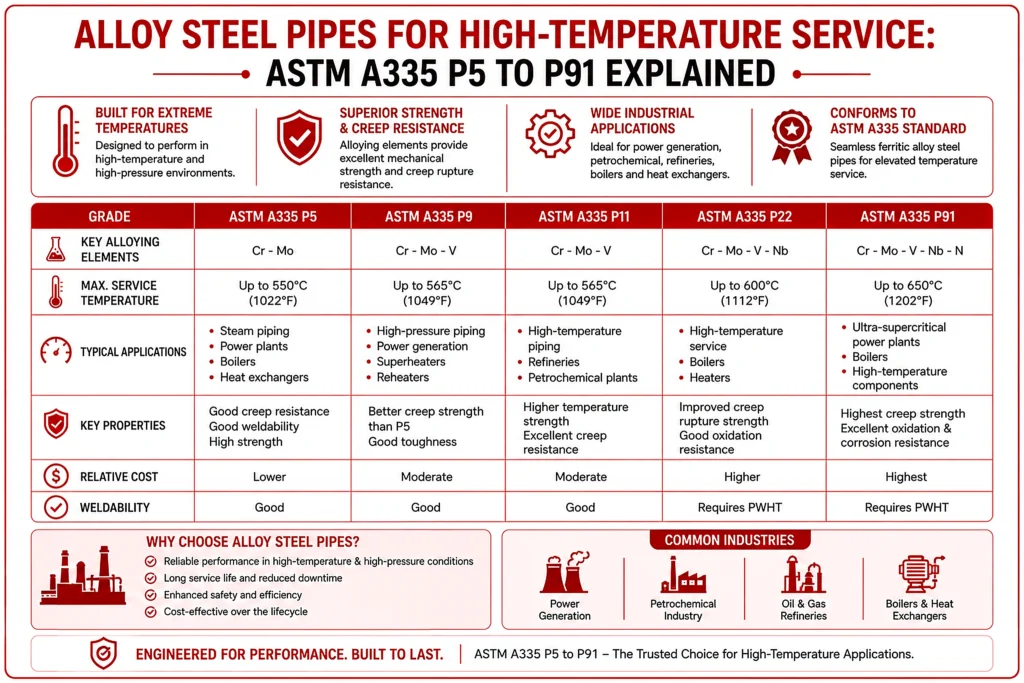
P5 vs P9 vs P11 vs P22 vs P91
Grade | General Characteristics | Typical Applications |
P5 | Cr-Mo alloy steel | Refineries, process piping |
P9 | Higher chromium Cr-Mo steel | High-temperature & oxidation-resistant service |
P11 | Versatile Cr-Mo grade | Boilers, steam & petrochemical systems |
P22 | Higher-performance Cr-Mo grade | Power plants, superheaters, reheaters |
P91 | High-strength 9% Cr alloy | Advanced power-generation systems |
The “higher” grade is not automatically the correct choice. Material selection should be based on design conditions and project specifications.
P11 vs P22
Due to their widespread use in power and petrochemical facilities, P11 and P22 are often compared.
P22 is typically utilized for more demanding high-temperature operation and offers a higher alloy composition.
P11, however, can offer a cost-effective alternative when its characteristics satisfy the design specifications.
The selection depends on:
- Design temperature
- Operating pressure
- Creep requirements
- Wall thickness
- Welding requirements
- Applicable design code
- Project specifications
P22 vs P91
P91 is a major advancement in high-temperature performance.
P91 is frequently utilized in contemporary high-efficiency power plants and offers significantly greater creep strength at high temperatures than P22.
But P91 also needs more care when it comes to heat treatment and manufacturing.
Careful control is required for its preheating, post-weld heat treatment, welding processes, and inspection requirements.
Welding Considerations for Alloy Steel Pipes
Welding is a critical consideration when using ASTM A335 alloy steel pipes.
Improper welding can negatively affect:
- Creep strength
- Toughness
- Hardness
- Microstructure
- Long-term service performance
Depending on the grade, fabrication may require:
- Preheating
- Controlled interpass temperature
- Qualified welding procedures
- Appropriate filler materials
- Post-weld heat treatment
- Hardness testing
- Non-destructive examination
P91 requires particularly strict welding and heat-treatment control because its performance depends heavily on maintaining the correct metallurgical structure.
Heat Treatment Requirements
Heat treatment is an important part of ASTM A335 pipe manufacturing.
It helps achieve the required:
- Mechanical properties
- Microstructure
- Hardness
- Toughness
- High-temperature performance
Buyers should review the applicable ASTM specification and project requirements to confirm the required heat-treatment condition.
For critical applications, heat-treatment records may also form part of the material documentation package.
How to Select the Right ASTM A335 Grade
When choosing between P5, P9, P11, P22, and P91, consider:
Operating Temperature
Determine the maximum design and operating temperature.
Design Pressure
Higher-pressure applications may require materials with greater high-temperature strength.
Creep Resistance
For long-term elevated-temperature service, creep strength is a critical consideration.
Corrosion and Oxidation
Consider the process environment and potential oxidation mechanisms.
Welding Requirements
Evaluate fabrication procedures, heat treatment, and qualified welding processes.
Project Standards
Always follow the applicable ASME design code, ASTM specification, EPC requirements, and customer specifications.
What Buyers Should Check Before Ordering
Before purchasing ASTM A335 pipes, verify:
- Grade: P5, P9, P11, P22, or P91
- Nominal pipe size
- Outside diameter
- Wall thickness
- Schedule
- Pipe length
- Seamless manufacturing requirement
- Heat-treatment condition
- Chemical composition
- Mechanical properties
- Hydrostatic testing
- NDT requirements
- Heat number traceability
- Material Test Certificate (MTC)
For P91, buyers should pay particular attention to heat treatment, hardness, welding procedures, and inspection documentation.
Why Choose a Reliable Alloy Steel Pipe Supplier?
Strict manufacturing controls and total traceability are necessary for high-temperature alloy steel pipework. A trustworthy provider should be aware of the distinctions between each ASTM A335 grade and offer supporting paperwork for project approval and inspection.
Metallon Pipings provides alloy steel pipes and associated piping products for high-temperature industrial, petrochemical, oil and gas, power generation, and refineries.
Along with the necessary material documentation and inspection standards, the organization can assist with requirements pertaining to grades including ASTM A335 P5, P9, P11, P22, and P91.
Conclusion
For high-temperature and high-pressure piping systems, ASTM A335 alloy steel pipes offer dependable performance. While P11 and P22 are frequently utilized in boilers, steam systems, refineries, and power plants, P5 and P9 are helpful Cr-Mo grades for high-temperature applications. P91 is frequently chosen for sophisticated high-temperature power-generation applications because it offers noticeably greater creep strength.
Temperature, pressure, creep requirements, corrosion conditions, welding techniques, heat treatment, and project parameters must all be carefully considered when selecting the appropriate grade.
To guarantee that the material satisfies the necessary ASTM and project standards, buyers should obtain pipes for critical high-temperature systems with comprehensive MTCs, heat traceability, testing records, and quality documentation.
How We Support You
Selecting the right alloy steel pipe is critical for high-temperature and high-pressure applications where strength, creep resistance, weldability, and long-term reliability are essential. Our team supports EPC contractors, power plant engineers, procurement specialists, and project consultants in selecting suitable ASTM A335 alloy steel pipe grades for demanding industrial and energy projects.
We support you with:
- Guidance in selecting ASTM A335 grades such as P5, P9, P11, P22, P91, and other alloy steel grades based on service conditions
- Recommendations based on operating temperature, steam pressure, creep strength, corrosion resistance, weldability, and expected service life
- Support for boiler piping, superheaters, reheaters, steam pipelines, heat exchangers, refinery process lines, and high-temperature process piping
- Assistance in selecting seamless alloy steel pipes for critical power generation, petrochemical, refinery, and industrial applications
- Guidance on the differences between P5, P9, P11, P22, and P91 to help buyers match the grade with specific temperature and pressure requirements
- Support for compatible alloy steel fittings, flanges, valves, and other piping components used in high-temperature systems
- Guidance on compliance with ASTM, ASME, API, EN, NACE, and project-specific EPC specifications
- Technical assistance with pipe schedules, wall thickness, heat treatment, welding procedures, preheating, post-weld heat treatment, and fabrication requirements
- Documentation support including Mill Test Certificates (MTCs), heat treatment records, hydrostatic test reports, NDT reports, third-party inspection certificates, and quality certifications
- Assistance with material traceability, bulk procurement, custom dimensions, inspection requirements, and project-specific documentation
- Fast quotations, export packaging, logistics coordination, and reliable supply support for GCC, African, European, and international projects
Whether your requirement involves thermal power plants, combined-cycle facilities, refineries, petrochemical plants, or high-temperature industrial process systems, we provide dependable ASTM A335 alloy steel pipe solutions designed to deliver strength, durability, safety, and compliance with international project requirements.