Boiler tubes are essential parts of steam generators, thermal power plants, heat recovery systems, and other high-temperature energy facilities. Material selection is crucial for the safe and dependable operation of these tubes because they are subjected to demanding combinations of high temperature, pressure, thermal cycling, and mechanical stress.
ASME SA213 T11, T22, and T91 are some of the materials that are frequently mentioned. These ferritic alloy-steel grades offer varying degrees of oxidation resistance, creep resistance, and high-temperature strength. The boiler design, operational temperature, pressure, fabrication specifications, and relevant project codes all influence which option is best.
The differences between SA213 T11, T22, and T91 boiler tubes are explained in this tutorial, along with how procurement teams and engineers can choose materials for thermal and nuclear power applications.
What Is ASME SA213?
ASME SA213 covers seamless ferritic and austenitic alloy-steel boiler, superheater, and heat-exchanger tubes.
The tubes are designed for high-temperature and high-pressure applications and are commonly used in:
- Boilers
- Superheaters
- Reheaters
- Heat exchangers
- Steam generators
- Power-generation equipment
SA213 and ASTM A213 are closely connected, and pressure equipment and power plant applications frequently refer to ASME specifications.
The mechanical performance and chemical composition of the tube are determined by the material grade.
Why Material Selection Matters in Power Plants
Boiler tubes are exposed to severe service conditions. Incorrect material selection can contribute to:
- Creep deformation
- Oxidation
- Thermal fatigue
- Stress-related cracking
- Tube wall thinning
- Premature failure
- Unplanned shutdowns
As plant operating temperatures and pressures increase, conventional carbon steel becomes less suitable. Chromium-molybdenum and advanced creep-resistant alloys offer improved performance.
SA213 T11 Boiler Tubes
SA213 T11 is a chromium-molybdenum alloy-steel grade widely used in conventional and industrial boiler applications.
It provides a useful combination of:
- High-temperature strength
- Creep resistance
- Oxidation resistance
- Weldability
- Cost effectiveness
T11 contains approximately 1.25% chromium and 0.5% molybdenum, with the exact composition controlled by the applicable specification.
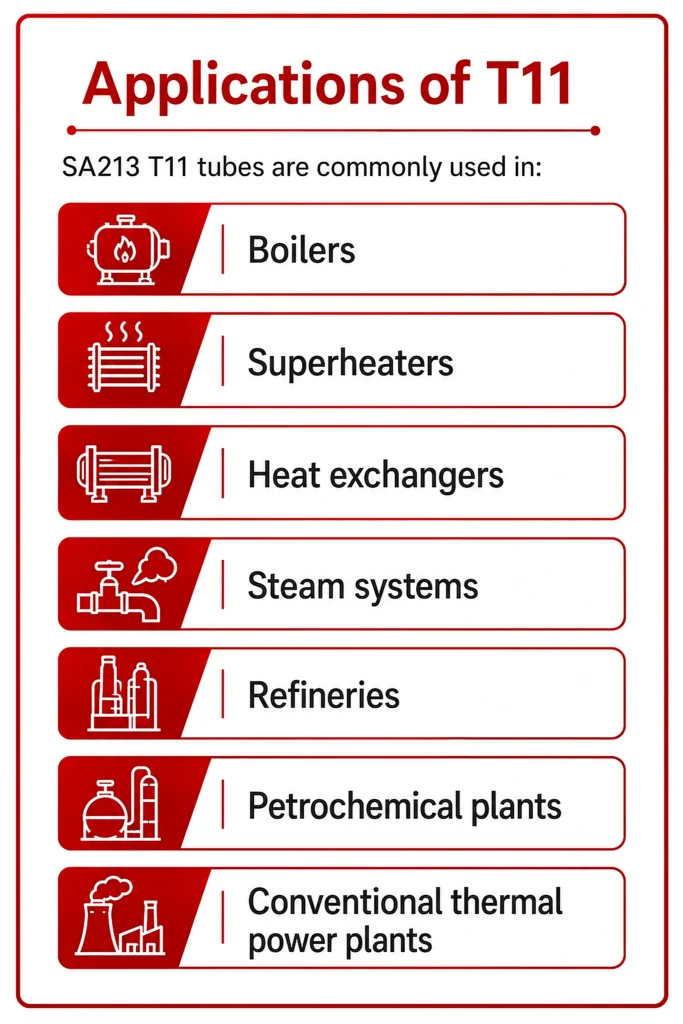
Applications of T11
SA213 T11 tubes are commonly used in:
- Boilers
- Superheaters
- Heat exchangers
- Steam systems
- Refineries
- Petrochemical plants
- Conventional thermal power plants
T11 can be an economical choice where the operating conditions remain within its applicable temperature and pressure limits.
SA213 T22 Boiler Tubes
SA213 T22 is a higher-alloy chromium-molybdenum steel compared with T11.
It contains approximately 2.25% chromium and 1% molybdenum, providing improved high-temperature strength and oxidation resistance.
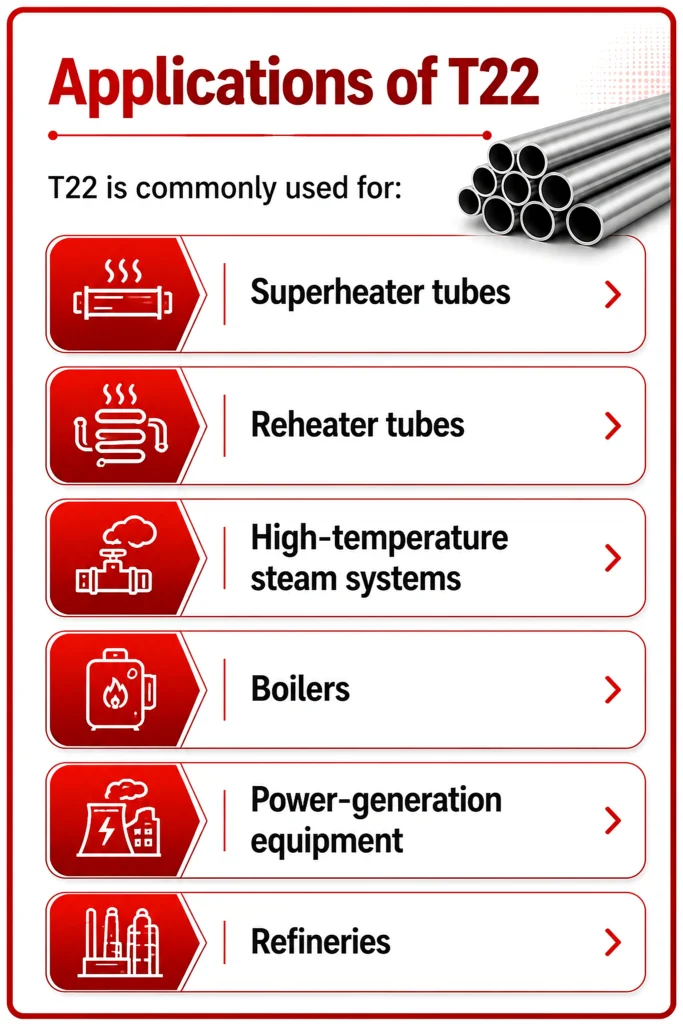
Applications of T22
T22 is commonly used for:
- Superheater tubes
- Reheater tubes
- High-temperature steam systems
- Boilers
- Power-generation equipment
- Refineries
Compared with T11, T22 is generally selected when higher temperature capability and improved long-term high-temperature performance are required.
SA213 T91 Boiler Tubes
A modified 9% chromium alloy steel called SA213 T91 was created for demanding high-temperature applications.
It is frequently linked to contemporary high-efficiency power plants and has significantly greater creep strength than traditional T11 and T22 grades.
Along with molybdenum, vanadium, niobium, nitrogen, and other regulated alloying elements, T91 has about 9% chromium.
High-temperature strength and a finer microstructure are the results of these additions.
Applications of T91
T91 is commonly used in:
- Superheaters
- Reheaters
- High-temperature boiler sections
- Main steam systems
- Advanced thermal power plants
- High-efficiency fossil-fuel power plants
Its higher creep strength makes it particularly valuable in applications where operating temperatures and pressures are significantly elevated.
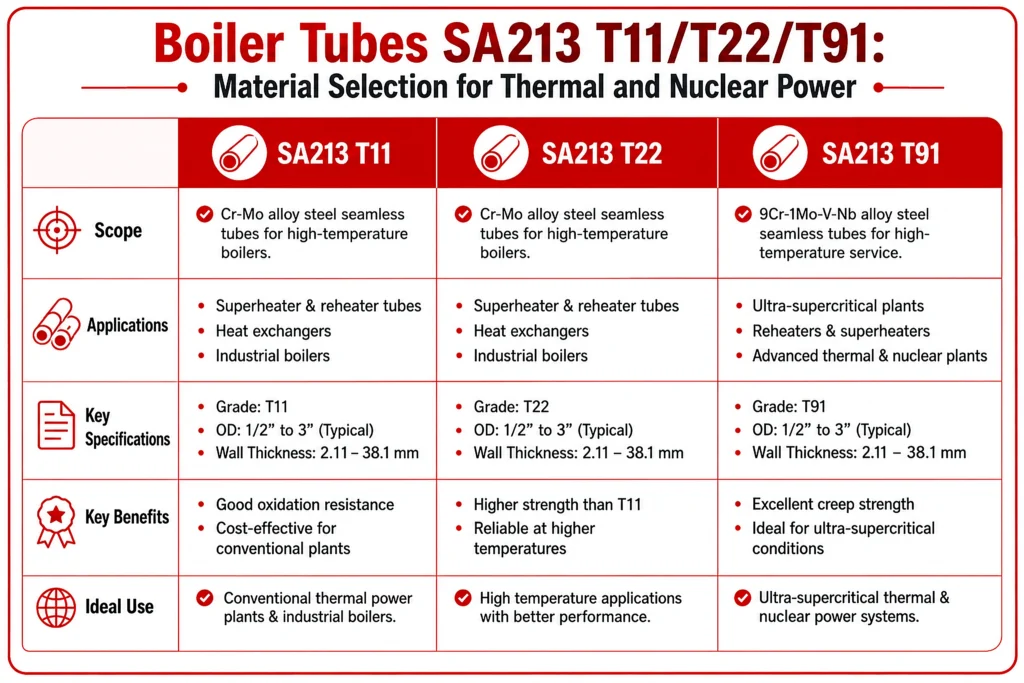
T11 vs T22 vs T91
Property | SA213 T11 | SA213 T22 | SA213 T91 |
Alloy Type | Cr-Mo | Higher Cr-Mo | 9% Cr modified alloy |
Chromium | ~1.25% | ~2.25% | ~9% |
Molybdenum | ~0.5% | ~1% | ~1% |
High-Temperature Strength | Good | Better | Excellent |
Creep Resistance | Good | Very Good | Excellent |
Oxidation Resistance | Good | Better | Excellent |
Fabrication Complexity | Moderate | Moderate | Higher |
Typical Use | Boilers & superheaters | Superheaters & reheaters | Advanced high-temperature service |
The exact chemical and mechanical requirements should always be verified against the applicable SA213 specification.
T11 vs T22: Which Is Better?
T22 is more than just a T11 substitute. The design conditions of the plant determine the proper grade.
When cost effectiveness is crucial and modest high-temperature performance is enough, T11 may be appropriate.
When increased chromium and molybdenum content is required for better elevated-temperature performance, T22 is typically chosen.
Engineers should consider:
- Design temperature
- Steam pressure
- Tube dimensions
- Creep requirements
- Oxidation environment
- Welding procedures
- Project specifications
T22 vs T91: Why Choose T91?
T91 provides significantly greater creep strength at elevated temperatures than conventional Cr-Mo grades.
This makes it attractive for modern power plants designed for higher efficiency and higher steam temperatures.
However, T91 requires more careful fabrication and quality control.
Important considerations include:
- Preheating
- Controlled welding heat input
- Appropriate filler materials
- Post-weld heat treatment
- Hardness control
- Microstructure control
- NDT requirements
Improper welding or heat treatment can significantly affect T91’s service performance.
Boiler Tube Applications in Thermal Power Plants
Thermal power plants contain multiple sections where different materials may be required.
Economizer
Economizers recover heat from flue gas and preheat boiler feedwater. Material selection depends on temperature, corrosion conditions, and tube design.
Superheater
Superheater tubes operate at high temperatures because they carry steam above its saturation temperature. T11, T22, and T91 may be considered depending on the operating conditions.
Reheater
Reheater tubes are exposed to high-temperature steam after partial expansion through the turbine. Higher-alloy materials may be required for severe service.
Heat Recovery Systems
High-temperature alloy tubes can also be used in heat recovery steam generators and other heat-recovery equipment.
Considerations for Nuclear Power Applications
Particularly strict material selection, quality control, fabrication controls, inspection, and traceability are needed for nuclear power systems.
Ferritic alloy steels like T11, T22, and T91 have significant high-temperature industrial uses, but their suitability for a particular nuclear component cannot be inferred from the material grade alone.
Nuclear projects may impose additional requirements related to:
- Applicable nuclear codes
- Material qualification
- Traceability
- Welding procedures
- Heat treatment
- Non-destructive examination
- Toughness
- Irradiation effects where applicable
- Quality assurance programs
Therefore, the material specification and nuclear component classification must be reviewed before selecting a boiler or steam-generator tube material.
Welding and Heat Treatment
Proper fabrication is essential for all three grades, particularly T91.
Key controls can include:
- Qualified welding procedures
- Preheating
- Interpass temperature control
- Appropriate consumables
- Post-weld heat treatment
- Hardness testing
- Non-destructive examination
For T91, welding and heat treatment are especially important because the material’s high-temperature properties depend on its controlled microstructure.
What Buyers Should Check Before Ordering SA213 Tubes
Before purchasing boiler tubes, buyers should verify:
- SA213 grade
- Tube outside diameter
- Wall thickness
- Length
- Seamless manufacturing requirement
- Heat-treatment condition
- Chemical composition
- Tensile strength
- Yield strength
- Elongation
- Hardness requirements
- Hydrostatic or applicable NDT requirements
- Heat number traceability
- Material Test Certificate
- Third-party inspection requirements
For critical power projects, procurement specifications may require additional testing and documentation beyond the base material standard.
Why Choose a Reliable Boiler Tube Supplier?
Complete traceability and constant material quality are necessary for power plant tubing. A trustworthy provider should be aware of the distinctions between T11, T22, and T91 and supply the paperwork needed for project approval and inspection.
Alloy steel boiler and heat-exchanger tubes for high-temperature industrial, petrochemical, refinery, and power generating applications are supplied by Metallon Pipings. Materials like SA213 T11, T22, and T91 can be provided in accordance with relevant specifications and client demands.
Conclusion
Important alloy-steel grades for high-temperature boiler, superheater, reheater, and heat-exchanger applications are ASME SA213 T11, T22, and T91.
T11 provides an affordable blend of manufacturing qualities and high-temperature performance. For more demanding services, T22 offers enhanced chromium-molybdenum performance. T91 is especially well-suited for advanced high-temperature thermal power applications and has noticeably increased creep strength.
The relevant nuclear codes, component categorization, qualification, quality assurance, and traceability standards must all be taken into account when choosing materials for nuclear projects.
The best boiler tube should ultimately be chosen based on factors other than grade name, such as design temperature, pressure, creep requirements, oxidation environment, fabrication techniques, applicable codes, and project parameters. Boiler dependability, operating life, and overall plant performance can all be greatly enhanced by careful material selection and quality management.
How We Support You
Selecting the correct boiler tube material is essential for maintaining heat transfer efficiency, high-temperature strength, pressure resistance, and long-term reliability in thermal and power generation systems. Our team supports EPC contractors, power plant engineers, procurement specialists, boiler manufacturers, and project consultants in selecting suitable ASME SA213 T11, T22, and T91 boiler tubes for demanding power applications.
We support you with:
- Guidance in selecting SA213 T11, T22, and T91 alloy steel boiler tubes based on operating temperature, steam pressure, heat transfer requirements, and service conditions
- Recommendations based on creep strength, oxidation resistance, thermal stability, weldability, and long-term high-temperature performance
- Support for boilers, superheaters, reheaters, heat exchangers, water-wall systems, and other high-temperature power plant components
- Assistance in comparing T11, T22, and T91 grades to determine the most suitable material for specific temperature and pressure conditions
- Guidance for thermal power plants, combined-cycle facilities, waste-to-energy plants, and applicable high-temperature industrial systems
- Technical support for seamless boiler tubes, tube dimensions, outside diameter, wall thickness, schedules, and project-specific requirements
- Assistance with compatible fittings, headers, tubesheets, and related boiler and heat exchanger components where required
- Guidance on compliance with ASME SA213, ASTM, EN, NACE, and project-specific EPC and power plant specifications
- Support for heat treatment, welding procedures, preheating, post-weld heat treatment (PWHT), and fabrication considerations for alloy steel boiler tubes
- Documentation support including Mill Test Certificates (MTCs), heat treatment records, hydrostatic test reports, NDT reports, PMI reports where applicable, third-party inspection certificates, and quality certifications
- Assistance with material traceability, bulk procurement, inspection requirements, and project-specific quality documentation
- Fast quotations, export packaging, logistics coordination, and reliable supply support for power generation projects across the GCC, Africa, Europe, and international markets
Whether your requirement involves thermal power plants, high-pressure boilers, superheater and reheater systems, or other demanding power generation applications, we provide reliable SA213 T11, T22, and T91 boiler tube solutions tailored to meet performance, safety, quality, and international project compliance requirements.