For industrial plumbing systems, choosing the appropriate seamless carbon steel pipe is crucial. ASTM A106 and ASTM A53 are two frequently used standards. Despite the fact that both standards apply to carbon steel pipes and may overlap in some situations, they were created with distinct service needs in mind.
Engineers, procurement teams, contractors, and project managers can select a pipe that satisfies operating temperature, pressure, fabrication requirements, and project criteria by being aware of the distinctions between ASTM A106 and ASTM A53 seamless pipe.
What Is ASTM A106 Pipe?
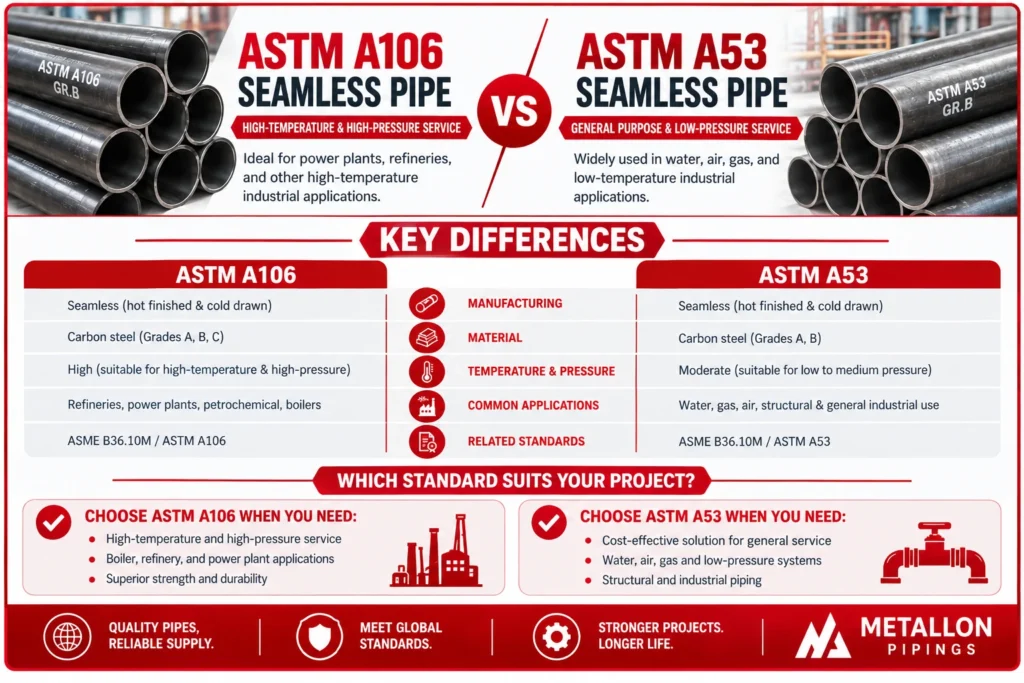
A typical specification for seamless carbon steel pipe meant for high-temperature use is ASTM A106. Refineries, power plants, petrochemical facilities, process plants, and other industrial settings where pipes may be subjected to high temperatures and pressures frequently employ it.
There are three grades of ASTM A106 seamless pipe: A, B, and C. Grade B is one of the most commonly specified grades for industrial piping.
The fact that ASTM A106 is especially well-suited for high-temperature service applications is one of its main benefits. Additionally, the longitudinal weld seen in welded pipe is eliminated by the seamless manufacturing method, which makes it appropriate for demanding piping systems where seamless construction is required.
Typical applications include:
- Steam and condensate lines
- Process piping
- Oil and gas facilities
- Refineries and petrochemical plants
- Boiler and heat exchanger connections
- High-temperature fluid transportation
- Power generation plants
What Is ASTM A53 Pipe?
The carbon steel pipe standard ASTM A53 covers both seamless and welded pipe. It is frequently utilized for general-purpose pipework as well as mechanical and pressure applications.
Depending on the product type and specifications, ASTM A53 pipe can be offered in a variety of manufacturing forms, including seamless and welded construction. It is available in Grade A and Grade B.
ASTM A53 is frequently used in applications such as:
- Water and air lines
- Low-pressure process piping
- Fire sprinkler systems
- Structural applications
- General industrial piping
- Compressed air systems
- Steam applications where the project specification permits it
Because ASTM A53 covers both seamless and welded products, buyers should clearly state the required manufacturing method when ordering pipe.
ASTM A106 vs ASTM A53 Seamless Pipe: Key Differences
While ASTM A106 and ASTM A53 seamless pipes can appear similar, there are several important differences that should be considered before selecting a standard.
1. Intended Service
The intended service environment is the primary distinction.
For seamless carbon steel pipe used in high-temperature applications, ASTM A106 was created especially. For process pipes and other applications where high operating temperatures are anticipated, it is frequently chosen.
In contrast, ASTM A53 is a carbon steel pipe specification that is more versatile. It is not meant to be the standard for high-temperature process pipes, but it can be utilized for mechanical and pressure applications.
When allowed by the relevant design code and project criteria, ASTM A106 is frequently specified for a high-temperature refinery or power-generation application.
2. Manufacturing
A seamless pipe specification is ASTM A106.
However, both seamless and welded pipes are included in ASTM A53. The procurement specification must specify the seamless product in detail if a project calls for seamless ASTM A53.
Because merely stating “ASTM A53” does not guarantee that the provided pipe would be seamless, this distinction is very crucial throughout the procurement process.
3. Chemical Composition
ASTM A53 and ASTM A106 have differing limits and standards for chemical composition. The material’s suitability for particular applications is impacted by these variations.
ASTM A106 grades contain chemical specifications suitable for industrial process pipework and are designed for high-temperature use.
Depending on the product and grade, ASTM A53 also specifies limits for carbon, manganese, phosphorus, sulphur, and other elements.
Instead of assuming that two pipes with the same nominal size and grade designation have the same chemistry, buyers should examine the actual material certificates and the relevant edition of the ASTM specification when comparing materials.
4. Mechanical Properties
Both specifications establish mechanical property requirements, including tensile strength and yield strength.
However, the requirements are not identical across all grades and product forms. For example, ASTM A106 Grade B and ASTM A53 Grade B are frequently compared, but they should not automatically be treated as interchangeable for every application.
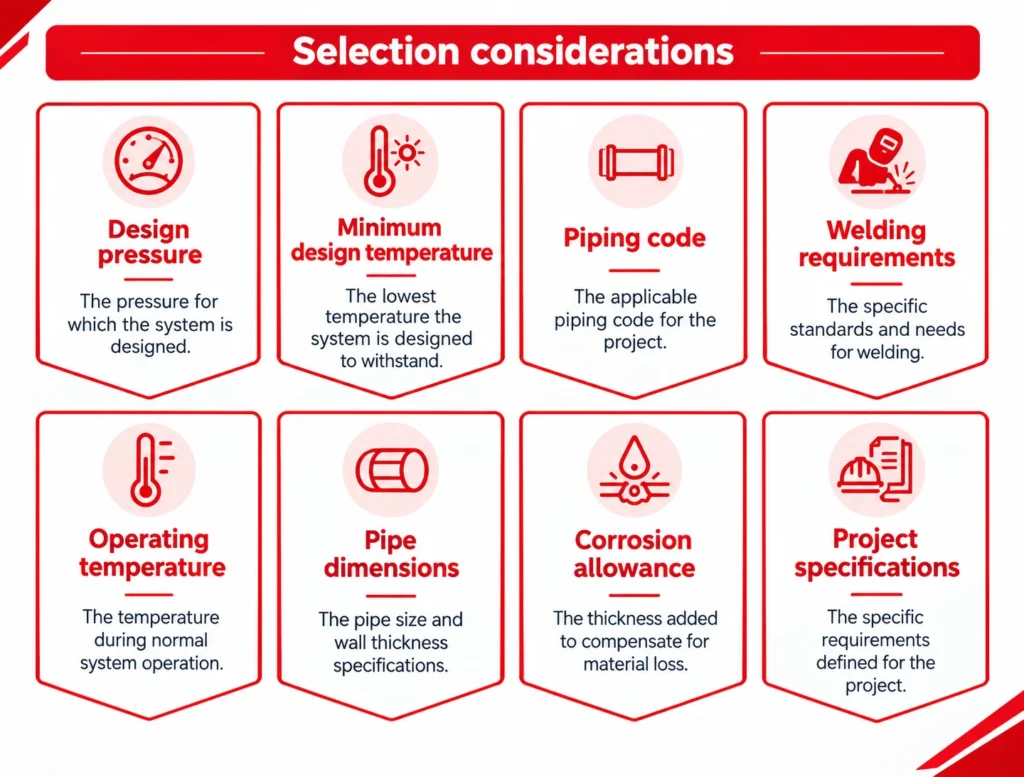
The correct selection should consider:
- Design pressure
- Operating temperature
- Minimum design temperature
- Pipe size and wall thickness
- Applicable piping code
- Corrosion allowance
- Welding requirements
- Project specifications
5. Temperature Capability
One of the most crucial considerations when deciding between these standards is temperature.
ASTM A106 is frequently used for steam, process, refinery, and power-generation pipes since it is closely linked to high-temperature service.
Although ASTM A53 can be used in a variety of mechanical and pressure applications, the engineering specification should clarify if ASTM A53 is appropriate if the piping system requires substantial elevated-temperature usage.
Put otherwise, the choice shouldn’t be made just on the basis of cost or accessibility. It is necessary to first check the working conditions.
ASTM A106 Grade B vs ASTM A53 Grade B
ASTM A106 Grade B and ASTM A53 Grade B are among the most commonly compared carbon steel pipe grades.
Both can be offered as seamless pipe, and their mechanical characteristics could seem comparable. Their specification criteria and application objectives, however, are different.
While ASTM A53 Grade B is frequently used for general-purpose pressure and mechanical pipes, ASTM A106 Grade B is frequently chosen for high-temperature industrial process applications.
For instance, if the project calls for a material meant for elevated-temperature service, a steam or high-temperature process line might be designated as ASTM A106 Grade B. If the design standards are met, a water, air, or general utility line may instead designate ASTM A53 Grade B.
As a result, substitution should only be done when the engineering specification, relevant code, and project documentation allow it.
Can ASTM A106 and ASTM A53 Be Substituted?
ASTM A53 and ASTM A106 may share mechanical and dimensional qualities in specific applications. They should not be seen as automatically interchangeable, though.
The engineering team or project consultant may need to approve a substitute. Material chemistry, mechanical characteristics, temperature service, pressure requirements, testing, dimensions, and relevant standards should all be taken into account while making the decision.
Prior to procurement, material substitution for critical oil and gas, petrochemical, power generation, and process pipe projects should be thoroughly examined.
Which Pipe Should You Choose?
The choice between ASTM A106 and ASTM A53 depends primarily on the project’s operating conditions.
Choose ASTM A106 seamless pipe when:
- High-temperature service is involved.
- The application is refinery or petrochemical process piping.
- Steam or hot fluid service is required.
- The project specification specifically calls for ASTM A106.
- Seamless construction is required for the application.
Consider ASTM A53 seamless pipe when:
- The application is general industrial piping.
- Water, air, or utility service is involved.
- The project specification permits ASTM A53.
- Seamless construction is specifically required.
- Operating conditions fall within the project’s approved design limits.
The final decision should always follow the applicable piping code, engineering specification, and operating conditions rather than relying solely on the pipe standard.
ASTM A106 vs ASTM A53: Quick Comparison
Feature | ASTM A106 | ASTM A53 |
Material | Carbon steel | Carbon steel |
Seamless option | Yes | Yes |
Welded option | No | Yes |
Common grades | A, B, C | A, B |
Typical service | High-temperature service | General-purpose pressure/mechanical service |
Common industries | Oil & gas, refinery, petrochemical, power | Construction, utilities, industrial piping |
High-temperature process piping | Commonly specified | Application dependent |
General utility piping | Suitable where specified | Commonly used |
Conclusion
Nominal size and grade are not the only factors that influence the decision between ASTM A106 and ASTM A53 seamless pipe. While ASTM A53 offers a more comprehensive general-purpose carbon steel pipe specification that covers both seamless and welded products, ASTM A106 is frequently chosen for high-temperature process and industrial piping.
When required by the design and relevant codes, ASTM A106 may be specified for projects involving steam, high temperatures, refinery processes, or rigorous industrial service. ASTM A53 can be suitable for general utility, water, air, mechanical, and other authorized services.
Always check the grade, manufacturing process, timetable, wall thickness, dimensions, testing requirements, pressure-temperature requirements, and relevant project specification before making a purchase. This guaranties that the chosen pipe satisfies operational and technical standards.
How We Support You
Selecting between ASTM A106 and ASTM A53 seamless pipe requires careful consideration of operating temperature, pressure, application, material requirements, and project specifications. Our team supports EPC contractors, procurement specialists, piping engineers, and industrial buyers in selecting the appropriate carbon steel pipe solution for process, utility, oil & gas, and industrial applications.
We support you with:
- Guidance in selecting ASTM A106 and ASTM A53 pipes based on operating temperature, pressure, application, pipe size, schedule, and service conditions
- Assistance in understanding the differences between ASTM A106 and ASTM A53, including scope, manufacturing requirements, grades, mechanical properties, and typical applications
- Recommendations for ASTM A106 Grade A, B, and C pipes for high-temperature and high-pressure process piping applications
- Guidance on ASTM A53 Grade A and B pipes for general-purpose, mechanical, pressure, water, steam, air, and structural applications
- Support in selecting seamless, ERW, and welded pipe configurations according to project specifications and service requirements
- Assistance with pipe schedules, outside diameter, wall thickness, length, end connections, and dimensional requirements
- Support for refineries, petrochemical plants, power generation facilities, oil & gas projects, water systems, and industrial process piping
- Guidance on compatible carbon steel fittings, flanges, valves, and other piping components for complete systems
- Assistance with compliance to ASTM, ASME, API, NACE, and project-specific EPC specifications
- Documentation support including Mill Test Certificates (MTCs), hydrostatic test reports, NDT reports, PMI reports where applicable, third-party inspection certificates, and quality certifications
- Support for material traceability, bulk procurement, custom dimensions, inspection requirements, and project-specific documentation
- Fast quotations, export packaging, logistics coordination, and reliable supply support for GCC, African, European, and international projects
Whether your project requires carbon steel piping for high-temperature process service, oil & gas facilities, utilities, water systems, or general industrial applications, we help you select and source ASTM A106 or ASTM A53 pipes according to the project’s technical, quality, safety, and compliance requirements.