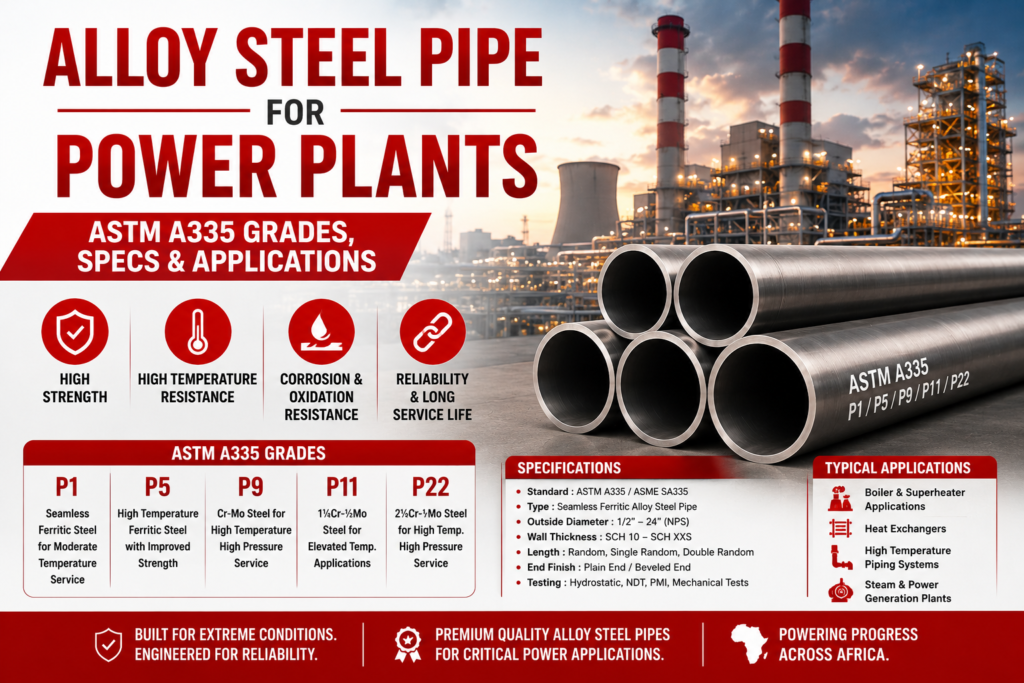
Alloy Steel Pipe is one of the most critical components used in modern thermal and power generation plants. Designed to withstand high pressure, elevated temperatures, and corrosive operating conditions, Alloy Steel Pipe is widely used in boilers, superheaters, heat exchangers, and steam pipelines across power plants worldwide.
Among the most trusted specifications for high-temperature piping systems is ASTM A335, which covers seamless ferritic alloy-steel pipes intended for high-temperature service. Different ASTM A335 grades such as P5, P9, P11, P22, and P91 are selected based on temperature, pressure, and operational requirements.
This guide explains ASTM A335 pipe grades, specifications, properties, and applications in power plants and industrial high-temperature systems.
What Is ASTM A335 Alloy Steel Pipe?
ASTM A335 is a standard specification for seamless ferritic alloy-steel pipe used in high-temperature and high-pressure applications. These pipes are manufactured with alloying elements like chromium and molybdenum to improve:
- Heat resistance
- Mechanical strength
- Corrosion resistance
- Oxidation resistance
- Creep strength
ASTM A335 Alloy Steel Pipe is commonly used in:
- Thermal power plants
- Nuclear power plants
- Refineries
- Petrochemical plants
- Boiler systems
- Steam piping networks
Why Alloy Steel Pipe Is Used in Power Plants
Power plants operate under extreme conditions involving superheated steam, high-pressure fluids, and continuous thermal cycling. Standard carbon steel pipes may fail under these demanding environments.
Alloy Steel Pipe offers several advantages:
High Temperature Resistance
ASTM A335 pipes can handle temperatures exceeding 500°C, making them ideal for boiler and steam applications.
Excellent Pressure Handling
The high tensile and yield strength of alloy steel allows pipes to perform safely under high-pressure conditions.
Improved Corrosion & Oxidation Resistance
Chromium and molybdenum improve resistance against oxidation, scaling, and corrosion in high-temperature environments.
Long Service Life
Alloy Steel Pipe provides reliable long-term performance with reduced maintenance and replacement costs.
Common ASTM A335 Grades Used in Power Plants
ASTM A335 P5 Pipe
P5 grade contains chromium and molybdenum for improved oxidation resistance.
Features
- Good heat resistance
- Moderate corrosion resistance
- Suitable for elevated temperature service
Applications
- Heat exchangers
- Refinery piping
- Boiler systems
ASTM A335 P9 Pipe
P9 offers higher chromium content for better oxidation resistance.
Features
- Superior thermal stability
- Good creep strength
- Enhanced durability
Applications
- High-temperature steam lines
- Power generation piping
- Superheater systems
ASTM A335 P11 Pipe
P11 is one of the most commonly used alloy steel grades in power plants.
Features
- Excellent creep resistance
- Good weldability
- Reliable high-temperature strength
Applications
- Boiler tubes
- Steam headers
- High-pressure pipelines
ASTM A335 P22 Pipe
P22 provides improved temperature resistance and mechanical strength.
Features
- Better corrosion resistance
- High pressure capability
- Excellent thermal fatigue resistance
Applications
- Main steam piping
- Superheater coils
- Reheater systems
ASTM A335 P91 Pipe
P91 is an advanced alloy steel grade widely used in ultra-supercritical power plants.
Features
- Exceptional creep strength
- High thermal efficiency
- Excellent long-term stability
Applications
- Ultra-high temperature steam lines
- Turbine piping
- Critical boiler components
Chemical Composition of ASTM A335 Pipes
The properties of ASTM A335 Alloy Steel Pipe depend on alloying elements such as:
- Chromium (Cr)
- Molybdenum (Mo)
- Vanadium (V)
- Nickel (Ni)
- Carbon (C)
Role of Alloying Elements
Chromium
- Improves oxidation resistance
- Enhances corrosion protection
- Increases high-temperature strength
Molybdenum
- Enhances creep resistance
- Improves toughness at high temperatures
Vanadium
- Increases strength and hardness
- Improves thermal stability
ASTM A335 Pipe Specifications
Manufacturing Type
- Seamless pipe
Size Range
- 1/8” NB to 24” NB and above
Wall Thickness
- SCH 20 to SCH XXS
Pipe Standards
- ASTM A335
- ASME SA335
Testing Requirements
- Hydrostatic testing
- Ultrasonic testing
- Hardness testing
- Tensile testing
- Flattening tests
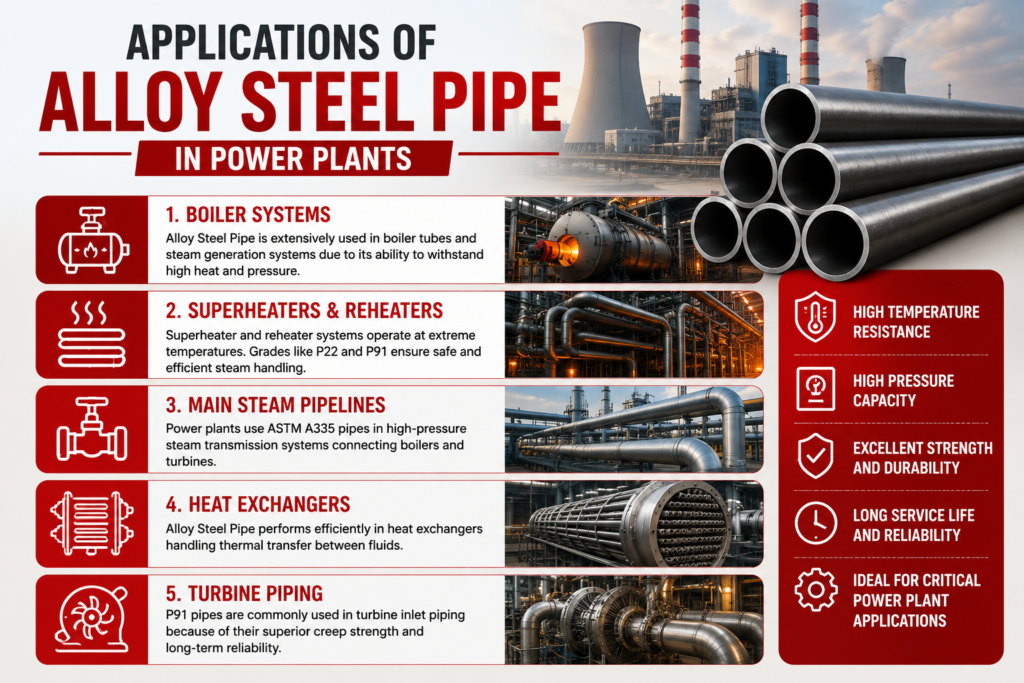
Applications of Alloy Steel Pipe in Power Plants
Boiler Systems
Alloy Steel Pipe is extensively used in boiler tubes and steam generation systems due to its ability to withstand high heat and pressure.
Superheaters & Reheaters
Superheater and reheater systems operate at extreme temperatures. Grades like P22 and P91 ensure safe and efficient steam handling.
Main Steam Pipelines
Power plants use ASTM A335 pipes in high-pressure steam transmission systems connecting boilers and turbines.
Heat Exchangers
Alloy Steel Pipe performs efficiently in heat exchangers handling thermal transfer between fluids.
Turbine Piping
P91 pipes are commonly used in turbine inlet piping because of their superior creep strength and long-term reliability.
Advantages of ASTM A335 Alloy Steel Pipe
High Mechanical Strength
ASTM A335 pipes provide superior tensile and yield strength for high-pressure operations.
Excellent Thermal Stability
These pipes maintain structural integrity even at elevated temperatures.
Reduced Maintenance Costs
Long operational life reduces downtime and maintenance expenses.
Better Energy Efficiency
High-performance piping systems improve overall thermal efficiency in power plants.
Resistance to Thermal Fatigue
ASTM A335 grades perform well under cyclic heating and cooling conditions.
Difference Between Carbon Steel Pipe and Alloy Steel Pipe
Property | Carbon Steel Pipe | Alloy Steel Pipe |
Temperature Resistance | Moderate | Excellent |
Pressure Capacity | Lower | Higher |
Corrosion Resistance | Limited | Better |
High-Temperature Strength | Moderate | Superior |
Cost | Lower | Higher |
Power Plant Usage | Limited | Extensive |
Factors to Consider When Selecting ASTM A335 Pipes
Operating Temperature
Higher grades like P91 are preferred for ultra-high-temperature applications.
Pressure Requirements
Wall thickness and grade selection depend on system pressure.
Corrosion Environment
Pipes exposed to oxidation and corrosive gases require higher chromium content.
Welding Requirements
Some grades require post-weld heat treatment for maintaining performance.
Conclusion
Modern power plants that operate in high-temperature, high-pressure environments require ASTM A335 Alloy Steel Pipe. For crucial steam and boiler systems, grades including P11, P22, and P91 offer exceptional strength, creep resistance, and long-term durability.
Alloy steel pipe guarantees dependable performance, increased thermal efficiency, and improved plant safety in everything from boiler tubes and turbine pipelines to superheaters and reheaters.
Power plant operators can lower maintenance costs, boost efficiency, and guarantee long-term operational reliability by choosing the appropriate ASTM A335 grade based on operating conditions.
How We Support You
Selecting the right alloy steel pipe is essential for ensuring high-temperature strength, pressure resistance, corrosion protection, and long-term reliability in power generation systems. Our team helps EPC contractors, power plant engineers, procurement specialists, and project consultants choose the most suitable ASTM A335 alloy steel pipe grades for thermal power plants, combined cycle plants, refineries, and industrial process facilities across GCC and African markets.
We support you with:
- Guidance in selecting suitable ASTM A335 grades such as P5, P9, P11, P22, and P91 for high-temperature and high-pressure applications
- Recommendations based on operating temperature, steam pressure, corrosion resistance, creep strength, and weldability requirements
- Support for boiler systems, superheaters, reheaters, heat exchangers, steam pipelines, and power plant process piping
- Assistance with compliance to ASTM, ASME, API, EN, NACE, and international EPC project specifications
- Guidance for seamless alloy steel pipe solutions for critical power generation applications
- Recommendations for thermal power plants, petrochemical plants, refineries, and industrial utility systems
- Technical support for pipe schedules, wall thickness calculations, fittings, flanges, and insulation requirements
- Documentation support including MTCs, hydro test reports, heat treatment records, third-party inspection, and quality certifications
- Fast quotations, export logistics, and bulk supply support for GCC & African power and energy projects
Whether your project involves steam transmission systems, boiler piping, refinery utilities, high-pressure process lines, or power generation infrastructure, we provide reliable ASTM A335 alloy steel pipe solutions tailored to meet performance, durability, safety, and international project compliance requirements.