Because they offer safe and leak-proof connections between pipes, valves, pumps, and other equipment, flanges are crucial parts of industrial piping systems. Choosing the right flange standard is essential for guaranteeing safety, dependability, and adherence to project specifications in sectors including oil and gas, petrochemicals, power generation, offshore platforms, and chemical processing.
ASME B16.5 and ASME B16.47 are two of the most widely used flange standards. Although pressure-rated flanges are covered by both standards, there are notable differences between them in terms of size range, pressure classes, dimensions, weight, and applications.
This buyer’s guide helps engineers, procurement teams, and contractors select the appropriate flange for their industrial plumbing projects by outlining the main distinctions between ASME B16.5 and ASME B16.47 flanges.
What Is ASME B16.5?
ASME B16.5 is the industry standard covering pipe flanges and flanged fittings for NPS ½ inch through 24 inches. It specifies dimensions, pressure-temperature ratings, tolerances, materials, marking requirements, and testing procedures.
The standard is widely used across industries including:
- Oil & gas
- Petrochemical plants
- Chemical processing
- Refineries
- Power generation
- Water treatment
- Marine engineering
ASME B16.5 includes several flange types such as:
- Weld Neck Flanges
- Slip-On Flanges
- Blind Flanges
- Socket Weld Flanges
- Threaded Flanges
- Lap Joint Flanges
What Is ASME B16.47?
Large-diameter steel flanges with NPS values between 26 and 60 inches are covered by ASME B16.47. These bigger flanges are made for heavy-duty industrial plumbing systems that need larger pipe diameters.
The standard is divided into two categories:
Series A
Series A flanges are generally thicker, heavier, and designed with fewer bolt holes but larger bolt sizes. They provide higher strength and are commonly selected for demanding applications.
Series B
Series B flanges are frequently used in situations where cutting weight and cost is crucial because they are lighter and require more bolts with smaller diameters.
Series A and Series B flanges are not interchangeable due to differences in bolt patterns and size.
Size Range Comparison
One of the most significant differences between the two standards is the pipe size they cover.
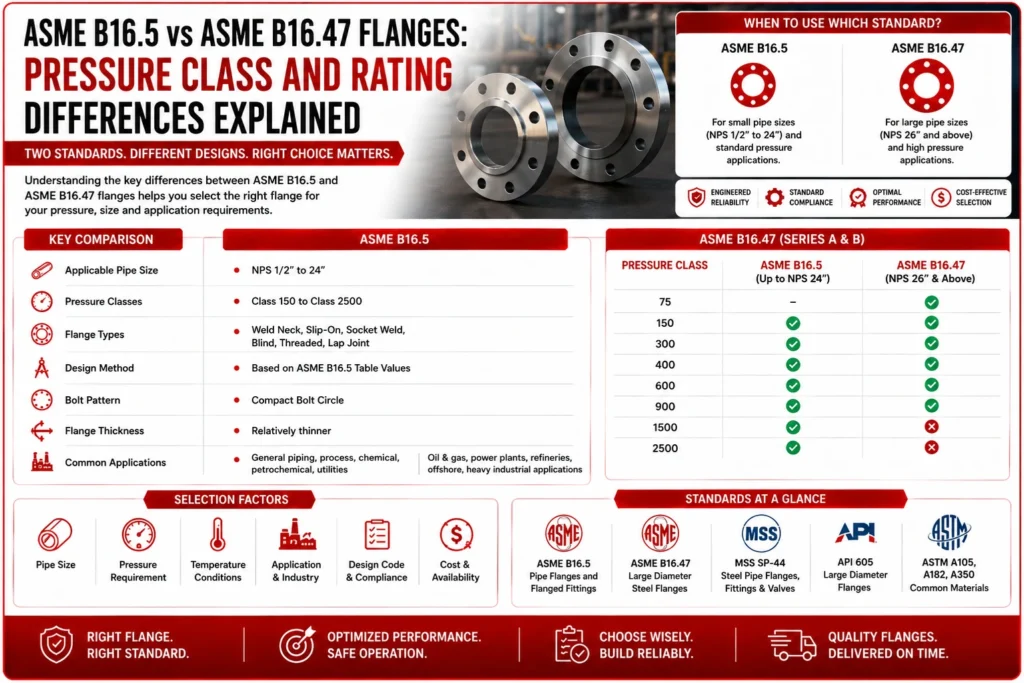
Standard | Pipe Size Range |
ASME B16.5 | NPS ½” to 24″ |
ASME B16.47 | NPS 26″ to 60″ |
For piping systems larger than 24 inches, ASME B16.47 becomes the applicable standard.
Pressure Classes in ASME B16.5
ASME B16.5 includes a wide range of pressure classes suitable for various operating conditions.
Common pressure classes include:
- Class 150
- Class 300
- Class 400
- Class 600
- Class 900
- Class 1500
- Class 2500
Higher pressure classes generally feature:
- Thicker flanges
- Larger hubs
- Higher bolt loads
- Increased pressure and temperature capabilities
The appropriate class depends on:
- Operating pressure
- Design temperature
- Material grade
- Process requirements
Pressure Classes in ASME B16.47
ASME B16.47 covers fewer pressure classes because it focuses on large-diameter piping systems.
Common classes include:
- Class 75
- Class 150
- Class 300
- Class 400
- Class 600
- Class 900
These pressure ratings are suitable for many transmission pipelines, offshore facilities, petrochemical plants, and process industries.
Key Differences Between ASME B16.5 and ASME B16.47
Although both standards define pressure-rated flanges, they differ in several important areas.
Pipe Size
ASME B16.5 applies to smaller pipe sizes, while ASME B16.47 is intended for larger-diameter piping systems.
Flange Dimensions
ASME B16.47 flanges have larger outside diameters, increased thickness, and different bolt circle dimensions compared to B16.5 flanges.
Weight
Large-diameter B16.47 flanges are significantly heavier due to their increased size and wall thickness.
Bolt Configuration
Series A and Series B flanges within ASME B16.47 have different bolt patterns.
These differences affect:
- Number of bolts
- Bolt diameter
- Bolt circle dimensions
Proper matching is essential during installation.
Applications
ASME B16.5 is commonly used in process piping, while B16.47 is typically selected for transmission pipelines and large industrial systems.
Pressure Rating vs Pressure Class
Although the terms “pressure rating” and “pressure class” are sometimes used synonymously, they are not the same.
The flange classification, such as Class 150 or Class 600, is referred to as the pressure class.
The highest pressure that a flange can safely tolerate at a certain operating temperature is known as its pressure rating.
The permitted pressure often drops as the temperature rises. Therefore, while choosing flanges, engineers should always refer to the pressure-temperature rating tables found in the relevant ASME standard.

Materials Used for ASME Flanges
Both ASME B16.5 and ASME B16.47 flanges are available in a wide range of materials depending on the application.
Common materials include:
Carbon Steel
- ASTM A105
- ASTM A350 LF2
Suitable for general industrial and pipeline applications.
Stainless Steel
- ASTM A182 F304
- ASTM A182 F304L
- ASTM A182 F316
- ASTM A182 F316L
Ideal for corrosive environments and chemical processing.
Alloy Steel
- ASTM A182 F11
- ASTM A182 F22
- ASTM A182 F91
Used for high-temperature and high-pressure applications.
Duplex Stainless Steel
- ASTM A182 F51
- ASTM A182 F53
- ASTM A182 F55
Commonly selected for offshore, seawater, and desalination projects.
Nickel Alloys
Materials such as Inconel, Monel, and Hastelloy are used where exceptional corrosion resistance and high-temperature performance are required.
Typical Applications
ASME B16.5 Flanges
These flanges are commonly used in:
- Refineries
- Petrochemical plants
- Chemical processing
- Power stations
- Water treatment plants
- Industrial process piping
ASME B16.47 Flanges
Large-diameter flanges are frequently used in:
- Crude oil pipelines
- Natural gas transmission
- Offshore platforms
- LNG terminals
- Water transmission lines
- Marine infrastructure
- Large process piping systems
Factors to Consider When Selecting a Flange
Before choosing between ASME B16.5 and ASME B16.47, consider the following:
- Pipe size
- Operating pressure
- Design temperature
- Material compatibility
- Corrosion resistance
- Flange type
- Project specifications
- Applicable industry standards
Selecting the correct flange helps improve safety, reduce maintenance, and ensure long-term system reliability.
Why Buy from a Reliable Flange Supplier?
Because industrial flanges are so important to piping systems, quality and certification are crucial. Every flange is guaranteed to adhere to relevant ASME standards and project specifications by a reliable source.
A wide variety of carbon steel, stainless steel, alloy steel, duplex, super duplex, and nickel alloy flanges made in accordance with international standards are available to customers at Metallon Pipings. For projects in the oil and gas, petrochemical, maritime, power generation, and infrastructure sectors, every product is provided with comprehensive documentation, such as Mill Test Certificates (MTC), material traceability, inspection reports, and quality certifications.
Conclusion
Choosing the appropriate parts for industrial pipe systems requires an understanding of the distinctions between ASME B16.5 and ASME B16.47 flanges. ASME B16.47 is the recommended option for large-scale pipelines and offshore installations since it covers bigger diameters from 26 to 60 inches, whereas ASME B16.5 is designed for pipe sizes up to 24 inches and offers a wide range of pressure classes.
Engineers and procurement specialists can select flanges that guarantee safe, effective, and long-lasting performance by taking into account variables including pipe size, pressure class, material, temperature, and application. For industrial projects all over the world, working with a reputable supplier like Metallon Pipings further ensures certified materials, technical know-how, and trustworthy assistance.
How We Support You
Selecting the correct flange standard and pressure class is essential for ensuring safe, leak-free, and code-compliant piping systems. Our team helps EPC contractors, procurement specialists, piping engineers, project consultants, and industrial buyers understand the differences between ASME B16.5 and ASME B16.47 flanges, enabling them to choose the right products for demanding industrial applications.
We support you with:
- Guidance in selecting between ASME B16.5 and ASME B16.47 flanges based on pipe size, pressure class, and application requirements
- Recommendations for pressure classes including Class 150, 300, 400, 600, 900, 1500, and 2500, ensuring compatibility with operating conditions
- Support in understanding the differences between ASME B16.47 Series A and Series B flanges, including dimensions, bolt patterns, weight, and interchangeability
- Assistance in selecting carbon steel, stainless steel, alloy steel, duplex, super duplex, and nickel alloy flanges for various industrial environments
- Guidance on flange selection for oil & gas, petrochemical, refinery, power generation, offshore, marine, chemical processing, and water treatment projects
- Assistance with compliance to ASME, ASTM, API, MSS, EN, NACE, and project-specific EPC standards
- Technical support for flange dimensions, pressure-temperature ratings, gasket compatibility, bolting requirements, and sealing performance
- Documentation support including Mill Test Certificates (MTCs), pressure test reports, dimensional inspection reports, third-party inspection certificates, and quality certifications
- Fast quotations, export logistics, and bulk supply support for standard and custom flange requirements across the GCC, Africa, and international markets
- Expert assistance in selecting matching pipes, fittings, valves, gaskets, fasteners, and related piping components for complete piping systems
Whether your project involves high-pressure process piping, refinery units, offshore platforms, power plants, or industrial infrastructure, we provide dependable flange solutions and technical expertise to ensure safety, performance, and compliance with international piping standards.