Different technical standards that specify requirements for materials, dimensions, manufacturing processes, testing, and performance are used in the production and supply of industrial pipes. When choosing the appropriate pipe for an oil and gas, petrochemical, power generating, chemical, maritime, or infrastructure project, buyers, engineers, contractors, and procurement teams must be aware of these criteria.
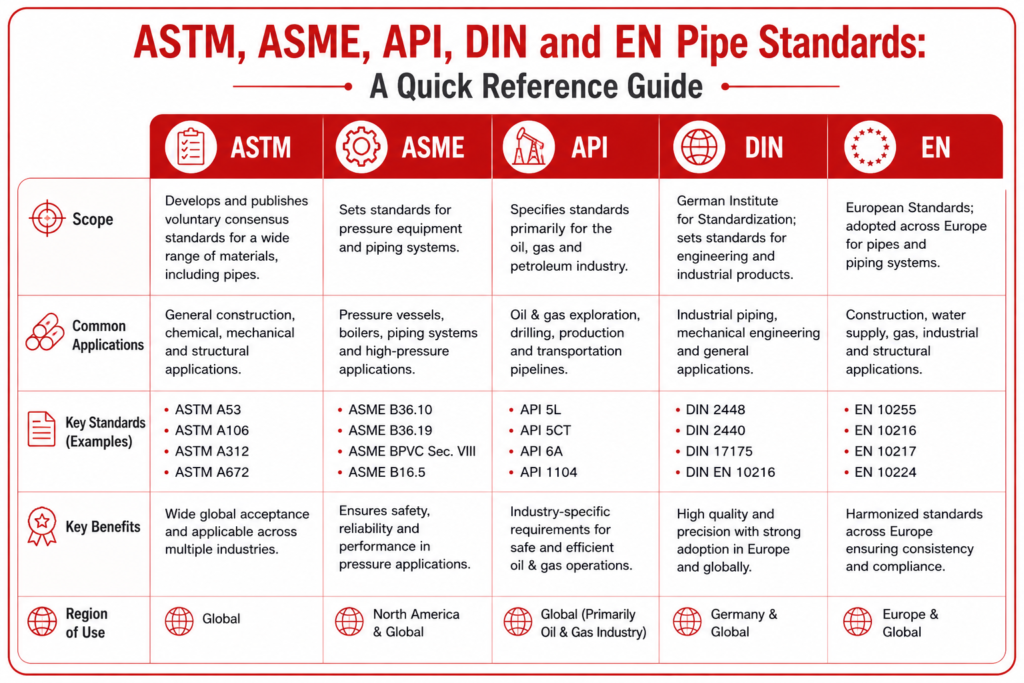
ASTM, ASME, API, DIN, and EN are some of the most widely used standards. These standards are published by separate organizations and serve different goals, despite the fact that they are occasionally cited together.
The distinctions between ASTM, ASME, API, DIN, and EN pipe standards are explained in this brief reference guide, which also identifies frequent applications for each.
What Are Pipe Standards?
A pipe standard is a technical specification or set of requirements that defines how a pipe should be manufactured, tested, dimensioned, or classified.
Depending on the standard, requirements may cover:
- Chemical composition
- Mechanical properties
- Pipe dimensions
- Wall thickness
- Manufacturing process
- Heat treatment
- Pressure testing
- Non-destructive testing
- Inspection requirements
- Marking and certification
When the relevant specifications are compatible, a pipe can meet many standards. However, just because two standards cover comparable products doesn’t mean that they may be used interchangeably.
ASTM Pipe Standards
Across numerous industries, ASTM International creates technical standards for goods, materials, testing procedures, and manufacturing specifications.
In industrial pipe and material specifications, ASTM standards are very prevalent.
Some widely used pipe standards include:
ASTM A106
ASTM A106 covers seamless carbon steel pipe for high-temperature service.
It is commonly used in:
- Refineries
- Power plants
- Process piping
- Steam systems
- Oil & gas facilities
Common grades include Grade A, Grade B, and Grade C, with Grade B being widely specified.
ASTM A53
ASTM A53 covers carbon steel pipe suitable for mechanical and pressure applications as well as other general industrial uses.
It is available in seamless and welded forms and is commonly used for:
- Water lines
- Air lines
- Structural applications
- General industrial piping
ASTM A312
ASTM A312 covers seamless, welded, and heavily cold-worked austenitic stainless steel pipe.
Common grades include:
- TP304
- TP304L
- TP316
- TP316L
These pipes are widely used in chemical processing, food processing, petrochemical plants, and corrosive environments.
ASTM A335
ASTM A335 covers seamless ferritic alloy-steel pipe for high-temperature service.
Common grades include:
- P5
- P9
- P11
- P22
- P91
These materials are frequently used in boilers, refineries, power plants, and high-temperature process systems.
ASME Pipe Standards
The American Society of Mechanical Engineers, or ASME, creates engineering standards and codes for mechanical components, pipes, pressure equipment, and related applications.
Power generating, refineries, process facilities, and pressure-containing systems all heavily rely on ASME standards.
ASME B36.10M
ASME B36.10M covers the dimensions of welded and seamless wrought steel pipe.
It provides information such as:
- Nominal pipe size
- Outside diameter
- Wall thickness
- Schedule
- Pipe dimensions
Common schedules include:
- SCH 10
- SCH 20
- SCH 40
- SCH 80
- SCH 160
ASME B36.19M
ASME B36.19M covers the dimensions of stainless steel pipe.
It is commonly used for stainless steel piping with schedules such as:
- 5S
- 10S
- 40S
- 80S
ASME B16.5
ASME B16.5 covers pipe flanges and flanged fittings for specified pressure classes and sizes.
It is commonly used for:
- Weld neck flanges
- Slip-on flanges
- Blind flanges
- Socket weld flanges
- Threaded flanges
ASME B16.47
ASME B16.47 covers large-diameter steel flanges, generally from NPS 26 through NPS 60.
It is particularly relevant to large pipelines, transmission systems, and major industrial facilities.
API Pipe Standards
API, or the American Petroleum Institute, develops standards specifically for the oil and natural gas industry.
API specifications are especially important for pipelines, drilling operations, production facilities, and petroleum infrastructure.
API 5L
API 5L is one of the most important pipeline standards in the oil & gas industry.
It covers seamless and welded steel line pipe used for pipeline transportation systems.
Common grades include:
- X42
- X52
- X60
- X65
- X70
API 5L products are widely used for transporting:
- Crude oil
- Natural gas
- Petroleum products
- Water in pipeline systems
API 5L can be supplied according to different product specification levels, depending on project requirements.
API 5CT
API 5CT covers casing and tubing used in wells.
These products are different from conventional process or transmission pipes and are primarily associated with oil and gas well construction.
DIN Pipe Standards
The German Institute for Standardization, or DIN, creates standards that are widely utilized in Germany and historically throughout the industrial markets of Europe.
Piping materials and dimensions are among the many engineering goods covered by DIN standards.
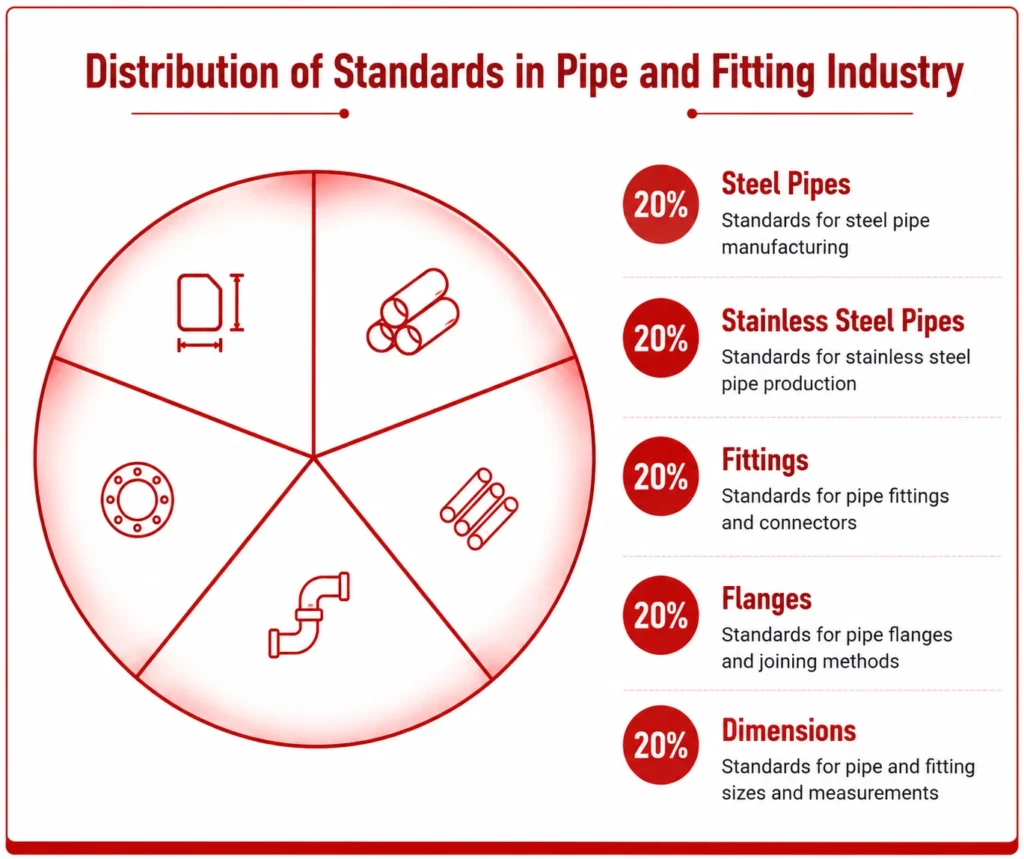
Examples include standards for:
- Steel pipes
- Stainless steel pipes
- Fittings
- Flanges
- Dimensions
- Mechanical requirements
Industrial procurement still uses DIN criteria, especially when equipment or projects are built using German or historical European technical standards.
However, many national standards have been superseded or replaced by EN standards, which are now used in many European applications.
EN Pipe Standards
The acronym EN represents European Standard. EN standards are widely used throughout Europe and are created within the European standardization system.
Material specifications, dimensions, manufacture, testing, and inspection for different kinds of pipes are all covered by EN pipe standards.
Examples include:
EN 10216
EN 10216 covers seamless steel tubes for pressure purposes.
Different parts address different material groups and service conditions.
EN 10217
EN 10217 covers welded steel tubes for pressure purposes.
EN 10219
EN 10219 covers cold-formed welded structural hollow sections.
EN 10220
EN 10220 provides dimensions and masses per unit length for seamless and welded steel tubes.
ASTM vs ASME vs API vs DIN vs EN
Standard | Organization/System | Main Focus | Common Applications |
ASTM | ASTM International | Materials, products & testing | Industrial piping, materials |
ASME | American Society of Mechanical Engineers | Engineering codes, piping & components | Process plants, power, pressure systems |
API | American Petroleum Institute | Oil & gas equipment and materials | Pipelines, drilling, petroleum |
DIN | German standardization system | German engineering standards | Industrial & mechanical applications |
EN | European Standards | European technical requirements | European industrial projects |
Are ASTM and ASME the Same?
No. This misconception is widespread.
While ASME creates engineering rules and standards for mechanical systems, pressure equipment, piping components, and related applications, ASTM mostly creates material and product specifications and test procedures.
For instance, a pipe may be dimensioned in accordance with an ASME dimensional standard and produced in accordance with an ASTM material specification.
A common example is:
ASTM A106 Grade B + ASME B36.10M
Here, ASTM A106 defines the material and manufacturing requirements, while ASME B36.10M addresses pipe dimensions.
How API Fits Into the Picture
Petroleum and natural gas applications are the main emphasis of API standards.
For instance, ASTM standards include many more general material categories, whereas API 5L deals with line pipe used in pipeline transportation systems.
Thus, a combination of API, ASTM, ASME, and project-specific standards may be specified in oil and gas projects.
Why Pipe Standard Selection Matters
Choosing the correct standard affects:
- Material compatibility
- Pressure capability
- Temperature performance
- Corrosion resistance
- Dimensional compatibility
- Welding requirements
- Inspection procedures
- Project approval
- Long-term reliability
Using an incorrect specification can result in material rejection, installation problems, project delays, or potentially serious safety issues.
What Buyers Should Check Before Ordering
Before purchasing industrial pipes, always verify:
Applicable standard – Confirm the exact ASTM, ASME, API, DIN, or EN specification.
Material grade – Check the required grade, such as A106 Grade B, A312 TP316L, or API 5L X65.
Pipe type – Confirm whether seamless, ERW, welded, or another manufacturing process is required.
Dimensions – Verify NPS, outside diameter, wall thickness, and schedule.
Pressure and temperature – Confirm suitability for the operating conditions.
Testing requirements – Review hydrostatic, ultrasonic, radiographic, PMI, and other specified tests.
Documentation – Request complete MTR/MTC and traceability documentation.
Project specifications – Check whether additional customer or EPC requirements apply.
Conclusion
Comprehending the distinctions between ASTM, ASME, API, DIN, and EN pipe standards facilitates the procurement of industrial pipes and aids purchasers in avoiding expensive specification errors.
DIN stands for German standardization, API specializes in oil and gas applications, ASME covers engineering and pipeline standards, ASTM standards are primarily concerned with materials and product requirements, and EN standards offer a common framework for European projects.
The right pipe specification should always be chosen in accordance with the design conditions and project requirements for oil and gas, petrochemical, offshore, power, chemical, and infrastructure projects. Buyers may find appropriate materials, dimensions, testing requirements, and documentation for their particular application by working with a seasoned supplier like Metallon Pipings.
How We Support You
Choosing pipes that comply with the correct international standards is essential for ensuring dimensional accuracy, material quality, pressure performance, and long-term reliability. Our team supports EPC contractors, procurement specialists, piping engineers, project consultants, and industrial buyers in understanding and selecting pipes according to ASTM, ASME, API, DIN, and EN requirements.
We support you with:
- Guidance in understanding the differences between ASTM, ASME, API, DIN, and EN pipe standards and where each is commonly applied
- Assistance in selecting suitable standards for carbon steel, stainless steel, alloy steel, duplex, super duplex, and nickel alloy pipes
- Recommendations based on material grade, manufacturing process, dimensions, pressure requirements, temperature, corrosion resistance, and service conditions
- Support in identifying commonly used specifications such as ASTM A106, ASTM A312, ASTM A335, API 5L, EN 10216, EN 10217, DIN standards, and related piping specifications
- Guidance on seamless, ERW, welded, and fabricated pipe requirements according to project specifications
- Assistance with dimensional standards, pipe schedules, outside diameter, wall thickness, tolerances, and length requirements
- Support for oil & gas, petrochemical, refinery, power generation, marine, desalination, chemical processing, and industrial piping projects
- Guidance on compliance with project-specific EPC specifications and applicable international codes and standards
- Documentation support including Mill Test Certificates (MTCs), EN 10204 3.1/3.2 certificates, hydrostatic test reports, PMI reports, inspection reports, and quality certifications
- Technical assistance in matching pipes with compatible fittings, flanges, valves, fasteners, and other piping components
- Fast quotations, bulk procurement support, export logistics, and international supply solutions for projects across the GCC, Africa, Europe, and global markets
Whether you need piping materials for a new EPC project, plant expansion, maintenance shutdown, or industrial distribution, we help you select standards correctly and source reliable pipe products that meet technical, quality, and project compliance requirements.