For industrial pipes, fittings, flanges, and other pipeline components throughout the GCC, the UAE has developed into a significant sourcing and distribution center. Because of the region’s robust logistical network and access to global manufacturers, piping materials are frequently sourced from UAE-based stockists by oil and gas firms, EPC contractors, refineries, petrochemical facilities, power projects, and industrial distributors.
But price shouldn’t be the sole consideration when selecting the top pipe and fitting provider in the United Arab Emirates. A trustworthy supplier must offer the appropriate materials, accurate specifications, consistent quality, thorough documentation, and dependable delivery. These elements may directly affect project timelines and total procurement expenses for major GCC projects.
Why Choose a UAE-Based Pipe and Fitting Stockist?
Due to its advantageous position, the UAE is a major hub for the trade of industrial materials. Customers in Saudi Arabia, Qatar, Kuwait, Oman, Bahrain, and other foreign markets can be served by domestic suppliers.
When products are needed fast, a UAE stockist can be especially helpful for EPC contractors and maintenance firms. Customers may be able to find available stock from a local provider rather than waiting for every product to be produced abroad.
Additionally, a skilled stockist may combine various products into a single shipment, making logistics and procurement easier.
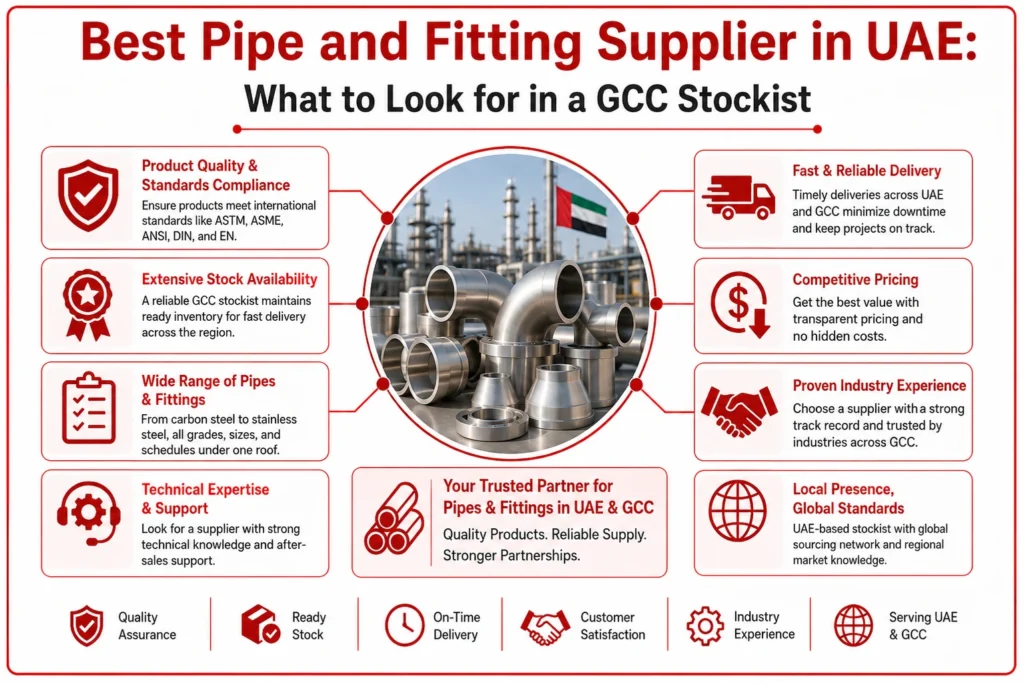
1. Check the Supplier’s Product Range
Before selecting a supplier, check whether it can provide the complete range of products required for your project. A supplier that handles only standard carbon steel pipes may not be sufficient for a refinery or offshore project requiring multiple material grades.
A capable industrial piping supplier should have access to products such as:
- Seamless and welded pipes
- steel pipes
- Stainless steel pipes
- Alloy steel pipes
- Duplex and super duplex pipes
- Nickel alloy pipes
- Butt-weld fittings
- Forged fittings
- Industrial flanges
Having multiple product categories under one supply chain can reduce the need to coordinate with several vendors.
2. Make Sure the Materials Meet International Standards
Industrial pipework needs to meet the project’s technical specifications. For applications involving oil and gas, petrochemicals, and power generation, this is particularly crucial.
ASTM, ASME, API, EN, DIN, and ISO are examples of common standards. For instance, a project might call for ASME B16.5 flanges, API 5L line pipe, ASTM A234 fittings, or ASTM A106 carbon steel pipe.
Instead of just matching a product based on its size or general description, the supplier should be aware of these characteristics.
For instance, just because both ASTM A106 Grade B and API 5L X52 are carbon steel products, they cannot be used interchangeably. They may have different specifications, testing standards, and intended uses.
3. Verify Stock Availability and Lead Time
Delivery time may be just as significant for GCC projects as material cost. Receiving materials within a certain timeline is frequently necessary for maintenance initiatives, shutdowns, and urgent building needs.
Instead than depending solely on a standard delivery statement, ask the provider about real availability before making an order.
Important questions include:
- Is the required grade currently available?
- What sizes and schedules are in stock?
- Can the complete quantity be supplied?
- What is the expected dispatch date?
- Can different sizes be consolidated into one shipment?
A supplier with strategically maintained inventory can provide an important advantage when project deadlines are tight.
4. Material Traceability Should Be a Priority
Buyers must be aware of the source of the material and if it satisfies the standards for essential pipe systems. Material traceability becomes crucial in this situation.
Each pipe or fitting should be properly identified so that it may be linked to the material paperwork. This could include manufacturer information, measurements, heat numbers, and grade markings, depending on the product.
Throughout the procurement process, a trustworthy supplier must be able to preserve traceability.
5. Check the MTC and Quality Documentation
Material Test Certificates (MTCs) are an important part of industrial piping procurement. They provide information about the chemical composition and mechanical properties of the material and may include testing and heat-treatment information.
Depending on the project, buyers may require documentation covering:
- Chemical analysis
- Tensile and yield strength
- Elongation
- Hardness
- Hydrostatic testing
- Heat treatment
- NDT results
- Heat number traceability
For critical GCC projects, additional inspection or third-party certification may also be required.
6. Consider Inspection and Testing Capability
Inspection requirements prior to shipment should be supported by a qualified stockist. This is especially crucial when supplying materials for large-scale petrochemical or oil and gas projects.
Depending on the purchase specification, inspection may include:
- Visual and dimensional inspection
- Positive Material Identification (PMI)
- Hydrostatic testing
- Ultrasonic testing
- Radiographic testing
- Hardness testing
- Third-party inspection
The exact testing requirements should always be based on the applicable material standard and project specification.
7. Look for GCC Project Experience
Having prior experience providing supplies for GCC projects can be quite beneficial. For oil and gas and industrial developments, Saudi Arabia, Qatar, Kuwait, Oman, Bahrain, and the United Arab Emirates have strict regulations.
The documentation, inspection, packaging, and technical requirements that EPC contractors and end users typically anticipate can be better understood by a supplier who has experience in GCC procurement.
When a project requires client specifications that go beyond the basic ASTM or ASME standard, this experience can also be helpful.
8. Specialty Materials Can Make a Difference
Not every piping project requires conventional carbon steel. Refineries, offshore platforms, chemical plants, desalination facilities, and high-temperature systems may require more specialized materials.
Depending on the application, buyers may need:
- Stainless steel 316L
- Stainless steel 904L
- Duplex 2205
- Super duplex 2507
- Alloy steel P11
- Alloy steel P22
- Alloy steel P91
- Inconel
- Hastelloy
- Monel
A supplier with access to specialty alloys can make procurement easier when a project has a complicated material schedule.
9. Evaluate Export and Logistics Support
Logistics support should be considered if materials are being transported from the UAE to another GCC nation or an outside location.
To avoid damage during shipment, pipes and fittings must be handled and packaged properly. Pallets, crates, pipe-end protection, bundling, protective wrapping, and specific loading arrangements may all be necessary depending on the shipment.
The supplier should also be able to coordinate relevant export documents such as:
- Commercial invoice
- Packing list
- Certificate of origin
- Inspection documents
- Material certificates
- Shipping documentation
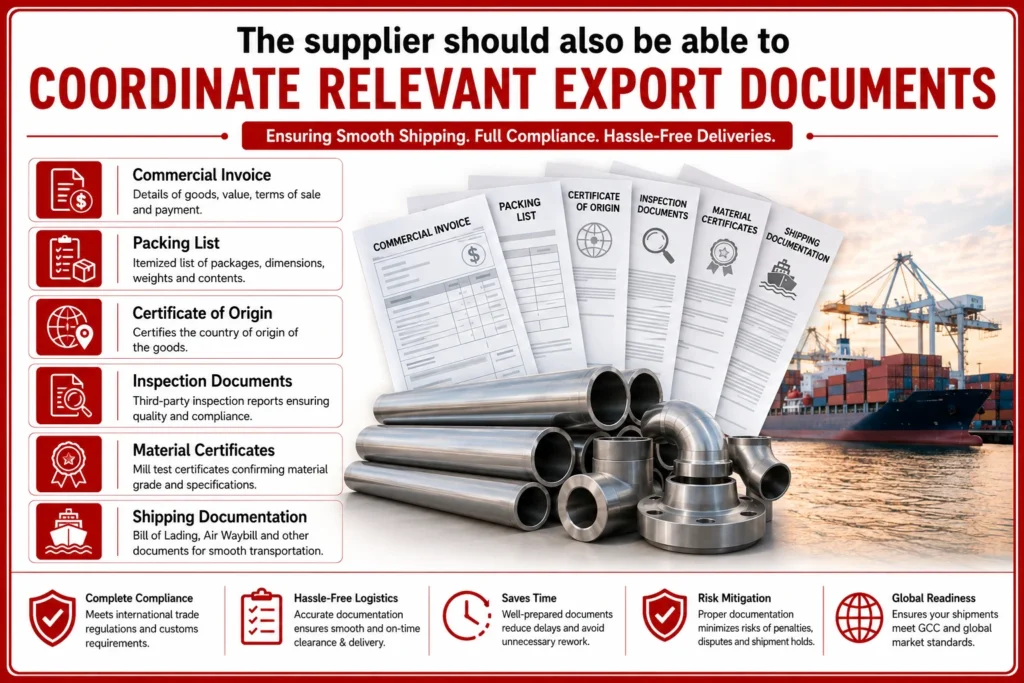
Good logistics planning can help prevent unnecessary delays after the material has been purchased.
10. Don’t Select a Supplier Based Only on Price
While price is undoubtedly significant, it shouldn’t be the sole factor used in the decision process.
If a lower quote for industrial plumbing leads to the wrong material, missing paperwork, delayed delivery, or item rejection, it can become costly.
A more accurate comparison takes into account the whole procurement value, which includes:
Material quality, certification, inspection, availability, delivery, logistics, and technical assistance
In the end, a supplier who maintains available stock and comprehensive documentation while charging a little bit more might offer a superior project value.
What Makes a Reliable UAE Pipe Supplier?
A trustworthy provider should have both strong supply capabilities and technological expertise. Purchasers should seek for a business that can comprehend the project specifications, suggest appropriate products, uphold traceability, set up inspections, and manage delivery.
Additionally, the supplier should be transparent about what is available, what has to be sourced, and how long each item will take.
When a purchase order includes dozens or hundreds of distinct pipe, fitting, and flange line items, this becomes more crucial.
Why Metallon Pipings?
Industrial pipe needs for oil and gas, petrochemical, refinery, offshore, marine, power generation, and infrastructure projects are supported by Metallon Pipings.
Along with fittings and flanges, the company offers a wide variety of piping products, such as carbon steel, stainless steel, alloy steel, duplex, super duplex, and nickel alloy pipes.
For GCC purchasers, matching the right quality, standard, dimensions, testing requirements, and documentation to the project is more important than just offering a product.
Conclusion
A thorough assessment of the product’s availability, quality, standards, paperwork, inspection, technical know-how, and delivery capacity is necessary when selecting the top pipe and fitting supplier in the United Arab Emirates.
More than just pipes and fittings should be available from a competent GCC stockist. The entire procurement process, including specification review, material sourcing, inspection, traceability, documentation, packing, and delivery, should be supported.
Buyers should give preference to suppliers who exhibit consistent quality, compliance with international standards, dependable stock, comprehensive MTCs, and demonstrated project-supply expertise for oil and gas, refinery, petrochemical, offshore, and power projects.
For GCC clients wishing to purchase pipes, fittings, flanges, and specialty piping materials via a coordinated supply chain, a UAE-based provider like Metallon Pipings can offer a feasible sourcing option.
How We Support You
Choosing the right pipe and fitting supplier in the UAE is essential for maintaining product quality, meeting project specifications, and avoiding costly procurement delays. Our team supports EPC contractors, procurement specialists, engineering consultants, distributors, and industrial buyers across the GCC with reliable sourcing, technical guidance, quality documentation, and efficient delivery solutions.
We support you with:
- Guidance in selecting carbon steel, stainless steel, alloy steel, duplex, super duplex, and nickel alloy pipes and fittings based on project requirements
- Recommendations based on operating pressure, temperature, corrosion resistance, fluid service, pipe size, schedule, and application conditions
- Support for oil & gas, petrochemical, refinery, power generation, marine, desalination, water treatment, and industrial infrastructure projects
- Assistance in evaluating supplier capabilities, product availability, technical expertise, quality systems, and delivery performance before procurement
- Sourcing of seamless, welded, ERW, fabricated, and specialty pipes along with elbows, tees, reducers, caps, couplings, flanges, and other fittings
- Guidance on compliance with ASTM, ASME, API, EN, DIN, ISO, NACE, and project-specific GCC and EPC specifications
- Support for checking material traceability, heat numbers, manufacturing records, inspection requirements, and product conformity
- Documentation support including Mill Test Certificates (MTCs), EN 10204 3.1/3.2 certificates, PMI reports, hydrostatic test reports, third-party inspection reports, and quality certifications
- Assistance with pipe schedules, dimensions, wall thickness, fitting classes, flange ratings, and component compatibility
- Reliable stock and bulk supply support to help reduce lead times and maintain project schedules
- Export packaging, logistics coordination, customs documentation, and delivery support for projects across Saudi Arabia, Qatar, Oman, Kuwait, Bahrain, and other GCC markets
- Fast quotations and dedicated procurement assistance from material selection through final delivery
Whether you are sourcing piping materials for an EPC project, refinery, petrochemical facility, power plant, infrastructure development, or industrial maintenance requirement, we provide dependable pipe and fitting supply backed by technical expertise, quality assurance, and efficient GCC-wide logistics.