Among the most popular pipeline goods in the oil and gas, petrochemical, construction, power generating, water, and infrastructure sectors are carbon steel pipes. They are appropriate for everything from process pipes to long-distance pipeline transportation due to their strength, availability, adaptability, and affordability.
But choosing the proper carbon steel pipe involves more than just picking a thickness and dimension. The distinction between seamless and ERW pipes, as well as the importance of API 5L grades used for oil and gas pipeline applications, must be understood by buyers.
The main varieties of carbon steel pipes, their production processes, common standards, API 5L grades, uses, and things buyers should think about before making a purchase are all covered in this book.
What Are Carbon Steel Pipes?
Carbon steel pipes are manufactured primarily from iron and carbon, with controlled quantities of elements such as manganese, silicon, sulfur, and phosphorus.
The carbon content and alloying elements influence properties such as:
- Tensile strength
- Yield strength
- Hardness
- Weldability
- Toughness
- Corrosion behavior
- Temperature performance
Carbon steel provides excellent mechanical strength, making it suitable for pressure and structural applications.
Common carbon steel pipe standards include:
- ASTM A53
- ASTM A106
- ASTM A333
- API 5L
- ASME dimensional standards
The appropriate specification depends on the intended application and project requirements.
Seamless Carbon Steel Pipes
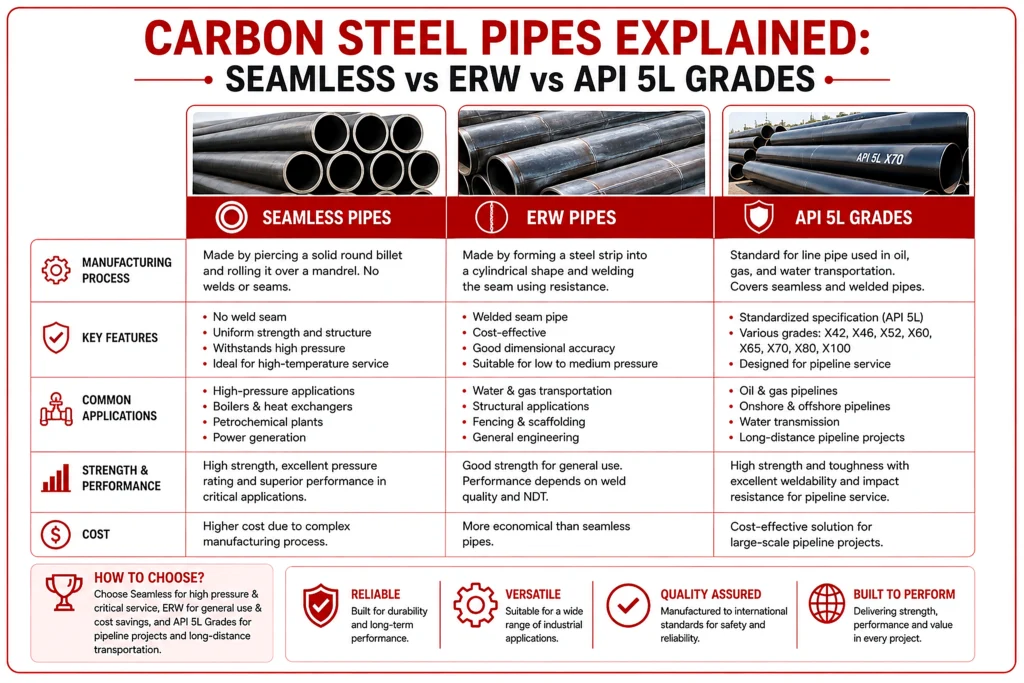
A longitudinal welded seam is not used in the production of a seamless pipe. A hollow tube is created by heating and piercing a solid steel billet, which is further treated to provide the necessary wall thickness and diameter.
Seamless pipe is often used for applications involving high pressure, high temperature, or stringent mechanical requirements since there is no weld seam.
Advantages of Seamless Pipes
- No longitudinal weld seam
- Excellent pressure resistance
- High mechanical strength
- Suitable for high-temperature applications
- Consistent performance under demanding conditions
- Available in a wide range of grades and sizes
Typical Applications
Seamless carbon steel pipes are commonly used in:
- Refineries
- Power plants
- Boilers
- Heat exchangers
- Process piping
- Oil & gas facilities
- High-pressure systems
ASTM A106 Grade B is a widely used seamless carbon steel pipe specification for high-temperature service.
ERW Carbon Steel Pipes
Electrical resistance welding is used to unite the edges of a flat steel strip or coil that has been formed into a cylindrical shape to create ERW, or electric resistance welded pipe.
Consistent weld quality and dimensional accuracy are provided by contemporary ERW manufacturing methods.
Applications where very high pressure is not the main design consideration frequently use ERW pipes.
Advantages of ERW Pipes
- Cost-effective manufacturing
- Excellent dimensional consistency
- Suitable for large production volumes
- Good surface finish
- Available in numerous sizes
- Efficient for many general industrial applications
Typical Applications
ERW carbon steel pipes are used for:
- Water pipelines
- Structural applications
- Low- and medium-pressure systems
- Oil & gas applications
- Utility pipelines
- Fire protection systems
- General industrial piping
Seamless vs ERW Carbon Steel Pipes
Feature | Seamless Pipe | ERW Pipe |
Manufacturing | Pierced solid billet | Formed steel strip + welded seam |
Weld Seam | None | Longitudinal weld |
Pressure Applications | Excellent | Suitable depending on specification |
High Temperature | Excellent for applicable grades | Depends on specification |
Dimensional Accuracy | Very good | Excellent |
Production Cost | Generally higher | Generally lower |
Large Volume Orders | Suitable | Highly suitable |
Typical Use | High-pressure/process service | General & pipeline applications |
Neither manufacturing method is automatically better for every application. The correct choice depends on the applicable standard, pressure, temperature, pipe size, service conditions, and project specification.
What Is API 5L?
API 5L is a key specification for steel line pipe used in pipeline transportation systems in the petroleum and natural gas industries.
API 5L covers requirements for seamless and welded line pipe used for transporting:
- Crude oil
- Natural gas
- Petroleum products
- Water
- Other fluids in pipeline systems
API 5L is particularly important for transmission and gathering pipeline projects.
Understanding API 5L Grades
API 5L grades identify the minimum strength level of the line pipe.
Common grades include:
- X42
- X52
- X60
- X65
- X70
The number following the “X” generally corresponds to the specified minimum yield strength in ksi.
For example:
X52 → minimum specified yield strength of approximately 52 ksi
X65 → minimum specified yield strength of approximately 65 ksi
Subject to engineering calculations and the relevant specification, higher-strength grades may be advantageous in applications where lower wall thickness or enhanced pressure capacity may be advantageous.
API 5L PSL1 vs PSL2
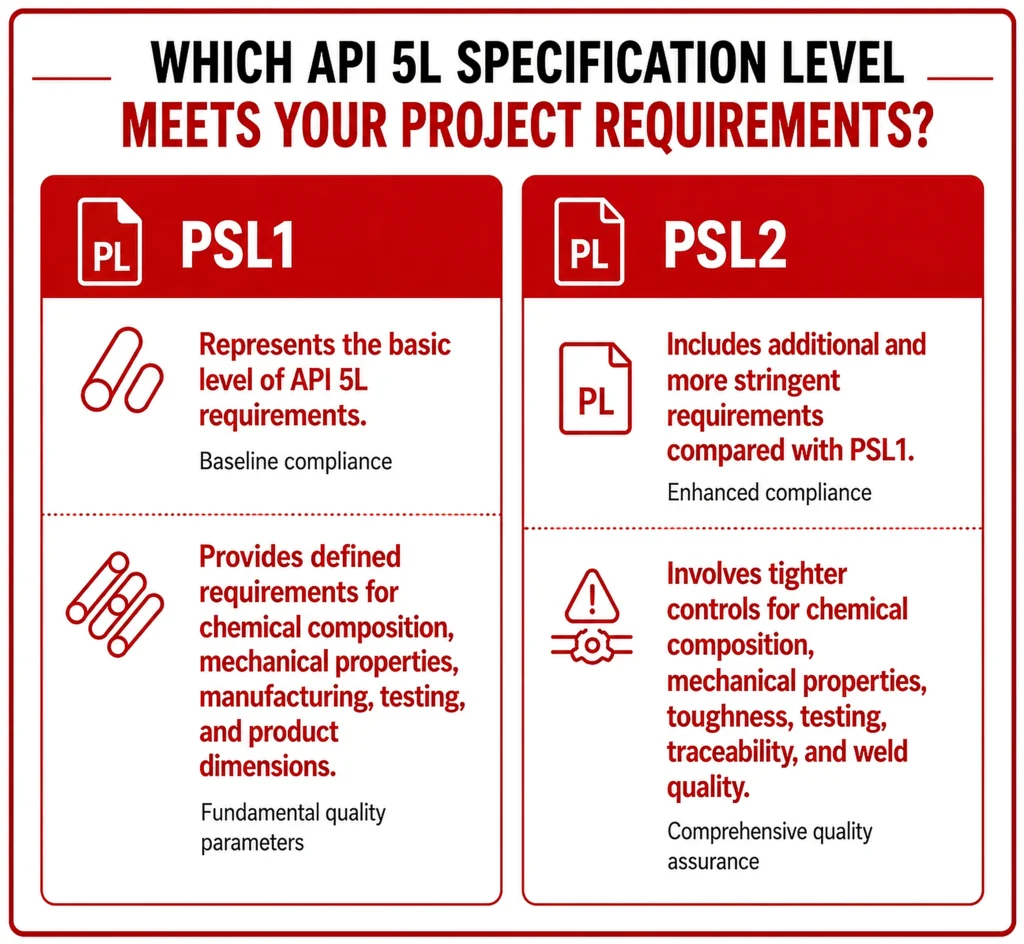
Another important consideration is the Product Specification Level (PSL).
PSL1
PSL1 represents the basic level of API 5L requirements.
It provides defined requirements for:
- Chemical composition
- Mechanical properties
- Manufacturing
- Testing
- Product dimensions
PSL2
PSL2 includes additional and more stringent requirements compared with PSL1.
Depending on the grade and application, PSL2 may involve tighter controls for:
- Chemical composition
- Mechanical properties
- Toughness
- Testing
- Traceability
- Weld quality
For critical oil and gas pipeline projects, PSL2 may be specified because of its enhanced quality and testing requirements.
Common API 5L Applications
API 5L pipes are widely used in:
Oil Transmission Pipelines
Carbon steel line pipes transport crude oil from production facilities to processing plants, storage terminals, and refineries.
Natural Gas Pipelines
High-strength API 5L grades are used in gas transmission and gathering systems.
Offshore Pipelines
Specialized line pipe specifications may be used for offshore applications where corrosion, pressure, temperature, and mechanical loading must be carefully considered.
Water Injection Systems
Pipelines can transport injection water in oilfield operations, subject to appropriate corrosion control and material selection.
ASTM A53 vs ASTM A106 vs API 5L
These specifications are often confused because all may involve carbon steel pipes, but they serve different purposes.
Specification | General Application |
ASTM A53 | General mechanical and pressure applications |
ASTM A106 | Seamless pipe for high-temperature service |
API 5L | Line pipe for pipeline transportation systems |
The correct specification should be determined based on the actual service and project requirements rather than substituting one standard for another simply because the pipe appears physically similar.
Factors to Consider When Selecting Carbon Steel Pipe
Before placing an order, buyers should evaluate:
1. Manufacturing Method
Determine whether seamless or welded/ERW pipe is required.
2. Material Grade
Select the appropriate grade based on pressure, temperature, strength, and service requirements.
3. Pipe Dimensions
Confirm:
- Nominal Pipe Size
- Outside Diameter
- Wall Thickness
- Schedule
- Length
4. Operating Conditions
Consider:
- Design pressure
- Operating temperature
- Fluid characteristics
- Corrosion conditions
- Flow requirements
5. Testing Requirements
Depending on the specification, requirements may include:
- Hydrostatic testing
- Ultrasonic testing
- Radiographic testing
- Visual inspection
- Dimensional inspection
- Impact testing
- Chemical analysis
6. Documentation
For industrial and oil & gas projects, request complete documentation including:
- Material Test Certificate
- Heat number traceability
- Chemical composition
- Mechanical test results
- Inspection reports
- Hydrostatic test certificates
- NDT reports where required
Why Choose a Reliable Carbon Steel Pipe Supplier?
In addition to grade, manufacturing controls, testing, traceability, and documentation all affect the quality of carbon steel pipe.
Carbon steel pipes for oil and gas, petrochemical, refinery, power generation, water, and industrial applications are supplied by Metallon Pipings. Its product line consists of seamless and welded pipes made in accordance with project specifications and relevant international standards.
Carbon steel piping can be sourced by customers along with associated goods like fittings and flanges, meeting all piping procurement needs.
Conclusion
Carbon steel pipes continue to be an essential part of energy and industrial infrastructure. While ERW pipes offer an affordable and effective option for many ordinary industrial and pipeline requirements, seamless pipes are frequently chosen for demanding high-pressure and high-temperature applications.
API 5L grades including X42, X52, X60, X65, and X70 offer variable strength levels to satisfy varied pipeline design requirements for oil and gas transmission. Buyers can choose piping that provides the necessary performance and dependability by being aware of the variations in manufacturing techniques, material specifications, grades, and PSL requirements.
Always confirm the relevant specification, grade, dimensions, testing requirements, and material paperwork prior to procurement for important projects.
How We Support You
Selecting the right carbon steel pipe is essential for ensuring strength, pressure resistance, weldability, and long-term reliability across industrial and pipeline applications. Our team supports EPC contractors, procurement specialists, piping engineers, project consultants, and industrial buyers in choosing the most suitable seamless, ERW, and API 5L pipe solutions for demanding projects.
We support you with:
- Guidance in selecting seamless, ERW, and API 5L carbon steel pipes based on application, pressure, temperature, diameter, wall thickness, and service conditions
- Assistance in understanding the differences between seamless and ERW pipes and selecting the appropriate manufacturing method for your project
- Recommendations for API 5L grades such as Grade B, X42, X52, X60, X65, and X70 for oil & gas transmission and pipeline applications
- Support for ASTM A106, ASTM A53, API 5L, and other commonly specified carbon steel pipe standards
- Guidance on pipe schedules, wall thickness, outside diameter, length, end connections, and dimensional requirements
- Support for oil & gas pipelines, refineries, petrochemical plants, power generation, water transmission, structural applications, and industrial process piping
- Assistance in selecting pipes based on tensile strength, yield strength, weldability, corrosion protection, and operating pressure requirements
- Guidance on compatible carbon steel fittings, flanges, valves, and other piping components for complete systems
- Support for compliance with ASTM, ASME, API, ISO, NACE, and project-specific EPC specifications
- Documentation support including Mill Test Certificates (MTCs), hydrostatic test reports, NDT reports, PMI where applicable, third-party inspection certificates, and quality certifications
- Assistance with bulk procurement, material traceability, custom sizes, project-specific testing, and quality documentation
- Fast quotations, export packaging, logistics coordination, and reliable supply support for GCC, African, European, and international projects
Whether your requirement involves a high-pressure pipeline, refinery process line, water transmission system, or industrial piping network, we provide reliable carbon steel pipe solutions tailored to meet your project’s technical, quality, safety, and delivery requirements.