Introduction
Piping networks that must function safely under a range of pressures, temperatures, and mechanical stresses are essential to water treatment plants, industrial process facilities, power plants, desalination projects, and municipal infrastructure systems. Engineers frequently employ specialized plumbing components like expansion joints and disassembly joints to preserve system dependability and make installation and maintenance easier.
Despite being put in piping systems, both parts have completely different functions. While disassembly joints are mostly used to make it easier to install, remove, and maintain equipment like valves, pumps, and flow meters, expansion joints are made to absorb movement and thermal expansion.
Understanding the differences between these two components is essential for selecting the right solution for water and process piping applications. This guide explains their functions, advantages, applications, and selection criteria to help engineers, contractors, and procurement professionals make informed decisions.
What Are Expansion Joints?
Flexible connectors called expansion joints are used in piping systems to absorb movement brought on by equipment movement, vibration, pressure changes, and thermal expansion.
Pipelines naturally expand and contract as they heat up or cool down while in use. The piping system may experience excessive stress in the absence of a device to absorb these motions, which could result in leaks, equipment damage, or early failure.
By allowing movement without placing undue strain on linked equipment, expansion joints offer flexibility and contribute to the preservation of system integrity.
Functions of Expansion Joints
Expansion joints are designed to:
- Absorb thermal expansion and contraction
- Reduce vibration transmission
- Compensate for pipe misalignment
- Minimize stress on pumps and equipment
- Absorb mechanical movement
- Improve system flexibility
They are commonly used in both above-ground and underground piping systems.
Types of Expansion Joints
Rubber Expansion Joints
Rubber expansion joints are widely used in water and wastewater systems.
Advantages
- Excellent vibration absorption
- Lightweight construction
- Corrosion resistance
- Easy installation
Applications
- Water treatment plants
- HVAC systems
- Pump discharge lines
- Municipal water networks
Metal Expansion Joints
Metal expansion joints are typically manufactured from stainless steel bellows.
Advantages
- High-temperature capability
- Pressure resistance
- Long service life
- Suitable for aggressive process fluids
Applications
- Refineries
- Petrochemical plants
- Power generation facilities
- Steam systems
Fabric Expansion Joints
Fabric expansion joints are commonly used in low-pressure ducting systems.
Applications
- Flue gas systems
- Air handling systems
- Industrial exhaust systems
What Are Dismantling Joints?
Adjustable piping parts called dismantling joints are made to make it easier to install, remove, replace, and maintain valves, pumps, flow meters, and other pipeline equipment.
Dismantling joints do not absorb thermal movement, in contrast to expansion joints. Their major purpose is to offer axial adjustment for installation and maintenance tasks.
They make it simple for engineers to disconnect equipment without having to cut or alter the pipeline.
Functions of Dismantling Joints
Dismantling joints help to:
- Simplify equipment installation
- Facilitate maintenance operations
- Allow easy removal of valves and pumps
- Compensate for installation tolerances
- Reduce downtime during repairs
- Improve accessibility in piping systems
These joints are particularly common in municipal water infrastructure and industrial process plants.
Components of a Dismantling Joint
A typical dismantling joint consists of:
- Main body section
- Adjustable middle section
- Tie rods
- Flanges
- Gaskets
- Fasteners
The adjustable design allows installers to create or remove space when connecting or disconnecting equipment.
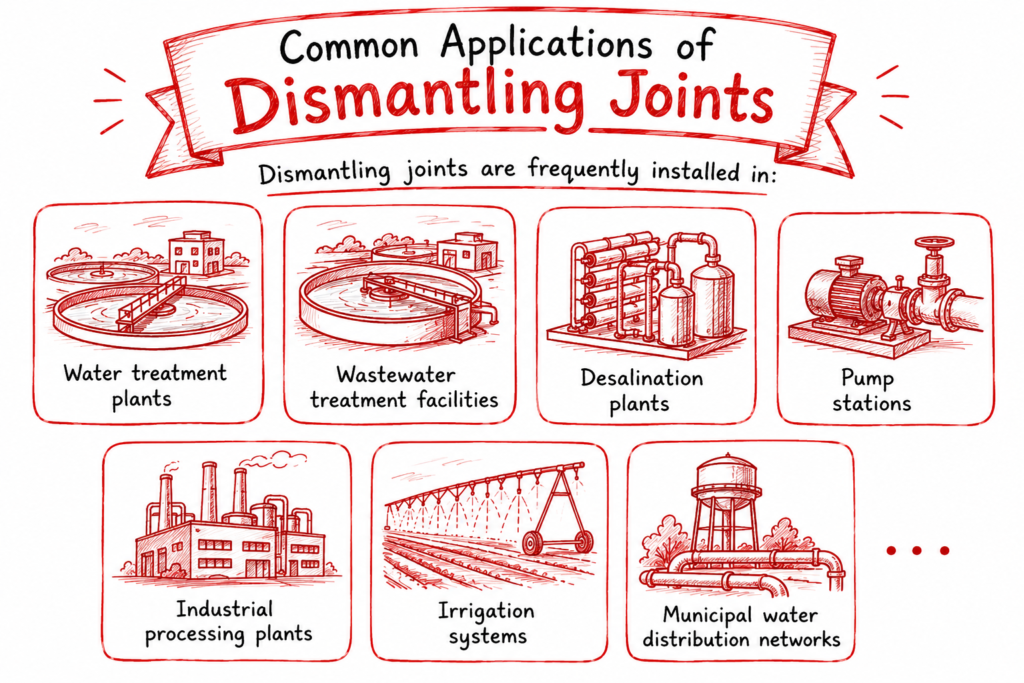
Common Applications of Dismantling Joints
Dismantling joints are frequently installed in:
- Water treatment plants
- Wastewater treatment facilities
- Desalination plants
- Pump stations
- Industrial processing plants
- Irrigation systems
- Municipal water distribution networks
They are particularly useful wherever regular maintenance or equipment replacement may be required.
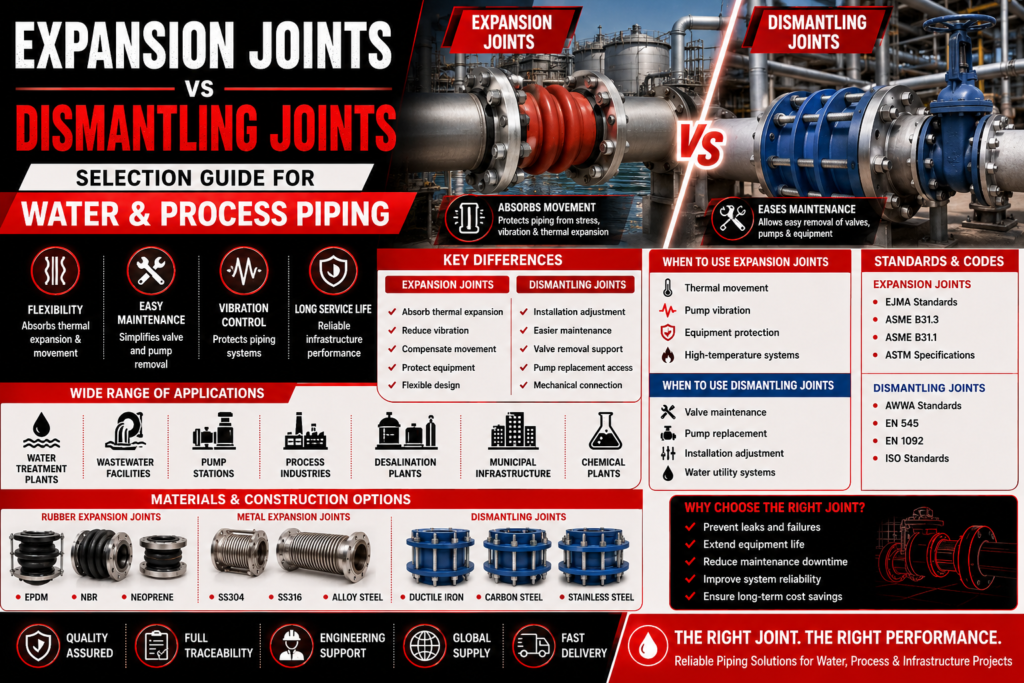
Expansion Joints vs Dismantling Joints: Key Differences
- Expansion joints absorb thermal expansion, vibration, and pipeline movement.
- Dismantling joints simplify equipment installation, removal, and maintenance.
- Expansion joints provide high flexibility, while dismantling joints offer length adjustment with limited flexibility.
- Expansion joints help reduce stress on piping systems, whereas dismantling joints improve maintenance accessibility.
- Expansion joints are typically made from rubber, metal, or fabric, while dismantling joints are commonly made from carbon steel, stainless steel, or ductile iron.
- Expansion joints accommodate movement and pressure changes; dismantling joints are designed primarily for assembly and disassembly.
When to Use Expansion Joints
Expansion joints should be selected when piping systems experience:
Thermal Expansion
High-temperature systems such as steam lines and hot process piping undergo significant expansion and contraction.
Equipment Vibration
Pumps, compressors, and rotating equipment often generate vibration that can damage connected piping.
Pipe Movement
Long pipeline runs may experience movement due to temperature changes, settlement, or operational loads.
Noise Reduction Requirements
Expansion joints help reduce vibration-related noise within piping systems.
Common Industries
- Power plants
- Petrochemical facilities
- Chemical processing plants
- HVAC systems
- Desalination facilities
When to Use Dismantling Joints
Dismantling joints are preferred when maintenance accessibility is a priority.
Valve Installation
Large valves often require dismantling joints to simplify future removal and replacement.
Pump Maintenance
Pump stations commonly use dismantling joints to facilitate equipment servicing.
Flow Meter Installations
Meters can be removed and calibrated more efficiently when dismantling joints are installed.
Water Infrastructure Projects
Municipal water systems frequently incorporate dismantling joints because they simplify long-term maintenance.
Common Industries
- Water treatment plants
- Wastewater treatment facilities
- Irrigation projects
- Municipal utilities
- Industrial process plants
Material Selection for Expansion and Dismantling Joints
Carbon Steel
Commonly used in industrial process systems where corrosion is manageable.
Stainless Steel
Preferred for corrosive environments, water treatment applications, and chemical processing facilities.
Ductile Iron
Widely used for dismantling joints in municipal water systems due to its strength and cost-effectiveness.
Rubber Materials
Expansion joints may utilize EPDM, NBR, or neoprene depending on the service conditions.
Material selection should be based on fluid characteristics, pressure, temperature, and environmental conditions.
Important Standards
Several international standards govern the design and manufacture of these components.
Expansion Joint Standards
- EJMA Standards
- ASME B31.3
- ASME B31.1
- ASTM Material Specifications
Dismantling Joint Standards
- AWWA Standards
- EN 545
- EN 1092
- ISO Standards
Compliance with applicable standards ensures safety, reliability, and long-term performance.
Factors to Consider During Selection
Operating Temperature
High-temperature systems generally require metal expansion joints.
Pressure Rating
The selected component must meet the system’s maximum operating pressure.
Fluid Compatibility
Materials must be compatible with the process fluid to prevent corrosion and degradation.
Maintenance Requirements
Systems requiring frequent equipment servicing benefit significantly from dismantling joints.
Available Installation Space
Space limitations may influence the type and size of the component selected.
Lifecycle Cost
Initial purchase cost should be evaluated alongside maintenance expenses and expected service life.
Common Mistakes to Avoid
Several errors frequently occur during component selection:
- Using dismantling joints to absorb thermal expansion
- Installing expansion joints where maintenance access is the primary requirement
- Ignoring pressure and temperature ratings
- Selecting incompatible materials
- Overlooking future maintenance needs
Proper engineering evaluation helps prevent these costly mistakes.
Conclusion
In water and process pipe systems, expansion joints and dismantling joints have distinct but equally significant functions. Expansion joints shield piping systems from stress-related failures by absorbing movement, vibration, and thermal expansion. On the other hand, by offering adjustable pipe connections, disassembling joints make equipment replacement, maintenance, and installation easier.
The right component must be chosen for water treatment plants, desalination facilities, municipal infrastructure, and industrial process systems in order to maximize dependability, minimize downtime, and reduce long-term maintenance costs. Engineers and project owners may guarantee effective and trouble-free piping system performance for years to come by comprehending the distinctive functions of each solution and taking into account elements like operating circumstances, maintenance needs, and material compatibility.
How We Support You
Selecting the right joint solution for water and process piping systems is essential for ensuring operational reliability, leak-free performance, maintenance efficiency, and long-term system integrity. Our team helps EPC contractors, utility operators, consultants, and procurement professionals choose the most suitable expansion joints and dismantling joints based on pressure requirements, pipeline movement, installation conditions, and project specifications.
We support you with:
- Guidance in selecting expansion joints and dismantling joints for water treatment, industrial processing, power generation, and infrastructure projects
- Recommendations for accommodating thermal expansion, vibration, misalignment, equipment movement, and maintenance requirements
- Support for potable water systems, wastewater treatment plants, desalination facilities, pump stations, and process piping networks
- Assistance with ASTM, ASME, AWWA, ISO, EN, BS, and project-specific compliance requirements
- Guidance on rubber expansion joints, metallic expansion joints, fabric expansion joints, and dismantling joint assemblies
- Support for high-pressure, high-temperature, corrosive, and vibration-prone operating conditions
- Assistance with valves, pumps, pipelines, fittings, flanges, and complete piping system integration
- Material selection guidance for carbon steel, stainless steel, ductile iron, duplex steel, and specialty alloy applications
- Support for Material Test Certificates (MTCs), inspection reports, third-party certifications, and quality documentation
- Fast quotations, custom sizing, export logistics, and bulk supply support for water and industrial infrastructure projects
Whether your project involves water distribution networks, wastewater treatment facilities, desalination plants, industrial process systems, power generation infrastructure, or large-scale EPC developments, we provide reliable jointing solutions tailored to your operational requirements, maintenance objectives, and project specifications.