Product quality is just as crucial as cost and delivery when buying industrial pipes for infrastructure, power generation, oil and gas, petrochemical, or marine applications. The Material Test Report (MTR), often called a Mill Test Certificate (MTC), is one of the most crucial documents that buyers should examine before accepting any shipment.
An MTR confirms that the pipe meets the necessary production requirements, mechanical characteristics, chemical composition, and material grade. Customers may be assured that the materials meet project specifications since it offers full traceability from the steel mill to the final product.
This article covers the contents of a pipe Material Test Report, how to read it, and why it’s important to comprehend a MTR in order to make wise purchasing decisions.
What Is a Material Test Report (MTR)?
After evaluating the material during manufacturing, the producer or steel mill issues an official quality assurance document called a Material Test Report. It attests to the supplied pipe’s manufacturing adherence to requirements and its passing of the necessary tests and inspections.
An MTR helps buyers verify:
- Material grade
- Chemical composition
- Mechanical properties
- Manufacturing standard
- Heat number traceability
- Inspection and testing results
- Compliance with project specifications
For industries such as oil & gas, chemical processing, power generation, and offshore engineering, reviewing the MTR is a standard part of the procurement and quality control process.
Why Is an MTR Important?
Industrial piping systems often operate under high pressure, extreme temperatures, and corrosive environments. Using incorrect or uncertified materials can lead to equipment failure, safety risks, and expensive project delays.
A Material Test Report provides assurance that:
- The correct material has been supplied.
- The pipe meets applicable international standards.
- Mechanical properties satisfy design requirements.
- Chemical composition is within specified limits.
- The material can be traced back to its manufacturing batch.
For critical projects, the MTR is often required before installation or project approval.
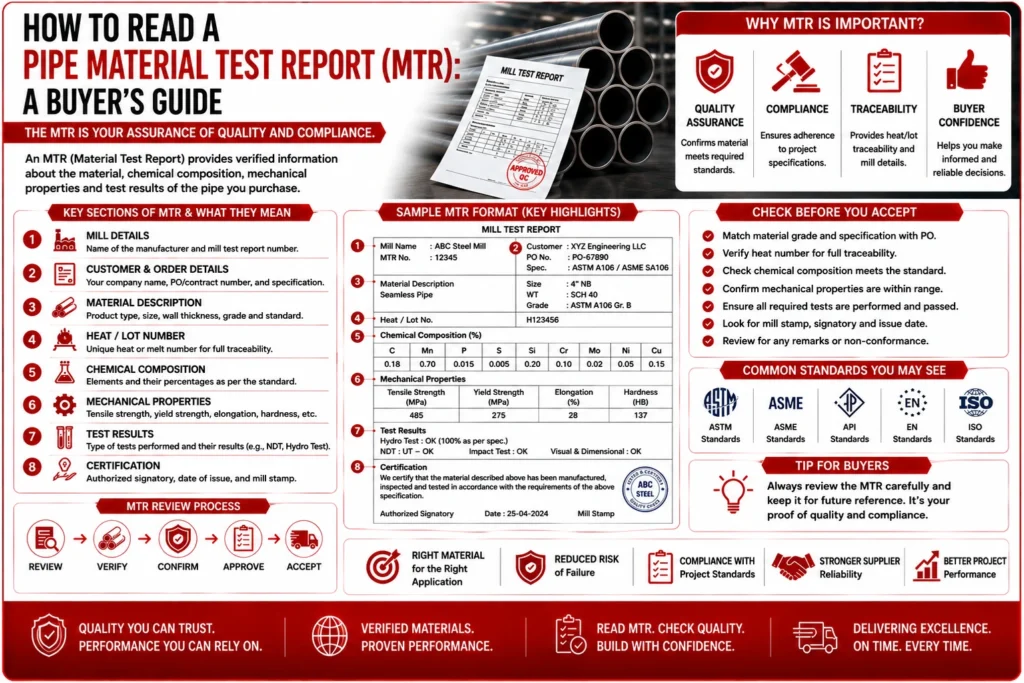
Key Sections of a Pipe Material Test Report
Although formats vary between manufacturers, most Material Test Reports include similar information.
1. Manufacturer Information
The report begins with details of the manufacturing mill or supplier, including:
- Manufacturer name
- Plant location
- Certificate number
- Date of issue
This information confirms the origin of the material.
2. Product Description
The report identifies the supplied product, including:
- Pipe type
- Pipe size
- Outside diameter
- Wall thickness
- Length
- Quantity
- Material grade
Ensure these details match your purchase order and project specifications.
3. Material Specification
The MTR states the manufacturing standard followed during production.
Examples include:
- ASTM A106
- ASTM A53
- ASTM A312
- ASTM A335
- ASTM A790
- ASTM A789
Buyers should confirm that the specified standard matches the project requirements.
4. Heat Number (Heat Traceability)
One of the most important details on an MTR is the heat number.
The heat number identifies the specific batch of steel used to manufacture the pipe and enables complete traceability throughout the supply chain.
The same heat number should appear on:
- The Material Test Report
- Pipe markings
- Product labels
- Inspection records
Matching these numbers helps verify that the supplied material corresponds to the certificate provided.
Understanding Chemical Composition
Every material grade has a specified chemical composition that determines its properties.
The MTR lists the percentage of elements such as:
- Carbon (C)
- Manganese (Mn)
- Silicon (Si)
- Chromium (Cr)
- Nickel (Ni)
- Molybdenum (Mo)
- Sulfur (S)
- Phosphorus (P)
For stainless steel, duplex stainless steel, alloy steel, and nickel alloys, these alloying elements are particularly important because they influence:
- Corrosion resistance
- Strength
- Weldability
- Heat resistance
Compare the reported values with the limits specified in the applicable ASTM standard to ensure compliance.
Mechanical Properties
The MTR also includes the results of mechanical testing carried out on the material.
Typical properties include:
Yield Strength
Yield strength indicates the stress at which the material begins to deform permanently.
Higher yield strength is often required for high-pressure applications.
Tensile Strength
Tensile strength measures the maximum load the material can withstand before failure.
This property is essential for structural integrity and pipeline safety.
Elongation
Elongation measures the material’s ductility or ability to stretch before breaking.
Good ductility helps absorb stress without cracking.
Hardness
Some material grades also include hardness test results, particularly for alloy steels and high-performance materials.
Non-Destructive Testing (NDT)
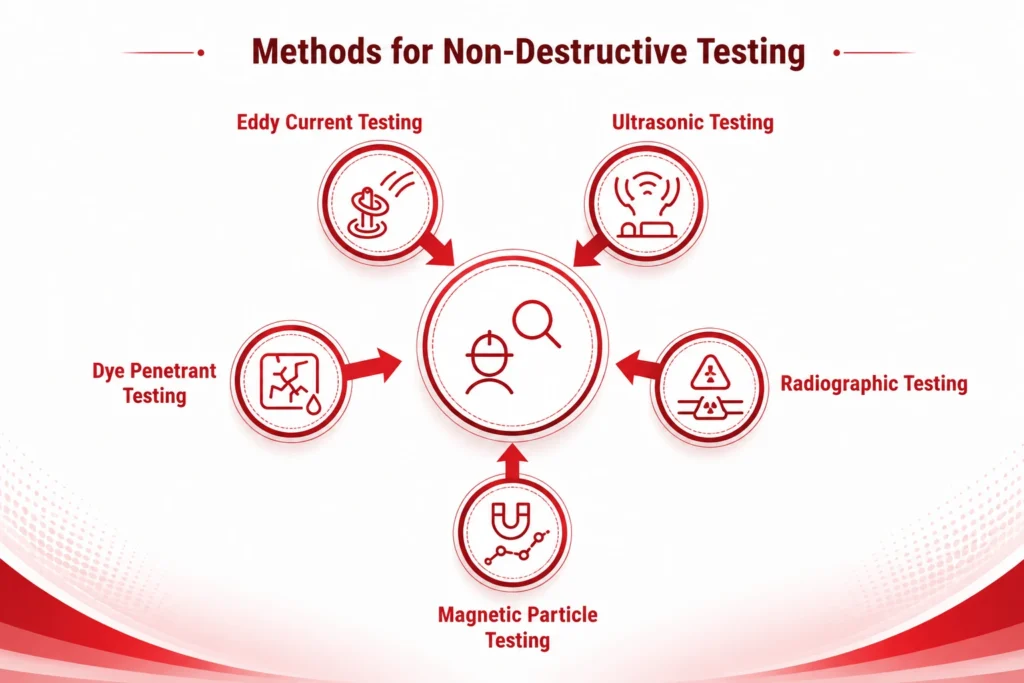
Many industrial pipes undergo Non-Destructive Testing to detect surface or internal defects without damaging the material.
Depending on project requirements, the MTR may reference tests such as:
- Ultrasonic Testing (UT)
- Radiographic Testing (RT)
- Magnetic Particle Testing (MT)
- Dye Penetrant Testing (PT)
- Eddy Current Testing (ET)
These inspections help ensure the pipe is free from significant manufacturing defects.
Hydrostatic Test Results
Pressure testing is commonly performed to verify the pipe’s ability to withstand internal pressure.
The MTR may include:
- Test pressure
- Test duration
- Test result
- Pass or fail status
Successful hydrostatic testing confirms the integrity of the pipe before shipment.
Dimensional Inspection
The report may also include dimensional verification, ensuring the pipe complies with specified tolerances.
Typical measurements include:
- Outside diameter
- Wall thickness
- Length
- Straightness
- Ovality
Accurate dimensions are essential for proper installation and compatibility with fittings and flanges.
How Buyers Should Verify an MTR
Before accepting any shipment, buyers should carefully review the Material Test Report and compare it with the purchase order and project specifications.
Important checks include:
- Verify the material grade.
- Confirm the ASTM or ASME specification.
- Match the heat number with the pipe markings.
- Review the chemical composition.
- Check mechanical property values.
- Confirm required inspections have been completed.
- Ensure certificates are complete and signed.
- Verify that quantities and dimensions match the order.
A systematic review helps prevent costly procurement errors.
Common Mistakes Buyers Should Avoid
When reviewing Material Test Reports, buyers should avoid the following mistakes:
- Accepting incomplete certificates.
- Ignoring heat number mismatches.
- Failing to compare the MTR with project specifications.
- Overlooking missing inspection reports.
- Assuming all pipes from the same supplier have identical certifications.
- Not verifying mechanical and chemical test results.
Careful documentation review can prevent quality issues before installation.
Why Buy from a Trusted Supplier
In addition to delivering industrial pipes, a trustworthy supplier offers full quality control and supporting paperwork for each shipment.
Every order at Metallon Pipings is supported by extensive documentation, such as traceability information, inspection records, material test reports, and mill test certificates. This guarantees that consumers receive goods that satisfy the technical specifications of difficult industries including oil and gas, petrochemicals, power generation, maritime engineering, and infrastructure when combined with stringent quality control and adherence to international standards.
Conclusion
One of the most important documents in the industrial procurement process is a pipe material test report. It offers full traceability from the steel mill to the final product while verifying the identity, quality, and compliance of the material supplied.
Buyers may make well-informed purchasing decisions and lower the risk of expensive project delays or material failures by learning how to read a MTR and confirm facts such material grade, heat number, chemical composition, mechanical qualities, and inspection results.
By working with a reliable supplier like Metallon Pipings, customers can be guaranteed that every shipment satisfies project requirements and international standards in addition to having access to high-quality industrial piping supplies, thorough documentation, and technical assistance.
How We Support You
Understanding a Pipe Material Test Report (MTR) is essential for verifying material quality, traceability, and compliance before procurement. Our team helps EPC contractors, procurement specialists, quality inspectors, project engineers, and industrial buyers interpret MTRs accurately to ensure every pipe meets project specifications and international quality standards.
We support you with:
- Guidance in understanding every section of a Pipe Material Test Report (MTR), including material grade, heat number, dimensions, and manufacturing details
- Assistance in verifying chemical composition, mechanical properties, tensile strength, yield strength, elongation, hardness, and impact test results
- Support for reviewing MTRs for carbon steel, stainless steel, alloy steel, duplex, super duplex, and high nickel alloy pipes
- Guidance on compliance with ASTM, ASME, API, EN 10204, ISO, NACE, and project-specific quality requirements
- Assistance in verifying heat treatment records, hydrostatic test results, non-destructive testing (NDT), PMI reports, and supplementary inspection data
- Support for confirming material traceability through heat numbers, batch identification, manufacturer details, and inspection records
- Recommendations for identifying discrepancies, non-conformities, and documentation issues before material acceptance
- Documentation support including EN 10204 3.1/3.2 certificates, Mill Test Certificates (MTCs), third-party inspection reports, certificates of origin, and quality certifications
- Guidance for procurement teams to validate supplier documentation and ensure compliance with EPC, refinery, petrochemical, offshore, and power plant project specifications
- Technical assistance to help buyers make informed purchasing decisions and minimize quality, compliance, and project execution risks
Whether you are procuring pipes for oil & gas, petrochemical, power generation, marine, desalination, or industrial infrastructure projects, we help you interpret Material Test Reports with confidence, ensuring product authenticity, regulatory compliance, and long-term project reliability.