Introduction
Some of the world’s most corrosive conditions are used by the marine and offshore sectors. The longevity of typical plumbing systems can be considerably reduced by continuous exposure to seawater, salt-laden air, chlorides, humidity, and fluctuating temperatures. Choosing the appropriate piping material is essential for guaranteeing long-term dependability and reducing maintenance costs, whether in shipbuilding, offshore oil and gas platforms, desalination plants, navy vessels, ports, or coastal infrastructure.
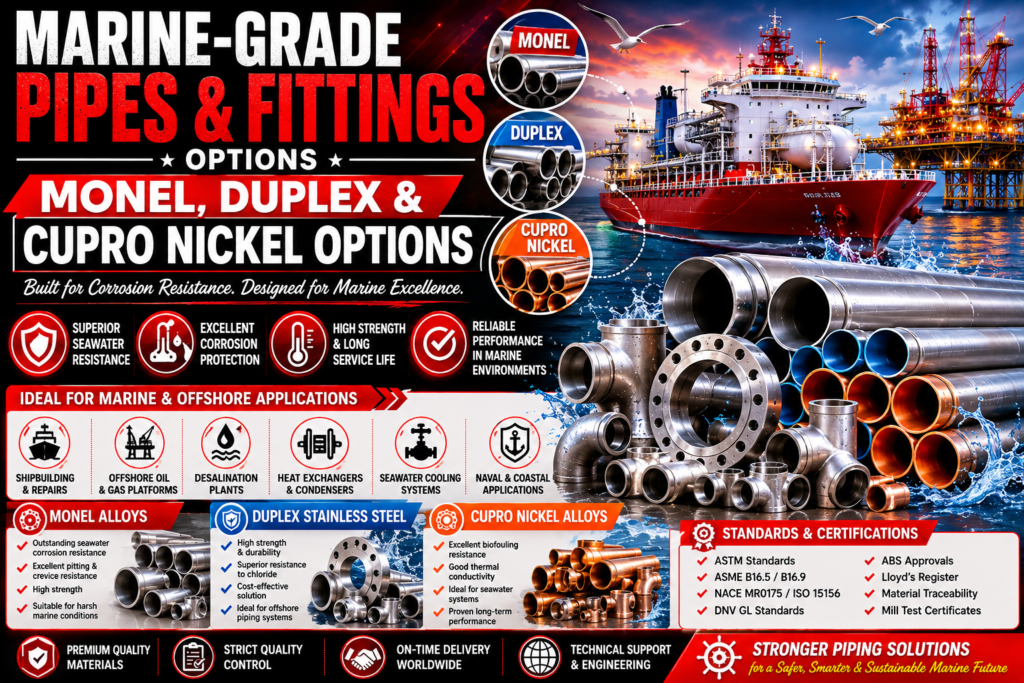
Marine-grade pipes and fittings are made especially to endure harsh seawater conditions without compromising their structural integrity or operational effectiveness. Cupro Nickel alloys, Duplex Stainless Steel, and Monel alloys are some of the most reliable materials for marine applications. In harsh marine conditions, these materials provide outstanding performance, durability, and resistance to corrosion.
This guide explores the properties, advantages, applications, standards, and selection considerations for Monel, Duplex, and Cupro Nickel pipes and fittings used in marine and offshore industries.
Why Marine Applications Require Specialized Pipes and Fittings
Standard carbon steel piping systems can quickly deteriorate due to special challenges seen in marine conditions. Corrosion is exacerbated by the high amounts of dissolved oxygen and chlorides found in seawater. Furthermore, maritime systems frequently deal with biological growth, high pressures, temperature fluctuations, and continuous operation.
Common corrosion problems in marine environments include:
- Pitting corrosion
- Crevice corrosion
- Galvanic corrosion
- Stress corrosion cracking
- Microbiologically influenced corrosion (MIC)
To combat these challenges, marine-grade materials must provide:
- Superior seawater corrosion resistance
- Long service life
- High mechanical strength
- Resistance to biofouling
- Low maintenance requirements
- Reliability under continuous operation
Monel, Duplex Stainless Steel, and Cupro Nickel have become preferred choices because they offer these essential performance characteristics.
Monel Pipes and Fittings
What Is Monel?
The nickel-copper alloy monel is renowned for its remarkable resistance to chemical corrosion and saltwater. Monel 400, which has about 67% nickel and 23% copper, is the grade most frequently utilized in marine applications.
Because monel alloys are strong and resistant to corrosion even in extremely hostile seawater conditions, they have been utilized in naval duty for many years.
Key Properties of Monel
Monel offers several advantages for marine applications:
- Outstanding resistance to seawater corrosion
- Excellent resistance to pitting and crevice corrosion
- High mechanical strength
- Good toughness across a wide temperature range
- Excellent weldability and fabrication characteristics
- Resistance to acidic and alkaline solutions
Unlike many conventional materials, Monel performs exceptionally well in both static and flowing seawater systems.
Common Standards for Monel Pipes and Fittings
Marine projects commonly specify Monel products manufactured according to:
- ASTM B165 (Seamless Pipe and Tube)
- ASTM B725 (Welded Pipe)
- ASTM B366 (Fittings)
- ASTM B564 (Forged Components)
Compliance with these standards ensures consistent quality and performance.
Applications of Monel in Marine Industries
Monel pipes and fittings are commonly used in:
- Offshore oil and gas platforms
- Seawater cooling systems
- Marine heat exchangers
- Desalination facilities
- Naval vessels
- Pump and valve components
- Firewater systems
Because of its excellent seawater resistance, Monel is often selected for critical systems where failure is not an option.
Limitations of Monel
While Monel offers exceptional performance, it also has some drawbacks:
- Higher material cost
- More expensive fabrication compared to stainless steel
- Greater weight than some alternative alloys
For this reason, Monel is generally used in highly critical applications where corrosion resistance justifies the investment.
Duplex Stainless Steel Pipes and Fittings
What Is Duplex Stainless Steel?
Duplex Stainless Steel combines ferritic and austenitic stainless steel microstructures. This unique composition provides a combination of high strength and excellent corrosion resistance.
The most commonly used grades include:
- UNS S31803
- UNS S32205 (Duplex 2205)
- UNS S32750 (Super Duplex)
- UNS S32760 (Super Duplex)
Duplex materials have become increasingly popular in marine and offshore projects due to their ability to provide superior performance at a lower cost than many nickel alloys.
Key Properties of Duplex Stainless Steel
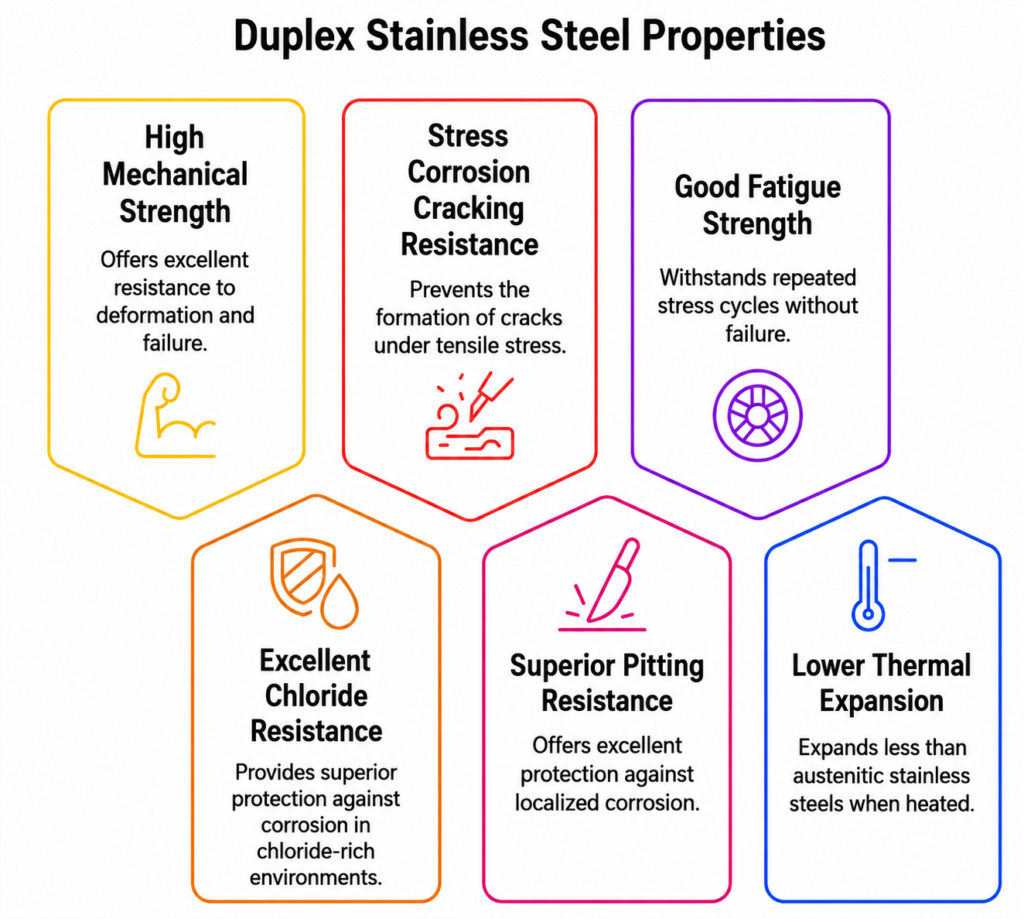
Duplex Stainless Steel offers:
- High mechanical strength
- Excellent chloride resistance
- Resistance to stress corrosion cracking
- Superior pitting resistance
- Good fatigue strength
- Lower thermal expansion compared to austenitic stainless steels
Its higher strength often allows designers to use thinner wall sections, reducing overall project weight and material costs.
Common Standards for Duplex Pipes and Fittings
Typical standards include:
- ASTM A790 (Seamless and Welded Pipe)
- ASTM A928 (Electric Fusion Welded Pipe)
- ASTM A815 (Fittings)
- ASTM A182 (Forged Components)
These standards are widely recognized in offshore and marine projects worldwide.
Applications of Duplex Stainless Steel
Duplex and Super Duplex materials are commonly used in:
- Offshore platforms
- Seawater injection systems
- Desalination plants
- Marine process piping
- Firewater systems
- Shipbuilding projects
- Coastal infrastructure
Super Duplex grades are particularly suitable for highly aggressive seawater environments due to their exceptional pitting resistance.
Advantages of Duplex Stainless Steel
The growing popularity of Duplex materials is driven by several benefits:
- Higher strength than conventional stainless steel
- Excellent seawater corrosion resistance
- Lower lifecycle costs
- Reduced maintenance requirements
- Good balance between performance and cost
Limitations of Duplex Stainless Steel
Despite its advantages, Duplex Stainless Steel requires careful fabrication and welding procedures to maintain its corrosion-resistant properties. Improper welding can negatively affect material performance.
Cupro Nickel Pipes and Fittings
What Is Cupro Nickel?
Cupro Nickel is a copper-nickel alloy specifically developed for marine and seawater applications. The most widely used grades are:
- 90/10 Cupro Nickel (90% Copper, 10% Nickel)
- 70/30 Cupro Nickel (70% Copper, 30% Nickel)
These alloys have been extensively used in shipbuilding and seawater systems for decades.
Key Properties of Cupro Nickel
Cupro Nickel offers:
- Excellent seawater corrosion resistance
- Natural resistance to marine biofouling
- Good thermal conductivity
- Excellent fabrication characteristics
- Long service life
- Resistance to erosion-corrosion
One of the most valuable characteristics of Cupro Nickel is its natural ability to resist marine organism growth.
Common Standards for Cupro Nickel Pipes and Fittings
Typical standards include:
- ASTM B466 (Seamless Pipe)
- ASTM B467 (Welded Pipe)
- ASTM B369 (Fittings)
- ASTM B151 (Plate and Sheet)
These standards ensure quality and suitability for marine service.
Applications of Cupro Nickel
Cupro Nickel is widely used in:
- Shipboard seawater piping systems
- Desalination plants
- Marine heat exchangers
- Condenser systems
- Offshore cooling water systems
- Power plant cooling circuits
Its excellent thermal conductivity makes it especially suitable for heat transfer applications.
Advantages of Cupro Nickel
Cupro Nickel provides several benefits:
- Outstanding resistance to biofouling
- Excellent seawater corrosion resistance
- Easy fabrication and repair
- Good thermal performance
- Proven long-term reliability
Limitations of Cupro Nickel
Compared to Duplex and Monel alloys, Cupro Nickel generally offers:
- Lower mechanical strength
- Reduced suitability for extremely high-pressure systems
- Higher material cost than standard stainless steels
However, its advantages often outweigh these limitations in cooling water applications.
Comparing Monel, Duplex, and Cupro Nickel
Each material offers distinct advantages depending on project requirements.
Monel is often chosen when maximum corrosion resistance is required in highly aggressive marine environments.
Duplex Stainless Steel is preferred when high strength and corrosion resistance must be combined with cost efficiency.
Cupro Nickel remains one of the best solutions for seawater cooling systems and applications where biofouling resistance is important.
Material selection should consider:
- Seawater exposure levels
- Operating pressure
- Temperature conditions
- Fabrication requirements
- Lifecycle costs
- Maintenance expectations
Quality Standards and Certifications
Marine and offshore projects often require compliance with:
- ASTM Standards
- ASME Standards
- NACE Requirements
- DNV Certifications
- ABS Marine Standards
- Lloyd’s Register Approvals
- ISO 9001 Quality Systems
These certifications help ensure product quality, traceability, and suitability for marine service.
Conclusion
For offshore, shipbuilding, desalination, and coastal infrastructure projects to operate safely and dependably, marine-grade pipes and fittings are crucial. Monel, Duplex Stainless Steel, and Cupro Nickel are some of the top material choices that offer special benefits for preventing seawater corrosion and prolonging service life.
Cupro Nickel continues to be a tried-and-true option for seawater cooling and heat transfer systems, Duplex Stainless Steel provides the perfect balance of strength and corrosion resistance, and Monel gives remarkable resilience to harsh marine environments. Engineers and procurement teams may choose the best marine-grade piping system for long-term performance and dependability by carefully assessing operating circumstances, corrosion hazards, pressure requirements, and project budgets.
How We Support You
Selecting the right marine-grade pipes and fittings is essential for ensuring long-term corrosion resistance, structural integrity, and reliable performance in harsh seawater and offshore environments. Our team helps shipbuilders, EPC contractors, offshore operators, marine engineers, and procurement professionals choose the most suitable piping materials, including Monel, Duplex Stainless Steel, and Cupro Nickel alloys, based on operating conditions, seawater exposure, pressure requirements, and project specifications.
We support you with:
- Guidance in selecting Monel, Duplex Stainless Steel, Super Duplex Stainless Steel, and Cupro Nickel pipes and fittings for marine applications
- Recommendations for shipbuilding, offshore platforms, desalination plants, naval infrastructure, ports, and coastal industrial facilities
- Support for seawater cooling systems, firewater networks, ballast systems, heat exchangers, and process piping applications
- Assistance with ASTM, ASME, API, ISO, NORSOK, DNV, ABS, and project-specific compliance requirements
- Guidance on material selection for resistance against seawater corrosion, chloride attack, biofouling, erosion-corrosion, and marine atmospheric exposure
- Support for seamless and welded pipes, fittings, flanges, valves, and complete marine piping packages
- Assistance with Material Test Certificates (MTCs), inspection reports, third-party certifications, and quality documentation
- Recommendations for high-pressure, high-flow, and corrosive offshore service conditions
- Support for custom sizes, schedules, fabrication requirements, and project-specific engineering solutions
- Fast quotations, export logistics, and bulk supply support for marine, offshore, and coastal infrastructure projects worldwide
Whether your project involves offshore oil & gas platforms, marine vessels, desalination facilities, coastal power plants, naval infrastructure, or seawater handling systems, we provide reliable marine-grade piping solutions tailored to your operational requirements, environmental conditions, and corrosion-resistance needs.