Introduction
The Middle East has emerged as one of the major global centers for the production and export of LNG. To fulfill the rising demand for energy worldwide, nations like Qatar, the United Arab Emirates, Saudi Arabia, and Oman continue to make significant investments in LNG infrastructure. With some of the biggest LNG plants and export terminals in the world, Qatar continues to be one of these countries’ top producers of LNG.
Highly sophisticated engineering technologies are used in LNG projects in order to process, transport, store, and export natural gas at very low temperatures. Choosing the right pipes, fittings, flanges, and associated parts is essential for guaranteeing safety, dependability, and long-term operating performance because LNG is transported and stored at a temperature of about -162°C.
This guide explains the most commonly used piping materials, fittings, standards, and procurement considerations for LNG projects in Qatar and across the Middle East.
Understanding LNG Project Requirements
LNG facilities operate under demanding conditions that require materials capable of handling:
- Cryogenic temperatures
- High-pressure systems
- Thermal cycling
- Corrosive process environments
- Offshore and marine conditions
- Continuous plant operation
Unlike conventional oil and gas facilities, LNG plants require piping materials that maintain strength and toughness even at extremely low temperatures.
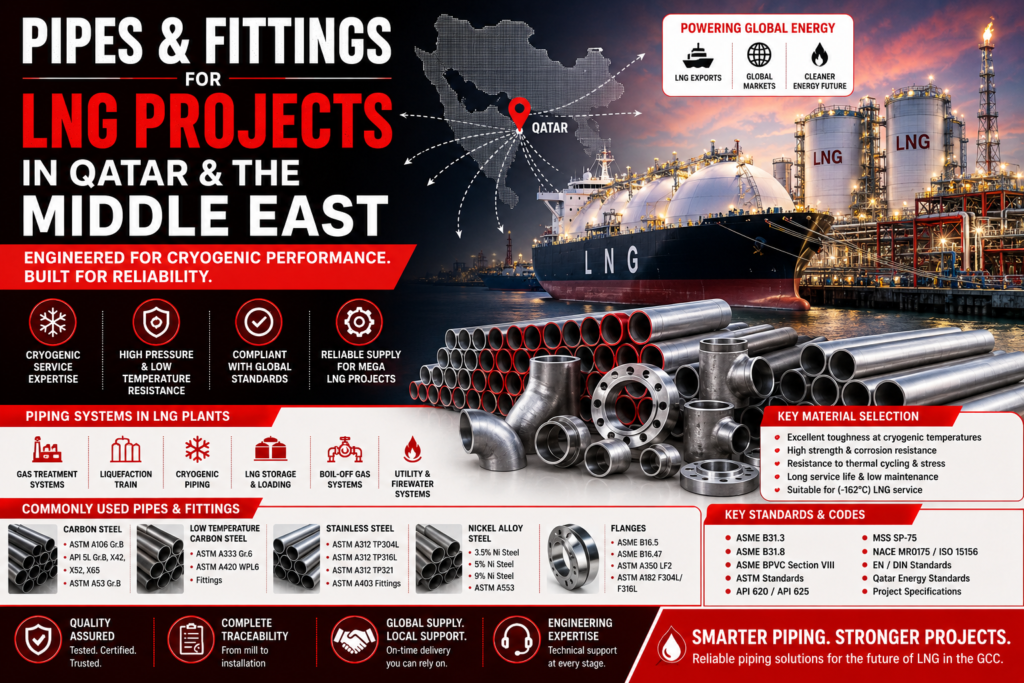
Major Piping Systems in LNG Facilities
LNG projects typically include multiple piping networks, including:
- Natural gas feed lines
- Cryogenic LNG transfer pipelines
- Refrigeration systems
- LNG storage tank piping
- Boil-off gas systems
- Utility piping networks
- Firewater systems
- Process piping systems
- Export terminal pipelines
Each system requires specific material grades depending on operating temperature, pressure, and fluid characteristics.
Carbon Steel Pipes for LNG Projects
Carbon steel pipes are widely used in non-cryogenic applications throughout LNG facilities.
Common Grades
- ASTM A106 Grade B
- ASTM A53 Grade B
- API 5L Grade B
- API 5L X42
- API 5L X52
- API 5L X65
Typical Applications
- Utility systems
- Firewater networks
- Compressed air systems
- Process support piping
- Water distribution systems
Carbon steel remains a cost-effective solution for applications that do not involve cryogenic temperatures.
Low-Temperature Carbon Steel (LTCS) Pipes
Low-Temperature Carbon Steel is one of the most important materials used in LNG facilities.
Common Grades
- ASTM A333 Grade 6
- ASTM A420 WPL6 Fittings
Advantages
- Excellent impact toughness at low temperatures
- Good weldability
- Cost-effective cryogenic performance
- Widely approved for LNG service
Applications
- LNG transfer lines
- Low-temperature process piping
- Cryogenic utility systems
ASTM A333 Grade 6 is one of the most commonly specified materials in LNG projects throughout Qatar and the Middle East.
Stainless Steel Pipes for LNG Plants
Stainless steel provides excellent corrosion resistance and cryogenic performance.
Common Grades
- ASTM A312 TP304L
- ASTM A312 TP316L
- ASTM A312 TP321
- ASTM A312 TP347
Advantages
- Excellent low-temperature toughness
- Superior corrosion resistance
- Long service life
- Good fabrication characteristics
Applications
- Cryogenic process systems
- LNG loading facilities
- Instrumentation tubing
- Chemical injection systems
Among these grades, 304L and 316L are widely used because of their excellent cryogenic properties.
Nickel Alloy Steel for Cryogenic Service
Nickel-containing steels are frequently used in LNG applications requiring superior low-temperature performance.
Common Grades
- 3.5% Nickel Steel
- 5% Nickel Steel
- 9% Nickel Steel
Advantages
- Exceptional cryogenic toughness
- High mechanical strength
- Excellent resistance to brittle fracture
Applications
- LNG storage tanks
- Cryogenic pressure vessels
- Critical low-temperature piping systems
9% Nickel Steel is particularly important for LNG storage tank construction and cryogenic service applications.
Stainless Steel Fittings for LNG Projects
Pipe fittings play a critical role in maintaining system integrity under cryogenic conditions.
Common Types
- Elbows
- Tees
- Reducers
- Caps
- Stub Ends
- Crosses
Common Standards
- ASTM A403
- ASTM A815
Common Grades
- 304L
- 316L
- Duplex 2205
- Super Duplex grades
These fittings must be manufactured and tested specifically for low-temperature service requirements.
Low-Temperature Carbon Steel Fittings
Cryogenic LNG systems frequently use LTCS fittings.
Common Standard
- ASTM A420
Common Grade
- WPL6
Applications
- LNG transfer pipelines
- Cryogenic process systems
- Storage terminal piping
These fittings are designed to maintain impact toughness at extremely low temperatures.
Flanges Used in LNG Projects
Flanges provide essential connections throughout LNG processing facilities.
Common Standards
- ASME B16.5
- ASME B16.47
Common Materials
- ASTM A105N
- ASTM A350 LF2
- ASTM A182 F304L
- ASTM A182 F316L
Applications
- Process piping systems
- Storage terminals
- Cryogenic transfer lines
- Export facilities
ASTM A350 LF2 is commonly specified for low-temperature carbon steel flange applications.
Cryogenic Piping Requirements
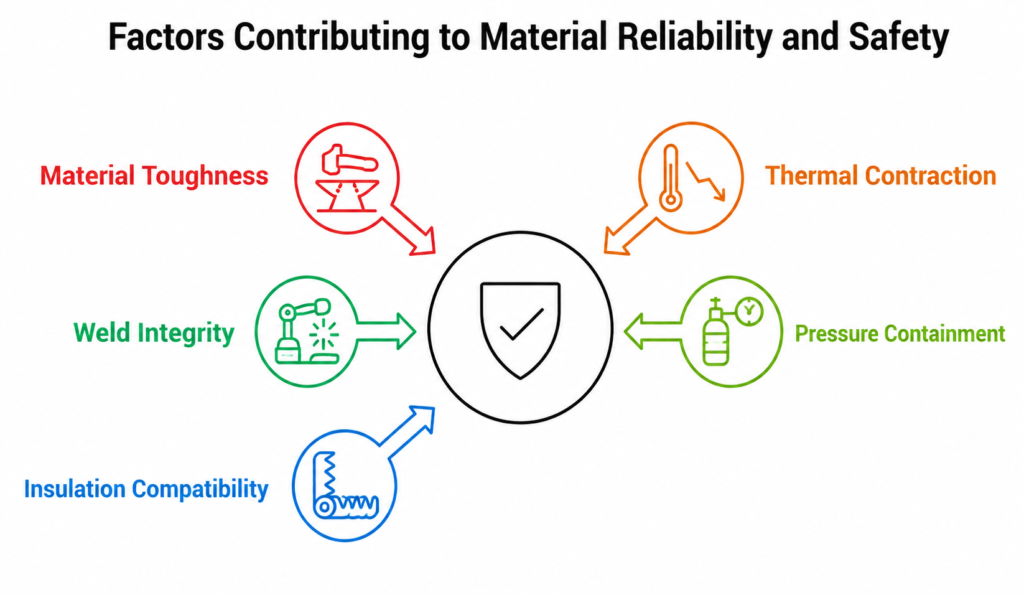
Cryogenic service introduces challenges not found in conventional process systems.
Key Considerations
- Material toughness at low temperatures
- Thermal contraction
- Weld integrity
- Insulation compatibility
- Leak prevention
- Pressure containment
Engineers must carefully evaluate all piping components to ensure safe operation at LNG temperatures.
Important Standards for LNG Piping Systems
LNG projects typically require compliance with internationally recognized standards.
Pipe Standards
- ASTM A333
- ASTM A106
- ASTM A312
- API 5L
Fittings Standards
- ASTM A420
- ASTM A403
- ASTM A815
Flange Standards
- ASME B16.5
- ASME B16.47
Welding Standards
- ASME Section IX
- AWS Welding Codes
Process Design Standards
- ASME B31.3
- ASME B31.8
These standards help ensure safety, quality, and long-term operational reliability.
Inspection and Testing Requirements
LNG projects maintain some of the strictest quality requirements in the energy sector.
Common Inspection Procedures
- Positive Material Identification (PMI)
- Radiographic Testing (RT)
- Ultrasonic Testing (UT)
- Hydrostatic Testing
- Impact Testing
- Dye Penetrant Testing (PT)
- Magnetic Particle Inspection (MPI)
These inspections help verify material integrity and compliance with project specifications.
Documentation Requirements
Suppliers serving LNG projects are expected to provide complete documentation packages.
Typical Documents
- Mill Test Certificates (MTC)
- EN 10204 3.1 Certification
- Material Traceability Records
- Heat Number Traceability
- Inspection Reports
- Welding Documentation
- Packing Lists
- Certificates of Origin
Proper documentation is often mandatory before materials are accepted on site.
Procurement Challenges in LNG Projects
Stringent Quality Standards
LNG operators require strict compliance with technical specifications and project requirements.
Long Project Lifecycles
Materials must deliver reliable performance over decades of operation.
Material Traceability
Complete traceability from raw material to final installation is often required.
Cryogenic Certification Requirements
Many piping components require additional testing and qualification for low-temperature service.
Global Supply Chain Management
Major LNG projects frequently source materials from approved manufacturers worldwide.
Selecting the Right Pipe and Fitting Supplier
Procurement teams should evaluate suppliers based on:
- LNG project experience
- Manufacturing certifications
- Cryogenic material expertise
- International standard compliance
- Inspection capabilities
- Traceability systems
- Export experience
- Delivery reliability
Suppliers with proven experience in LNG projects are often preferred by EPC contractors and plant operators.
Future Growth of LNG Infrastructure in the Middle East
Infrastructure for LNG production, storage, and export is still actively invested in by the Middle East. Manufacturers and suppliers of pipes, fittings, flanges, and cryogenic components are benefiting greatly from expansion projects in Qatar and other GCC nations.
The need for premium low-temperature piping materials is anticipated to rise significantly as LNG capacity increases, especially for cryogenic applications that call for sophisticated materials and stringent quality control.
Conclusion
In Qatar and throughout the Middle East, pipes and fittings are essential parts of LNG plants. Material selection is crucial to guaranteeing safety, effectiveness, and long-term dependability because LNG systems work at extremely low temperatures and under difficult process conditions.
LNG infrastructure frequently uses materials including nickel-alloy steels, low-temperature carbon steel fittings, stainless steel grades 304L and 316L, and ASTM A333 Grade 6. These materials assist the successful operation of some of the biggest LNG projects in the world when they are used in conjunction with rigorous adherence to ASTM, ASME, and API standards.
Achieving project success still depends on EPC contractors, project developers, and procurement teams choosing qualified suppliers with solid LNG experience, robust quality systems, and full traceability capabilities.
How We Support You
Selecting the right pipes and fittings for LNG projects is essential for ensuring safety, cryogenic performance, corrosion resistance, and long-term operational reliability. Our team helps EPC contractors, LNG plant operators, procurement specialists, and project consultants choose the most suitable piping materials and components for liquefaction, storage, transportation, and regasification facilities across Qatar and the Middle East.
We support you with:
- Guidance in selecting carbon steel, stainless steel, low-temperature carbon steel (LTCS), duplex steel, and high nickel alloy piping materials
- Recommendations for LNG liquefaction plants, storage terminals, regasification facilities, offshore gas projects, and transmission infrastructure
- Support for cryogenic service conditions, low-temperature applications, and high-pressure gas systems
- Assistance with ASTM, ASME, API, ISO, NACE, QatarEnergy, ADNOC, Saudi Aramco, and project-specific compliance requirements
- Guidance on seamless, welded, ERW, EFW, and specialized LNG piping solutions
- Support for pipes, fittings, flanges, valves, and complete cryogenic piping packages
- Assistance with Material Test Certificates (MTCs), inspection reports, third-party certifications, and quality documentation
- Recommendations for corrosion-resistant materials suitable for marine, offshore, and sour gas environments
- Support for custom dimensions, schedules, fabrication requirements, and project-specific engineering needs
- Fast quotations, export logistics, and bulk supply support for LNG and gas processing projects across the GCC region
Whether your project involves LNG export terminals, gas processing facilities, storage tanks, regasification plants, offshore gas developments, or large-scale energy infrastructure, we provide reliable piping and fitting solutions tailored to your operational requirements, safety standards, and project specifications.