Introduction
Some of the biggest desalination plants in the world are located in the Gulf Cooperation Council (GCC), providing freshwater to millions of people and fostering industrial development in nations including Saudi Arabia, the United Arab Emirates, Qatar, Kuwait, Bahrain, and Oman. Large-scale saltwater desalination project investments are rising dramatically as water demand keeps rising.
Because desalination plants are constantly exposed to seawater, high concentrations of chloride, chemicals, and high working pressures, they operate in extremely corrosive environments. Therefore, choosing the appropriate piping materials and standards is essential to guaranteeing long-term dependability, operational effectiveness, and lower maintenance costs.
The most popular piping materials, industry norms, and important factors for desalination projects around the Gulf Cooperation Council are all covered in this book.
Why Material Selection Matters in Desalination Plants
Desalination systems expose piping components to challenging operating conditions, including:
- High salinity seawater
- Chloride-rich environments
- High-pressure reverse osmosis systems
- Corrosive chemicals
- Variable temperatures
- Continuous operation requirements
Improper material selection can lead to:
- Corrosion failures
- Leakage issues
- Reduced plant efficiency
- Increased maintenance costs
- Unplanned shutdowns
Choosing corrosion-resistant piping materials significantly improves system reliability and service life.
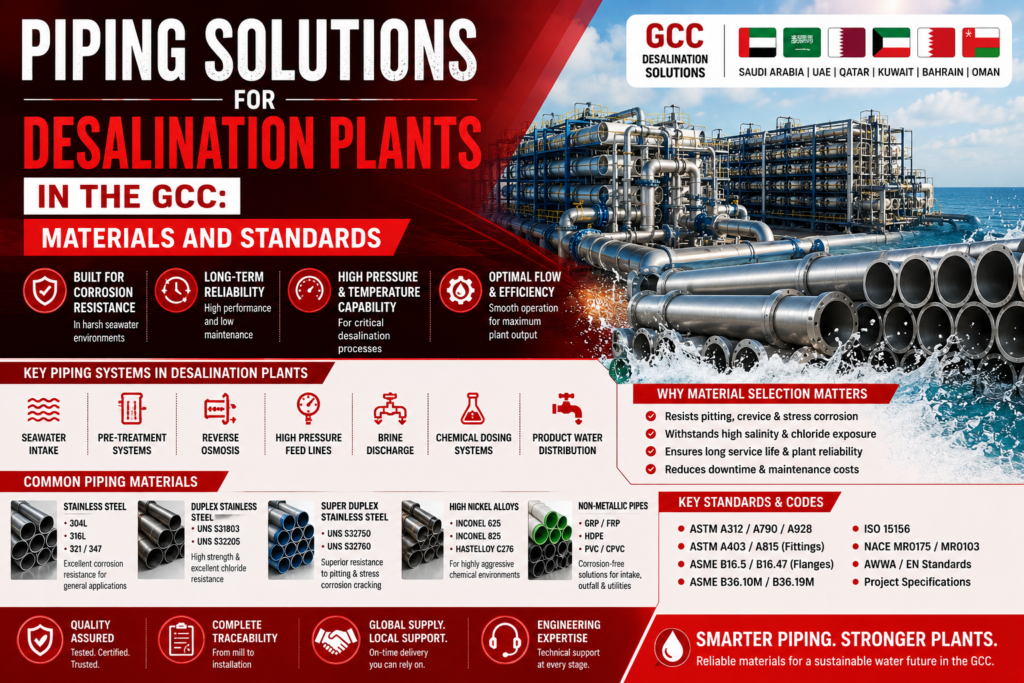
Key Piping Systems in Desalination Plants
Desalination facilities typically include several piping networks, such as:
- Seawater intake pipelines
- Pre-treatment systems
- Reverse osmosis piping
- High-pressure feed lines
- Brine discharge pipelines
- Chemical dosing systems
- Product water distribution systems
- Utility and service piping
Each system may require different materials depending on operating conditions and water chemistry.
Stainless Steel Pipes for Desalination Plants
Stainless steel remains one of the most widely used materials in desalination facilities.
Common Grades
- ASTM A312 TP304L
- ASTM A312 TP316L
- ASTM A312 TP321
- ASTM A312 TP347
Advantages
- Excellent corrosion resistance
- Good weldability
- Hygienic water handling
- Long service life
- Low maintenance requirements
Typical Applications
- Product water systems
- Chemical dosing lines
- Utility piping
- Low to moderate chloride environments
Among these grades, 316L is generally preferred due to its improved resistance to chlorides.
Duplex Stainless Steel Pipes
Duplex stainless steels provide greater strength and corrosion resistance than conventional stainless steel grades.
Common Grades
- UNS S31803
- UNS S32205 (Duplex 2205)
Advantages
- High mechanical strength
- Excellent chloride resistance
- Resistance to stress corrosion cracking
- Reduced wall thickness requirements
Typical Applications
- Seawater handling systems
- Reverse osmosis feed lines
- High-pressure piping
- Industrial water transfer systems
Duplex 2205 is one of the most commonly specified materials for GCC desalination projects.
Super Duplex Stainless Steel Pipes
Super Duplex materials are widely used in highly aggressive seawater environments.
Common Grades
- UNS S32750
- UNS S32760
Advantages
- Outstanding seawater corrosion resistance
- Superior pitting resistance
- Excellent mechanical strength
- Long operational lifespan
Typical Applications
- Seawater intake systems
- High-pressure RO piping
- Brine discharge pipelines
- Offshore desalination facilities
These grades are often selected for critical systems where corrosion resistance is the highest priority.
High Nickel Alloy Pipes
Nickel alloys are used in severe service conditions where even duplex materials may face limitations.
Common Grades
- Inconel 625
- Inconel 825
- Hastelloy C276
- Monel 400
Advantages
- Exceptional corrosion resistance
- Excellent performance in chloride-rich environments
- Resistance to chemical attack
- High durability
Typical Applications
- Chemical dosing systems
- Acid handling lines
- Specialized desalination processes
- Critical corrosion-sensitive areas
Important Standards for Desalination Plant Piping
Compliance with international standards is essential for ensuring safety, quality, and long-term reliability.
Pipe Manufacturing Standards
- ASTM A312
- ASTM A790
- ASTM A358
- ASTM A928
- API 5L
Fittings Standards
- ASTM A403
- ASTM A815
- ASTM A234
Flange Standards
- ASME B16.5
- ASME B16.47
Pipe Dimension Standards
- ASME B36.10M
- ASME B36.19M
These standards are commonly referenced in GCC desalination projects and EPC specifications.
Corrosion Considerations in GCC Desalination Plants
Corrosion is one of the primary challenges in desalination facilities.
Common Corrosion Risks
- Pitting corrosion
- Crevice corrosion
- Stress corrosion cracking
- Galvanic corrosion
- Microbiologically influenced corrosion
Material selection should be based on chloride concentration, temperature, flow conditions, and chemical exposure.
Quality Control and Inspection Requirements
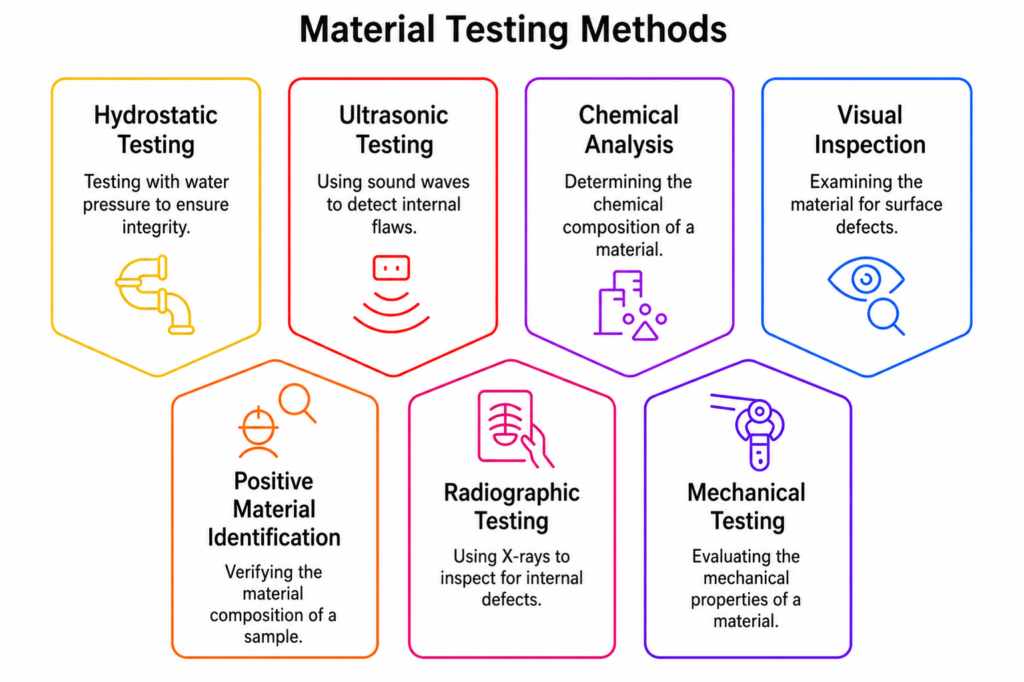
Desalination projects generally require comprehensive testing and inspection procedures.
Common Inspection Requirements
- Hydrostatic testing
- Positive Material Identification (PMI)
- Ultrasonic testing
- Radiographic testing
- Chemical analysis
- Mechanical testing
- Visual inspection
These procedures help ensure material integrity and compliance with project specifications.
Documentation Requirements
Suppliers are typically expected to provide:
- Mill Test Certificates (MTC)
- EN 10204 3.1 Certification
- Inspection Reports
- Material Traceability Records
- Quality Assurance Documentation
- Packing and Shipping Documents
Complete documentation is essential for project approval and acceptance.
Factors to Consider When Selecting Piping Materials
Seawater Exposure
Higher chloride concentrations generally require duplex or super duplex materials.
Operating Pressure
Reverse osmosis systems often require high-strength materials capable of handling elevated pressures.
Lifecycle Cost
Higher-grade materials may have greater initial costs but often reduce maintenance and replacement expenses.
Fabrication Requirements
Material selection should consider welding procedures, installation practices, and field fabrication needs.
Project Specifications
EPC contractors and project owners may specify approved materials based on operational requirements and design standards.
Benefits of Using the Right Piping Materials
Selecting appropriate piping materials provides several advantages:
- Extended service life
- Reduced corrosion-related failures
- Lower maintenance costs
- Improved operational efficiency
- Increased plant reliability
- Enhanced safety performance
These benefits contribute significantly to the long-term success of desalination facilities.
Conclusion
The Gulf Cooperation Council’s desalination plants face some of the harshest operating circumstances in the water treatment sector. Piping materials that offer outstanding corrosion resistance and long-term dependability are necessary for continuous exposure to seawater, chemicals, chlorides, and high pressures.
In desalination infrastructure, stainless steel, duplex stainless steel, super duplex stainless steel, high nickel alloys are all crucial components. Project owners, EPC contractors, and procurement teams can optimize plant performance while reducing lifecycle costs and maintenance requirements by choosing the proper material grades and guaranteeing compliance with international standards.
How We Support You
Selecting the right piping solutions for desalination plants is essential for ensuring long-term reliability, corrosion resistance, operational efficiency, and compliance with stringent GCC water infrastructure standards. Our team helps EPC contractors, plant operators, consultants, and procurement professionals choose the most suitable piping materials and components for seawater intake, treatment, distribution, and brine discharge systems.
We support you with:
- Guidance in selecting stainless steel, duplex steel, super duplex steel, high nickel alloys, and corrosion-resistant piping materials
- Recommendations for reverse osmosis (RO), multi-stage flash (MSF), and multi-effect distillation (MED) desalination facilities
- Support for seawater intake systems, high-pressure pipelines, pretreatment units, and brine discharge networks
- Assistance with ASTM, ASME, API, ISO, AWWA, ADNOC, Saudi Aramco, and project-specific compliance requirements
- Guidance on material selection for chloride-rich, high-salinity, and corrosive marine environments
- Support for pipes, fittings, flanges, valves, expansion joints, and complete piping packages
- Assistance with Material Test Certificates (MTCs), inspection reports, third-party certifications, and quality documentation
- Recommendations for high-pressure and high-flow desalination process applications
- Support for custom sizes, schedules, fabrication requirements, and project-specific solutions
- Fast quotations, export logistics, and bulk supply support for GCC desalination and water infrastructure projects
Whether your project involves municipal water production, industrial desalination facilities, power and water co-generation plants, or large-scale GCC water infrastructure developments, we provide reliable piping solutions tailored to your operational requirements, environmental conditions, and project specifications.