Choosing between seamless and welded pipes is a crucial decision that directly impacts strength, cost, performance, and application suitability. The debate around seamless vs welded pipe is common among procurement engineers, project managers, and industrial buyers.
While both types serve essential roles in piping systems, their manufacturing process, durability, and use cases vary significantly. This guide provides a clear, structured comparison to help you select the right pipe for your project with confidence.
What Is a Seamless Pipe?
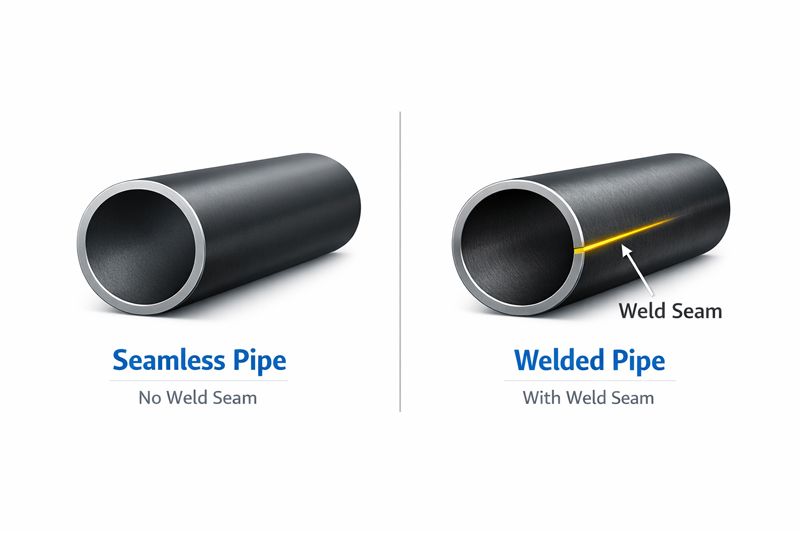
Seamless pipes are manufactured without any welding joints. They are produced by piercing a solid steel billet and forming it into a hollow tube.
Key Features
- No welded joints (uniform structure)
- Higher strength and pressure resistance
- Better performance in extreme conditions
- Smooth internal surface
Advantages
- Ideal for high-pressure applications
- Lower risk of leakage
- Stronger structural integrity
What Is a Welded Pipe?
Welded pipes are made by rolling flat steel plates or coils and welding the edges together to form a cylindrical shape.
Key Features
- Available in various sizes and thicknesses
- More cost-effective
- Easier to manufacture in large quantities
Advantages
- Lower production cost
- Suitable for low to medium pressure
- Faster availability
Seamless vs Welded Pipe: Key Differences
1. Manufacturing Process
- Seamless → Formed from solid billet without welding
- Welded → Formed by welding steel plates
2. Strength and Durability
- Seamless → Higher strength and reliability
- Welded → Moderate strength
Best for heavy-duty use: Seamless Pipe
3. Pressure Handling
- Seamless → Handles high pressure efficiently
- Welded → Suitable for low to medium pressure
4. Corrosion Resistance
- Seamless → Better resistance due to no weld seam
- Welded → Weld area may be prone to corrosion
5. Cost Comparison
- Seamless → More expensive
- Welded → Cost-effective
Best for budget projects: Welded Pipe
6. Size Availability
- Seamless → Limited size range
- Welded → Available in larger diameters
7. Surface Finish
- Seamless → Smooth and uniform
- Welded → May have visible seam
8. Manufacturing Time
- Seamless → Slower production process
- Welded → Faster and scalable
9. Applications
- Seamless → Oil & gas, high-pressure systems
- Welded → Construction, water pipelines
When Should You Choose Seamless Pipes?
Ideal Applications
- Oil and gas exploration
- High-pressure pipelines
- Boilers and heat exchangers
- Chemical processing plants
Why It Works
Seamless pipes provide maximum strength and reliability, making them ideal for critical applications.
When Should You Choose Welded Pipes?
Ideal Applications
- Water distribution systems
- Structural and construction projects
- Low-pressure pipelines
- Large-diameter piping
Why It Works
Welded pipes offer cost efficiency and flexibility, making them suitable for general applications.
How to Choose Between Seamless and Welded Pipes
Step-by-Step Decision Guide
-
Check Pressure Requirements
High pressure → Seamless
Low/medium pressure → Welded -
Evaluate Budget
High budget → Seamless
Cost-sensitive → Welded -
Consider Application Type
Critical systems → Seamless
General use → Welded -
Analyze Size Requirements
Large diameter → Welded
Standard size → Seamless -
Assess Risk Factors
High risk → Seamless
Low risk → Welded
People Also Ask
Which pipe is stronger, seamless or welded?
Seamless pipes are generally stronger because they do not have a welded joint.
Are welded pipes reliable?
Yes, modern welded pipes are reliable for low to medium pressure applications.
Why are seamless pipes more expensive?
Because of their complex manufacturing process and higher strength.
Can welded pipes be used for high pressure?
They can be used in some cases, but seamless pipes are preferred for high-pressure systems.
Which pipe is better for water supply?
Welded pipes are commonly used due to their cost-effectiveness and availability.
Real-World Example
Practical Scenario
Project: Industrial pipeline system
- Requirement: High pressure and safety
Solution: Seamless pipe
Result: Reliable performance with minimal risk of failure
Related Reports
- What Is Inconel Pipe? Uses, Grades & Why It’s Used in Oil & Gas
- Types of Stainless Steel Pipes Explained: Seamless, Welded, Duplex & Super Duplex
- Inconel vs Stainless Steel Pipe: Which Should You Choose for High-Temp Applications?
Conclusion
The choice between seamless vs welded pipe depends on application, pressure requirements, and budget.
Final Takeaways
- Seamless pipes offer strength, durability, and reliability
- Welded pipes provide cost efficiency and flexibility
- Always evaluate project requirements before selection
Procurement Insight
A well-informed choice ensures better performance, reduced risk, and optimized cost, helping engineers deliver successful projects.