Introduction
Flanged connections in industrial pipe systems are only as dependable as the bolts that secure them. While pipes, fittings, flanges, and gaskets frequently receive a lot of attention during project planning and procurement, stud bolts and nuts are just as important for preserving connections that are pressure-resistant and leak-free.
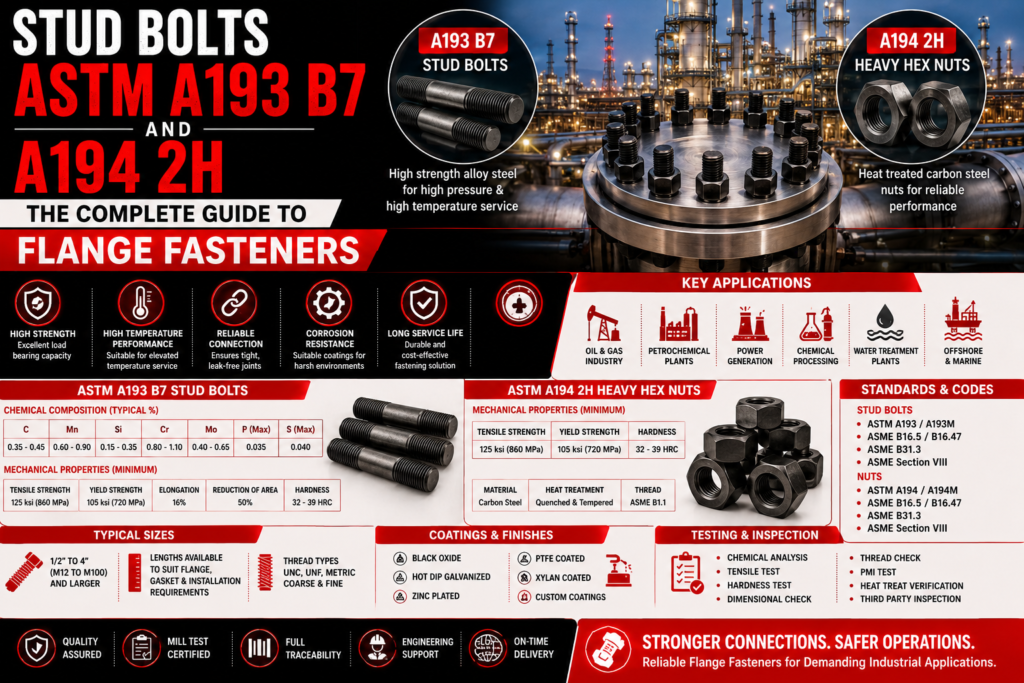
ASTM A193 Grade B7 Stud Bolts and ASTM A194 Grade 2H Heavy Hex Nuts are two of the most popular fastener combinations in the oil and gas, petrochemical, power generating, water treatment, and process sectors. For carbon steel and alloy steel flange assemblies operating at moderate to high pressure and temperature, this combination has become the industry standard.
This guide provides a comprehensive overview of ASTM A193 B7 stud bolts and ASTM A194 2H nuts, including material properties, standards, applications, advantages, and selection considerations for industrial piping projects.
What Are Stud Bolts?
A stud bolt is a threaded fastener with threads on both ends and an unthreaded section in the middle. Unlike conventional bolts, stud bolts are used together with two heavy hex nuts to create secure flange connections.
Stud bolts are widely used in:
- Pipeline systems
- Pressure vessels
- Heat exchangers
- Refineries
- Petrochemical plants
- Power generation facilities
- Offshore platforms
They provide uniform clamping force across gasket surfaces, helping maintain sealing integrity under pressure and temperature fluctuations.
Understanding ASTM A193 Grade B7 Stud Bolts
ASTM A193 is a standard specification covering alloy steel and stainless steel bolting materials for high-temperature and high-pressure service.
What Is Grade B7?
One of the most often mentioned alloy steel fastener grades under ASTM A193 is grade B7. To obtain high strength and durability, it is heat-treated by quenching and tempering chromium-molybdenum alloy steel.
Chemical Composition of ASTM A193 B7
Typical alloying elements include:
- Carbon
- Manganese
- Chromium
- Molybdenum
- Silicon
- Phosphorus
- Sulfur
The chromium and molybdenum additions improve strength, hardness, and temperature resistance.
Mechanical Properties of ASTM A193 B7
Typical mechanical properties include:
- Minimum Tensile Strength: 125 ksi (860 MPa)
- Minimum Yield Strength: 105 ksi (720 MPa)
- Good impact resistance
- Excellent fatigue strength
- High load-bearing capability
These properties make B7 suitable for demanding industrial environments.
What Are ASTM A194 Grade 2H Nuts?
ASTM A194 covers carbon steel, alloy steel, and stainless steel nuts used with high-pressure and high-temperature bolting applications.
Understanding Grade 2H
Heat-treated carbon steel heavy hex nuts of grade 2H are made especially to be used with high-strength fastening materials like ASTM A193 B7 stud bolts.
To make sure they can sustain the loads created during bolt tightening and system operation, the nuts are heat-treated.
Key Characteristics
- High strength
- Excellent thread integrity
- Suitable for elevated temperatures
- Reliable performance under pressure
- Compatible with ASTM A193 B7 bolting
Because of these characteristics, A194 2H nuts are commonly supplied together with A193 B7 stud bolts as a matched fastening system.
Why ASTM A193 B7 and A194 2H Are Used Together
The ASTM A193 B7 and ASTM A194 2H combination has become an industry standard because both components are engineered to work together.
Advantages of the Combination
- Matching mechanical properties
- Reliable clamping force
- Excellent gasket sealing performance
- High pressure resistance
- Suitable for elevated temperatures
- Proven industrial performance
Using compatible fasteners helps prevent thread failure, relaxation, and leakage issues.
Common Applications of B7 Stud Bolts and 2H Nuts
Oil and Gas Industry
The oil and gas sector is one of the largest users of B7/2H fasteners.
Applications include:
- Pipeline flanges
- Refinery process units
- Offshore platforms
- Gas processing facilities
- Storage terminals
Petrochemical Plants
Petrochemical facilities require reliable bolting systems capable of handling demanding operating conditions.
Applications include:
- Process piping
- Heat exchangers
- Pressure vessels
- Reactors
Power Generation Facilities
Power plants utilize ASTM A193 B7 fasteners for:
- Steam piping
- Boiler systems
- Turbine connections
- High-temperature process lines
Water Treatment and Desalination Plants
Although corrosion-resistant alloys are often used in seawater systems, B7/2H fasteners remain common in utility and non-corrosive service areas.
Chemical Processing Plants
The high strength of B7 stud bolts makes them suitable for many chemical processing applications where pressure containment is critical.
Pressure and Temperature Performance
One reason ASTM A193 B7 fasteners are widely used is their ability to perform under elevated temperatures and pressures.
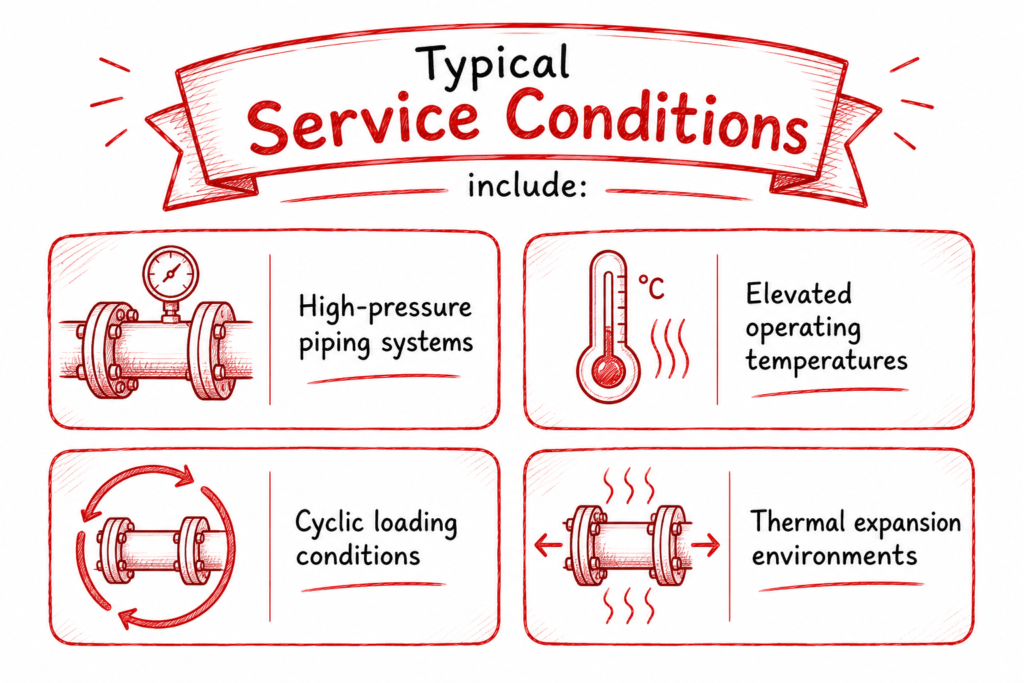
Typical service conditions include:
- High-pressure piping systems
- Elevated operating temperatures
- Cyclic loading conditions
- Thermal expansion environments
The exact operating limits depend on project specifications and applicable design codes.
Common Dimensions and Sizes
ASTM A193 B7 stud bolts are available in a wide range of sizes, including:
- ½ inch to 4 inches and larger
- Metric equivalents
- Fully threaded designs
- Double-end stud configurations
Lengths are selected based on:
- Flange thickness
- Gasket thickness
- Washer requirements
- Nut engagement requirements
Proper sizing is essential to ensure adequate bolt preload and sealing performance.
Protective Coatings and Surface Finishes
Fasteners may be supplied with various coatings to improve corrosion resistance.
Common Finishes
- Plain black finishZinc
- plating
- Hot-dip galvanizing
- PTFE coatings
- Xylan coatings
- Cadmium-free specialty coatings
The selected finish should be compatible with the service environment and project specifications.
Important Standards Associated with Flange Fasteners
Several international standards govern the design, manufacture, and use of stud bolts and nuts.
Fastener Standards
- ASTM A193
- ASTM A194
- ASTM F436 (Washers)
Flange Standards
- ASME B16.5
- ASME B16.47
Pressure Vessel and Piping Codes
- ASME B31.3
- ASME Section VIII
- ASME B31.1
Compliance with these standards helps ensure safety and reliability.
Inspection and Testing Requirements
Industrial projects typically require extensive quality verification.
Common Tests
- Tensile testing
- Hardness testing
- Chemical composition analysis
- Dimensional inspection
- Thread inspection
- Heat treatment verification
- Positive Material Identification (PMI)
Testing ensures that fasteners meet project specifications and industry standards.
Documentation Requirements
For critical projects, suppliers are generally required to provide:
- Mill Test Certificates (MTC)
- EN 10204 3.1 Certification
- Heat treatment records
- Inspection reports
- Material traceability documentation
- Packing and identification records
Complete documentation is often mandatory for refinery, petrochemical, and offshore projects.
Common Procurement Considerations
When sourcing ASTM A193 B7 stud bolts and ASTM A194 2H nuts, buyers should evaluate:
Material Certification
Verify compliance with applicable ASTM standards.
Traceability
Ensure full traceability from raw material to finished product.
Manufacturing Quality
Select suppliers with proven quality control systems.
Coating Requirements
Confirm compatibility with project specifications and operating environments.
Delivery Capability
Large industrial projects often require significant quantities and reliable delivery schedules.
Common Mistakes to Avoid
Several issues can affect flange performance:
- Mixing incompatible bolt and nut grades
- Using incorrect bolt lengths
- Improper tightening procedures
- Inadequate corrosion protection
- Failure to verify certifications
- Poor storage and handling practices
Avoiding these mistakes helps maintain flange integrity and long-term system reliability.
Conclusion
One of the most popular and reliable fastener combinations in industrial plumbing systems is ASTM A193 Grade B7 stud bolts and ASTM A194 Grade 2H heavy hex nuts. They are perfect for applications in the oil and gas, petrochemical, power generating, water treatment, and process industries due to their high strength, temperature resistance, and dependable performance.
Engineers, procurement teams, and project managers can guarantee secure and leak-free flange connections by comprehending material specifications, mechanical characteristics, standards, inspection requirements, and appropriate selection procedures. In challenging industrial settings, selecting certified, premium B7 stud bolts and 2H nuts is still essential to long-term dependability and operational success.
How We Support You
Selecting the right stud bolts and heavy hex nuts is critical for ensuring flange joint integrity, leak prevention, pressure containment, and long-term reliability in industrial piping systems. Our team helps EPC contractors, maintenance engineers, procurement specialists, and project consultants choose the most suitable ASTM A193 B7 stud bolts and ASTM A194 2H nuts based on operating conditions, pressure ratings, temperature requirements, and project specifications.
We support you with:
- Guidance in selecting ASTM A193 B7 stud bolts and ASTM A194 2H heavy hex nuts for piping, pressure vessel, and equipment applications
- Recommendations for oil & gas, petrochemical, refinery, power generation, LNG, offshore, and process industry projects
- Support for high-pressure, high-temperature, and critical flange connection applications
- Assistance with ASTM, ASME, ANSI, API, Saudi Aramco, ADNOC, SABIC, and project-specific compliance requirements
- Guidance on bolting materials for raised face, ring-type joint (RTJ), and custom flange assemblies
- Support for carbon steel, alloy steel, stainless steel, duplex steel, and specialty alloy flange fastening requirements
- Assistance with bolt sizing, thread specifications, coating options, and corrosion protection requirements
- Support for Material Test Certificates (MTCs), inspection reports, third-party certifications, and quality documentation
- Recommendations for refinery turnaround projects, plant maintenance, pipeline construction, and new EPC installations
- Fast quotations, bulk supply support, and export logistics for industrial projects across GCC, Africa, and global markets
Whether your project involves refinery piping systems, offshore platforms, petrochemical plants, pressure vessels, pipeline infrastructure, or critical process equipment, we provide reliable stud bolt and flange fastening solutions tailored to your technical requirements, safety standards, and project specifications.